Every Building Maintenance Unit (BMU) eventually reaches a point where routine repairs are no longer enough. For owners of buildings that are 20 to 40 years old, the question often shifts from maintaining the existing equipment to determining whether refurbishment, modernization, or complete replacement represents the best long-term investment.
The answer is rarely straightforward. Cost, downtime, compliance requirements, parts availability, and the overall condition of the equipment all influence the decision. What may appear to be an aging BMU nearing the end of its life can often be restored through targeted refurbishment or modernization. In other cases, replacement is the only viable path forward. According to Jonathan Lin, RRR Sales Manager for North America at Facade Access Solutions, the most effective approach is not to immediately consider replacement. Instead, owners should follow a structured progression: refurbish first, retrofit when necessary, and replace only when neither option can meet the building’s operational requirements.
Discussions about aging BMUs are often reduced to a simple choice between repairing the existing equipment or replacing it entirely. In reality, most projects fall somewhere between those two extremes. The Refurb, Retrofit, Replace framework recognizes that different stages of a BMU’s lifecycle require different solutions. A well-maintained system can often continue operating safely and efficiently for years through planned maintenance and strategic upgrades.
Refurbishment represents the foundation of this approach. The objective is to maintain safe, reliable operation through preventive maintenance, component repairs, and ongoing service activities. For most BMUs, refurbishment provides the strongest return on investment because it preserves the existing asset while minimizing disruption and capital expenditure.
When refurbishment alone is no longer sufficient, retrofit solutions provide the next step. Modernizing controls, upgrading winches, improving operator interfaces, and incorporating updated safety systems allow aging equipment to continue operating while meeting current operational expectations and compliance requirements. Facade Access Solutions offers retrofit services for both CoxGomyl and Manntech equipment, helping owners extend service life without undertaking a complete replacement project. Replacement remains the final option. It becomes appropriate when refurbishment and retrofit can no longer keep the BMU safe, compliant, or capable of meeting the building’s access requirements.
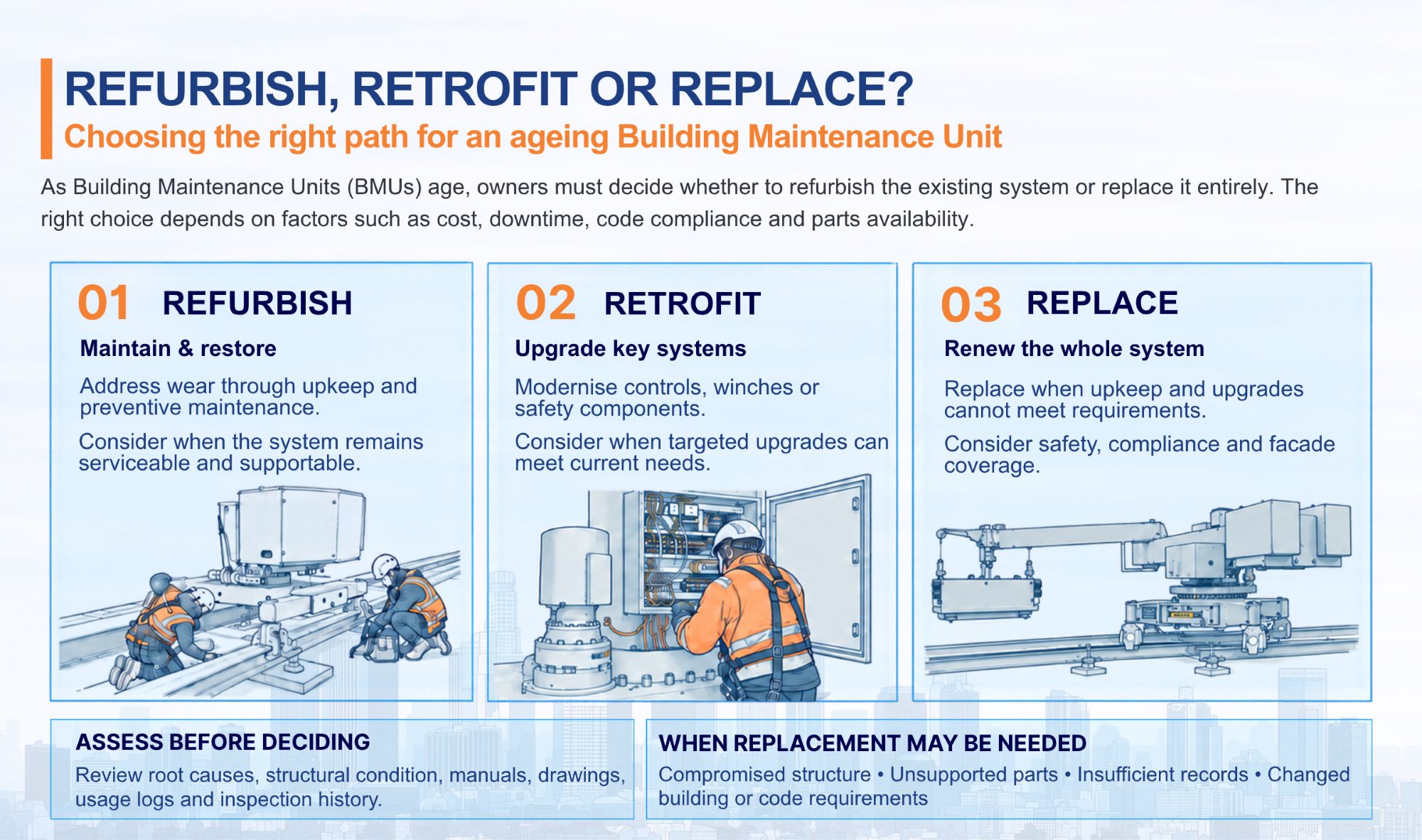
Before recommending any course of action, a comprehensive assessment is required. According to Jonathan, two questions guide every evaluation. The first is identifying the root cause of the issues preventing the BMU from operating as intended. The second is determining where the equipment sits within its overall lifecycle. Understanding both factors provides a clearer picture of the system’s current condition and its future potential.
A thorough assessment begins with documentation. Original operating and maintenance manuals help establish the equipment’s intended design and functionality. Mechanical and electrical drawings reveal how the system was engineered and how individual components interact. Usage records, inspection reports, and operational history provide insight into how the equipment has been maintained and how heavily it has been used throughout its life.
Previous safety inspections often reveal recurring issues that may not have been fully addressed. These records can help distinguish between isolated failures and systemic problems that require a broader solution. Operational considerations also play an important role. Budget cycles, scheduled building projects, and access requirements may influence which solution is most practical. Even when replacement ultimately represents the best long-term strategy, a refurbishment or targeted retrofit can provide a valuable interim solution while funding and planning are secured.
While many aging BMUs can be refurbished or modernized, certain conditions remove those options entirely. Structural deterioration is one of the most significant. Jonathan points to a project in Miami involving a BMU from an era when only the exterior surfaces of the steel structure were galvanized. Years of exposure to salt-laden coastal air resulted in ongoing internal corrosion that could not be effectively addressed through mechanical or electrical upgrades. In that case, replacement became unavoidable because the structural integrity of the equipment itself had been compromised.
Missing documentation can create a similar challenge. Without accurate records showing how the BMU was designed, assembled, and maintained, reliable engineering assessments become significantly more difficult. When critical drawings, manuals, and historical data are unavailable, owners may lack the information necessary to support a refurbishment strategy. Parts availability is another important consideration. As equipment ages, manufacturers may discontinue support for legacy platforms, making replacement components increasingly difficult and expensive to source. Eventually, the effort required to maintain obsolete systems can outweigh the benefits of continued refurbishment.
Building modifications can also force replacement decisions. Changes to the façade, new architectural features, recladding projects, or alterations to building geometry may render the original BMU incapable of reaching all required areas. Similarly, evolving code requirements can make older systems non-compliant even when they remain operational. Under these circumstances, replacement often becomes the only solution capable of meeting current building requirements.
The practical differences between refurbishment and replacement extend beyond the initial project budget. One of the most significant distinctions is the project timeline. Jonathan notes that refurbishment projects are typically completed within a matter of months, while replacement projects frequently require more than a year from planning through commissioning. When properly scheduled, many refurbishments can be completed during periods of lower building activity, minimizing or eliminating operational disruption.
Replacement projects are inherently more complex. Demolition of existing equipment, structural verification, manufacturing, delivery, installation, and commissioning all contribute to longer project durations. Roof access requirements and coordination with building operations add additional layers of complexity. Cost considerations often favor refurbishment as well. A targeted refurbishment or retrofit can typically be completed at a fraction of the cost of full replacement while extending the useful life of the existing equipment. Phased modernization programs can also spread expenditures across multiple budget cycles, making funding approval easier to obtain.
Jonathan recalls a service account in San Francisco where a competitor had concluded that a Mannesmann BMU installed in 1985 had reached the end of its life and required replacement. After reviewing the equipment as the OEM, Facade Access Solutions identified refurbishment opportunities and preventive maintenance measures that had been overlooked. By presenting the work in phases, the owner was able to secure funding and extend the service life of the equipment without pursuing immediate replacement.
Age alone does not determine whether a BMU should be replaced, but it does influence the available options. As operating hours accumulate, equipment requires increasing attention. Through effective lifecycle management, owners can plan major refurbishments and retrofits before performance issues become critical. However, there comes a point when aging components and obsolete subassemblies limit what can reasonably be achieved through modernization.
For this reason, many North American facilities have increased their focus on maintaining inventories of critical spare parts. Keeping essential components on site helps reduce downtime, supports continuity of operations, and provides additional flexibility when planning modernization projects. Facade Access Solutions supports this strategy through its OEM spare parts program, which provides genuine components engineered to original specifications. The ability to proactively manage spare parts often determines how long a BMU can continue operating safely and effectively.
Many owners begin exploring replacement because they have been told their BMU has reached the end of its service life. While that assessment may sometimes be accurate, it can also overlook opportunities for modernization. Jonathan notes that OEMs possess unique advantages when evaluating aging equipment. Access to original engineering drawings, historical records, design intent, and certified components often reveals solutions that are not available to service providers without direct manufacturer support.
This knowledge frequently allows OEMs to identify upgrade and refurbishment strategies capable of extending service life by a decade or more while avoiding the cost and disruption associated with replacement. For owners evaluating capital expenditure options, that difference can be substantial. The value of OEM asset management becomes particularly clear as equipment ages. Engineering expertise, retained design knowledge, and access to certified replacement parts can significantly expand the range of viable solutions available to building owners.
Determining whether to refurbish, retrofit, or replace a BMU is rarely a one-size-fits-all decision. The right path depends on the structural condition of the equipment, available documentation, spare-part support, compliance requirements, operational priorities, and long-term building plans. Evaluating these factors through a structured OEM-led assessment provides owners with the clearest understanding of their options.
For many buildings, refurbishment or a carefully planned retrofit will provide the most practical balance of cost, performance, and operational continuity. Replacement remains the correct solution when structural deterioration, missing documentation, obsolete systems, or changing building requirements leave no viable alternative. Ultimately, the objective is not simply to extend equipment life or minimize capital expenditure. It is to ensure the building maintains safe, reliable, and compliant façade access for decades to come.
Disclaimer: Graphics shown are illustrative only and do not represent actual products, equipment, or real-life conditions.
Binanız için doğru çözümü keşfetmek üzere uzmanlarımızla görüşün.
Request a Quote TodayBMU stands for Building Maintenance Unit. In facade cleaning, it refers to the permanent access system installed on a building, typically on the roof, that carries workers and equipment along the exterior for cleaning, inspection, and repair. A BMU replaces the need for scaffolding or rope access on tall buildings and gives crews a stable, engineered platform to reach every elevation of the facade.
BMU stands for Building Maintenance Unit. The term is used across the facade access industry to describe the roof-mounted machine that provides access to a building’s exterior for maintenance work. A building maintenance unit system typically includes a base structure, a jib or boom, a suspended cradle, and the hoist and control systems that move workers along the facade.
In construction, BMU refers to the Building Maintenance Unit specified during the design and engineering phase of a project. Architects and facade consultants coordinate with BMU manufacturers to integrate the access system into the building structure. Roof loads, track layouts, anchoring points, and parking positions all need to be planned before construction, which is why the BMU is treated as a structural and architectural consideration, not an afterthought.
In architecture, refurbishment means restoring an existing building or system to functional condition without replacing it entirely. Applied to facade access, BMU refurbishment restores the original equipment to reliable operation through targeted repairs, component replacement, and preventative maintenance. FAS refurbishment solutions cover both cosmetic and mechanical restoration, extending the working life of the BMU while preserving the original design intent.
BMU work is governed by a range of international and regional standards. EN 1808 sets safety requirements for suspended access equipment across Europe. ASME A120.1 governs powered platforms in the United States, and OSHA 1910.66 provides the federal regulatory framework. Canada follows CAN/CSA-Z271. Australia uses AS 1418.13 and AS/NZS 2550.13. Any refurbishment or replacement should bring the BMU into compliance with the standards in force at the property. FAS publishes a detailed overview of applicable codes, regulations, and standards for reference.
Inspection frequency depends on jurisdiction, but most codes require at least an annual thorough examination by a qualified inspector. Operators should also complete routine daily checks before and after using the equipment, while a pre-use inspection to certify the BMU for use must be completed by a competent worker. EN 1808 and ASME A120.1 both specify inspection intervals, and many owners run more frequent inspections as part of an ongoing BMU maintenance program. Regular inspections also feed the historical record that informs future refurb or replacement decisions.