Window washing on mid-rise and high-rise buildings is a highly regulated working-at-height activity. From OSHA and CSA in North America to EN 1808 standards in Europe and AS/NZS 1418.13:2013 regulations in Australia, the compliance landscape varies significantly across regions. Building owners, developers, facilities managers, architects, and facade consultants must navigate a complex framework of safety regulations, anchor certifications, equipment standards, and maintenance obligations before any facade cleaning operation begins. This comprehensive blog article serves as a practical reference for understanding who is responsible for safety compliance, what major regional regulations require, and what permanent access infrastructure must be in place to support compliant operations. The focus centers entirely on the regulatory obligations that apply to commercial buildings and the facade access systems designed to satisfy them.
Permanent facade access systems, including Building Maintenance Units (BMUs), davit systems, monorails, tieback anchors, rope descent and fall protection systems, directly address the operational and compliance requirements established by these regulations. Throughout the breakdown below, Facade Access Solutions is positioned as an expert engineering partner to help building teams navigate these technical and regulatory challenges across the full building lifecycle.
Responsibility for window washing safety is distributed across building owners, employers or contractors, and the workers themselves. Obligations vary depending on the jurisdiction and the stage of the building lifecycle. Failure at any point in this compliance chain can create severe legal liability and safety exposure for all parties involved.
In most regulatory frameworks, the building owner carries the foundational responsibility. Before work begins, the owner must ensure the building features compliant anchor points, certified facade access systems, and written documentation confirming the infrastructure meets required load and safety standards. Under OSHA 1910.27(b)(1)(i), building owners must identify, test, certify, and maintain each anchorage used for rope descent systems so it can support at least 5,000 lb (22.2 kN) per attached worker in any direction. Equivalent obligations exist globally under EN 1808, AS/NZS 1418.13:2013, and CAN/CSA standards for permanent access systems and suspended access equipment.
The contractor performing the work handles day-to-day operational compliance. Before deployment, the employer must obtain written anchor certification from the building owner. The company is responsible for verifying these certifications, supplying compliant equipment (harnesses, rope descent systems, suspended platforms, and fall protection systems), training workers under OSHA 1910.30 or regional equivalents, developing emergency rescue procedures, and ensuring operations adhere to weather and height limitations. Employers must also establish a prompt rescue plan and ensure stabilization protocols are followed during operations exceeding 130 ft (39.6 m).
Workers form the final layer of defense and carry direct duties under working-at-height regulations. Before operating any suspended access or rope descent system, workers must complete authorized training covering equipment use, inspection, storage, and emergency protocols. Workers are required to inspect personal protective equipment before each use to identify wear or degradation. When utilizing a rope descent system, they must use a separate independent personal fall arrest system alongside the working line as mandated by OSHA 1910.27. Additionally, all tools must be secured with lanyards to prevent falling objects from injuring people below.
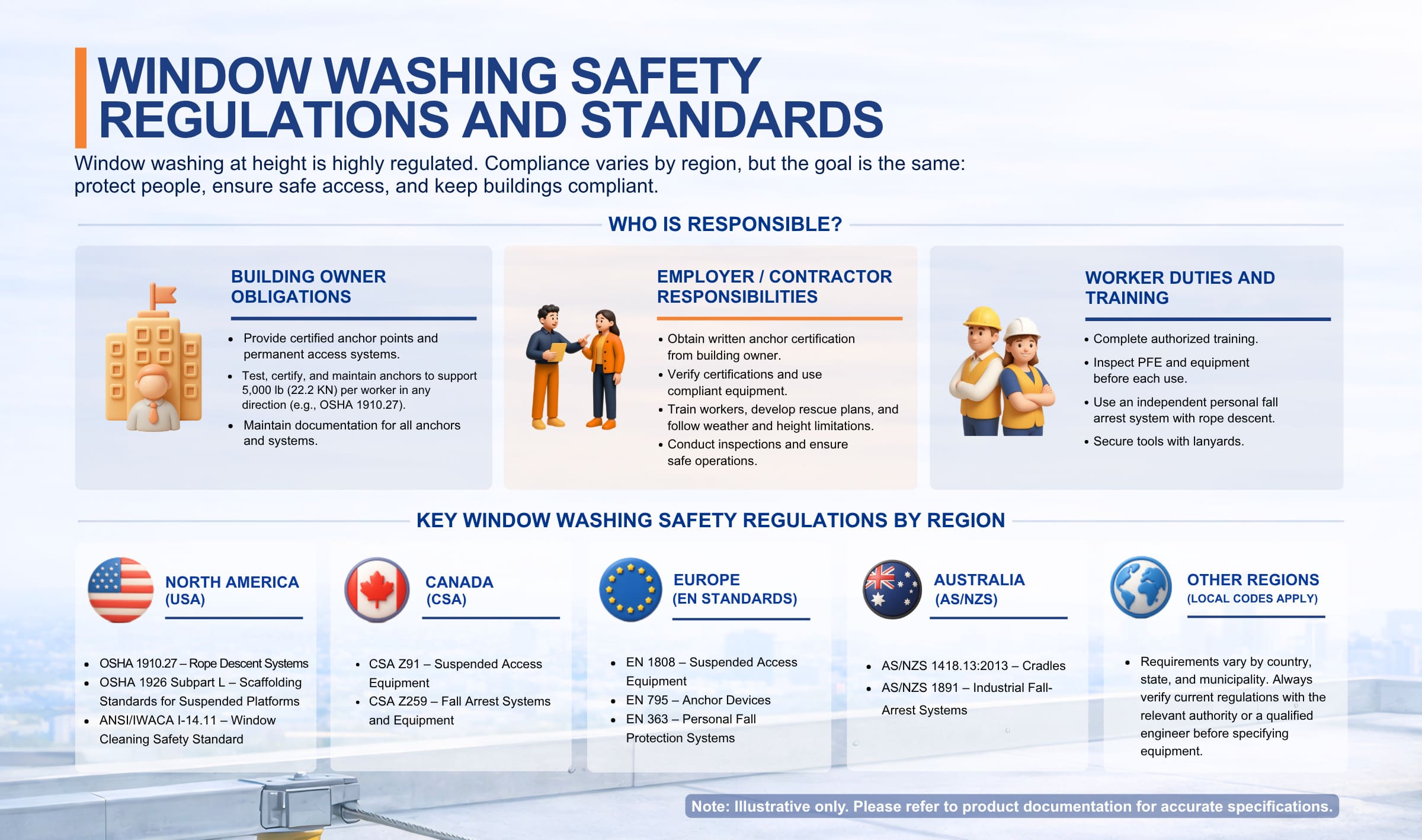
There is no single global standard governing window washing safety; requirements vary by country, state, and municipality. Building teams must understand which localized regulations apply to their properties and should always verify current requirements with the relevant authority having jurisdiction or a qualified engineer before specifying equipment.
North America enforces detailed, prescriptive regulations regarding rope descent systems, suspended platforms, anchor certification, and fall protection.
OSHA 1910.27 establishes federal safety requirements for rope descent systems used during exterior building maintenance. It mandates a 300 ft height limit for standard RDS operations measured from ground level, allowing exceptions only where alternative access methods are infeasible or present a greater hazard. Key items include anchor systems rated for at least 5,000 lb (22.2 kN) per worker in any direction, separate independent fall arrest lines, stabilization for descents over 130 ft (39.6 m), strict hazardous weather restrictions, and mandatory prompt rescue plans.
This subpart governs suspended platform systems, including swing stages, used on commercial towers, hospitals, airports, and residential high-rises. It sets clear provisions for scaffold design, erection, operation, and worker protection. A competent person must supervise scaffold erection and perform regular safety inspections to ensure the platform remains safe throughout the operation.
ANSI/IWCA I-14.1 is the industry consensus safety standard developed by the International Window Cleaning Association through the 1990s and first published in 2001. The standard draws on OSHA enforcement guidance—including a 1991 OSHA memorandum on suspended access and rope descent operations—together with broader industry best practices for window cleaning safety.
CAN/CSA-Z91:17 establishes Canada’s operational safety requirements for suspended access equipment used during window cleaning, facade maintenance, inspection, and related building maintenance activities. Equipment design requirements are governed separately under CAN/CSA-Z271. Provincial occupational health and safety authorities enforce these standards across Canadian jurisdictions.
Europe regulates facade access through harmonized safety standards and construction management regulations that govern equipment engineering and lifecycle design.
This harmonized European standard dictates design and safety requirements for BMUs, suspended platforms, and monorail systems. It mandates structural load testing, fail-safe devices, emergency descent systems, and electrical safety parameters. Notably, EN 1808:2015 §6.1.2.5 specifies a strict minimum 12:1 safety factor on all suspension ropes. All Facade Access Solutions products for Europe comply with these criteria.
A British Standard focused on designing buildings so windows and facades can be cleaned safely throughout their operational life. It encourages architects, developers, and consultants to integrate permanent access infrastructure—such as BMUs, davits, monorails, and roof protection—early in the design stage rather than relying on temporary post-construction setups.
The Construction (Design and Management) Regulations 2015 mandate that safe access for future maintenance be planned from the earliest design stages. It places legal health and safety coordination duties on both the Principal Designer (who coordinates safe access during design) and the Principal Contractor (who manages safety and installation during construction).
The Asia-Pacific region combines statutory working-at-height frameworks with rigorous national standards for permanent access infrastructure.
This standard regulates the design, manufacture, installation, and operation of BMUs. AS/NZS 1418.13:2013 §11 requires inspection by a competent person at least annually, and a thorough structural examination at intervals not exceeding 10 years. Mechanical overhaul is triggered by examination findings rather than a fixed schedule. These requirements are supplemented by state-level Work Health and Safety (WHS) legislation (e.g., SafeWork NSW, WorkSafe Victoria) and AS/NZS 1891.4 for associated fall arrest devices.
This code governs permanent access equipment, supporting Singapore’s Workplace Safety and Health framework enforced by the Ministry of Manpower (MOM). Given the high density of tall commercial and mixed-use developments in the region, permanent access systems are typically integrated during initial building design to ensure long-term maintenance access and regulatory compliance. SS 573 separately governs personal fall protection systems used alongside suspended access equipment during facade maintenance operations.
Managed by the Labour Department, this code regulates suspended working platforms through mandatory equipment registration, periodic inspection, load testing, and operator certification. In Hong Kong’s dense urban high-rise environment, these controls are strictly enforced to ensure safe facade maintenance across residential, commercial, and transport infrastructure projects.
Window washing operations in the UAE are governed by Dubai Municipality requirements, Abu Dhabi’s OSHAD-SF (Occupational Safety and Health System Framework), and adopted international EN/BS standards. Dubai Municipality dictates specific criteria for BMUs, safety anchors, and rooftop systems during the building permitting process, while OSHAD-SF establishes wider working-at-height and rescue planning frameworks.
The Gulf region’s extreme environmental conditions—including intense UV exposure, sand abrasion, humidity, and high thermal cycling—accelerate equipment wear and facade deterioration. Durable permanent access systems and proactive maintenance programs are essential for long-term safety. Facade Access Solutions maintains a regional engineering office in Dubai and holds extensive experience managing landmark supertall developments like the Burj Khalifa.
Safety compliance depends on personal protective gear, suspended machinery, and structural engineering working together as a unified system to mitigate risk at height.
Regulations across OSHA, EN, CSA, and AS/NZS frameworks require compliant fall protection gear whenever workers operate at height. Typical PPE includes full-body harnesses, shock-absorbing lanyards, self-retracting lifelines (SRLs), rope grabs, and hard hats. Under OSHA 1910.27, rope descent operators must use a separate independent personal fall arrest system connected to an independent anchorage. All gear must be inspected daily for wear or UV degradation and retired according to manufacturer timelines.
Building Maintenance Units (BMUs) and powered platforms provide controlled facade traversal and stabilization on complex or tall structures. Governed by standards like EN 1808, ASME A120.1, AS/NZS 1418.13:2013, CAN/CSA, and OSHA 1910.66, these systems utilize dual lines (a working rope and an independent secondary safety rope) at each suspension point. Facade Access Solutions provides Standard, Modular, and Custom BMUs designed for all building tiers, from compact installations under 150 m to multi-stage custom systems used on supertall towers like Merdeka 118, Shanghai Tower, and Burj Khalifa.
Rope descent systems and bosun’s chairs are portable solutions for targeted facade cleaning or areas with restricted access. A standard setup consists of a structural roof anchor, support rope, descent device, carabiners, and a seat board or bosun’s chair. Per OSHA 1910.27, all load-bearing RDS components must support a minimum breaking strength of 5,000 lb (22.2 kN), and seat boards must support a minimum load of 300 lb (1.33 kN) per OSHA 29 CFR 1926.452(o)(3). Stabilization mechanisms are legally required for any descents exceeding 130 ft (39.6 m) to reduce sway and facade contact.
Structural anchors form the foundation for fall arrest lines, tiebacks, lifelines, and suspended platforms. Major global standards mandate that access anchors support a minimum 5,000 lb (22.2 kN) service load per attached worker. Facade Access Solutions offers engineered tieback anchor systems designed for suspended access and fall protection applications. These systems are engineered for a 5,000 lb factored load in any direction.
The regional regulations examined here—from North America’s OSHA/CSA to Europe’s EN 1808 and Australia’s AS/NZS 1418.13:2013—demonstrate a unified rule: commercial buildings require permanently engineered, certified access infrastructure to maintain compliance and protect lives throughout their operational life. Successfully managing risk at height demands a shared commitment where owners, employers, and operators fully execute their legal duties.
Operating dedicated engineering offices across North America, Europe, the Middle East, and Asia-Pacific, Facade Access Solutions designs, manufactures, installs, and services permanent facade access systems tailored to local statutory codes. Whether your property requires certified safety tiebacks, a permanent BMU, or a comprehensive rooftop access assessment, contact Facade Access Solutions to discuss your engineering requirements.
Disclaimer: Graphics shown are illustrative only and do not represent actual products, equipment, or real-life conditions.
Binanız için doğru çözümü keşfetmek üzere uzmanlarımızla görüşün.
Request a Quote TodayOperations require a mix of permanent building infrastructure and personal equipment. Workers must utilize full-body harnesses, shock-absorbing lanyards or self-retracting lifelines, rope grabs, and hard hats. This personal protective gear must connect securely to certified structural roof anchors or permanent equipment like a Building Maintenance Unit (BMU).
Anchor systems must undergo routine structural safety inspections at least annually by a competent person. Depending on local jurisdictions and engineering codes, formal load testing or major engineering recertification cycles may also be required after building modifications or structural building upkeep.
Under OSHA 1910.27 standards in North America, rope descent systems are capped at a maximum height of 300 ft above grade. Exceptions apply only if alternative access options are proven to be mechanically infeasible or inherently more dangerous. Stabilization anchors are required for any descents over 130 ft to control sway hazards.
Both stakeholders hold non-transferable legal duties. Building owners must install permanently engineered, certified anchor points and supply written verification of load compliance before operations begin. Contractors must inspect the site, verify this paperwork, and ensure their crew utilizes the infrastructure safely.
Baseline engineering standards include OSHA 1910.66 and ASME A120.1 in the United States, CAN/CSA-Z271 and CAN/CSA-Z91:17 in Canada, EN 1808:2015 in Europe, and AS/NZS 1418.13:2013 in Australia and New Zealand. These standards govern structural design, load testing, suspended access operation, emergency descent systems, and equipment safety requirements.