Global Site - English
Selecting the correct standard ladder dimensions is not just a design choice. In commercial, industrial, and high-rise environments, it is a critical safety and compliance requirement. Incorrect ladder width, spacing, or configuration can lead to failed inspections, operational delays, and serious risks to workers.
For architects, engineers, and facilities managers, ladder specifications must support a broader building access strategy. This means aligning ladder dimensions with global safety standards, site conditions, and long-term maintenance requirements.
This guide covers ladder width standards, dimensional requirements by ladder type, and how to choose the right ladder system for safe, compliant, and efficient access.
Understanding ladder width standards across regions is essential for ensuring compliance and avoiding redesigns. Many commercial projects require alignment with multiple regulations, particularly in global developments.
In the United States, OSHA defines the baseline for ladder safety compliance. Fixed ladders must have a minimum clear width of 16 inches (41 cm), while portable ladders must be at least 11.5 inches (29 cm) wide. Updated OSHA regulations also require ladders above 24 feet to include ladder safety systems or personal fall arrest systems. Safety cages are no longer accepted as the sole protection method, and all replacements before 2036 must comply with these updated requirements.
ANSI standards expand on OSHA by defining ladder load ratings and performance classes. Light-duty ladders require a minimum width of 11.5 inches, while heavy-duty applications require 12 inches or more. These classifications directly influence ladder design, durability, and load capacity.
Across Europe, EN 131 introduces usability requirements. Portable ladders must have a minimum width of 280 mm (11 inches), while platform ladders require a minimum standing area of 400 mm (16 inches).
In Australia and New Zealand, AS/NZS 1892 governs ladder design across materials and applications, with requirements varying by ladder type. Other global standards include CSA Z11 in Canada, which aligns with ANSI, and GB/T 17889 in China, which links ladder dimensions to load capacity. In the Middle East, projects typically reference OSHA, EN, or British Standards.
These frameworks show that standard ladder width is not universal. It must be selected based on region, application, and integration with safety systems.
Regulation |
Region |
Portable Ladder Min. Width |
Fixed Ladder Min. Width |
Platform Ladder Min. Width |
| OSHA 1910 / 1926 | United States | 11.5 in (29 cm) | 16 in (41 cm) | 16 in (41 cm) |
| ANSI A14 Series | United States | 11.5 in (29 cm) | 16 in (41 cm) | 12+ in (30+ cm) |
| EN 131 | Europe (EU) | 280 mm (11 in) | Per national annex | 400 mm (16 in) |
| AS/NZS 1892 | Australia / NZ | Verify by type | Per AS/NZS 1892.4 | Verify by type |
| GB/T 17889 | China | Per national standard | Per national standard | Per national standard |
| CSA Z11 | Canada | Similar to ANSI | Similar to ANSI | Similar to ANSI |
While regulations define minimum requirements, selecting the right ladder type ensures safe access, usability, and long-term performance. Each ladder type has specific ladder dimension requirements that must match the working environment.
Step ladders are self-supporting and commonly used for indoor maintenance tasks. Typical step ladder dimensions include a width of 12 to 20 inches and rung spacing between 10 and 12 inches. They are ideal for painting, lighting adjustments, and general facility work where mobility and compact design are essential.
Extension ladders are designed for vertical reach in construction and facade access. Standard extension ladder dimensions range from 14 to 18 inches in width, with rung spacing of 12 inches. For safe use, the ladder must extend at least 3 feet above the landing, follow a 4:1 angle ratio, and be placed on a stable base. These ladders are widely used for roof access, inspections, and temporary facade work.
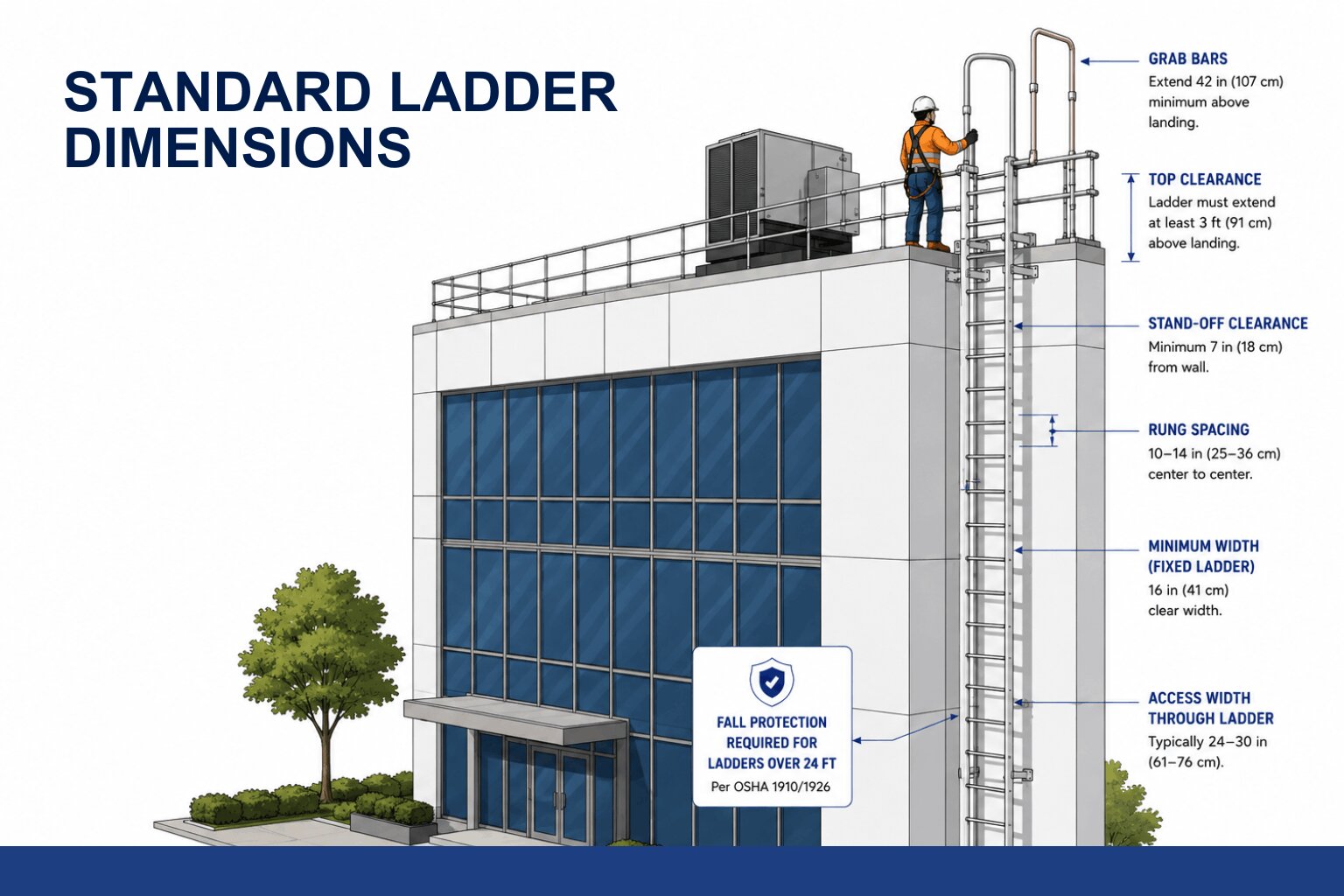
Fixed ladders are a key component of roof access systems and facade maintenance strategies. Standard fixed ladder dimensions include a minimum width of 16 inches, rung spacing between 10 and 14 inches, at least 7 inches of stand-off clearance, and grab bars extending 42 inches above the landing. Access width through the ladder typically ranges from 24 to 30 inches.
For ladders exceeding 24 feet, fall protection systems are mandatory, and safety cages can no longer be used as the only protection method. These ladders are commonly integrated with BMUs, monorails, and rooftop equipment.
Platform ladders are designed for stability and worker comfort. Standard platform ladder dimensions range from 16 to 22 inches in width, providing a secure standing area for detailed tasks such as electrical work and inspections.
Industrial ladders are built for high-frequency use in demanding environments. Typical industrial ladder dimensions range from 20 to 30 inches in width, allowing for greater stability and load capacity. OSHA requires these ladders to support at least four times their intended load and to include handrails and stable rolling mechanisms.
Multi-position ladders offer flexibility across multiple configurations. Standard multi-position ladder dimensions range from 18 to 24 inches in width, making them suitable for uneven terrain, stairways, and renovation projects.
Ladder Type |
Typical Width |
Rung Spacing |
Height Range |
Load Rating |
Best Applications |
| Step Ladder | 12–20 in | 10–12 in | 4–14 ft | Type II–IA | Interior maintenance, painting |
| Extension Ladder | 14–18 in | 12 in | 16–40 ft | Type I–IA | Roof access, construction |
| Fixed Ladder | 16+ in | 10–14 in | Custom | Custom | Permanent building access |
| Platform Ladder | 16–22 in | 10–12 in | 4–16 ft | Type IA–IAA | Prolonged tasks, electrical work |
| Industrial/Rolling | 20–30 in | ≤10 in rise | 4–20 ft | Type IAA (375+ lbs) | Warehouses, facade maintenance |
| Multi-Position | 18–24 in | 12 in | 6–22 ft | Type IA | Stairways, uneven terrain |
Ladder width directly impacts stability, load capacity, and worker safety. Wider ladders distribute weight more effectively, reducing the risk of tipping in professional environments.
As a general rule, each additional inch of ladder width can increase load capacity by approximately 20 to 30 pounds. For example, a 16-inch ladder rated at 300 pounds offers significantly more stability than a 12-inch ladder rated at 200 pounds. In most commercial applications, a width of around 18 inches is recommended to allow safe movement, especially when workers use tools or wear PPE.
Environmental conditions also influence ladder selection. Wet or corrosive environments require slip-resistant materials, while confined spaces may require narrower ladders supported by additional safety systems.
Choosing the right ladder dimensions depends on application, environment, and frequency of use. In commercial and industrial facilities, wider ladders of 20 inches or more are often preferred for stability and repeated access. In high-rise buildings, fixed ladders typically range from 16 to 20 inches and must integrate with facade access systems.
Ladders exceeding 24 feet must include compliant fall protection systems, while all ladder designs should align with rooftop equipment such as BMUs, davits, and monorails. Construction environments must meet OSHA requirements, while confined spaces may require more compact solutions with additional safety controls.
Ladders are only one element of a complete building access system. They must integrate with fall protection systems, monorails, davits, and facade access equipment to ensure safe and efficient maintenance.
Fixed ladders provide access to rooftops and service areas, while BMUs enable full facade coverage. Proper coordination between these systems improves safety, reduces operational risk, and supports long-term maintenance efficiency.
Early collaboration between architects, engineers, and facade access specialists helps ensure compliance and prevents costly design changes later in the project.
Selecting the correct standard ladder dimensions ensures safe, compliant, and efficient building operations. Every detail, from width and rung spacing to clearance and fall protection, plays a role in long-term performance.
To achieve the best results, project teams should go beyond minimum standards and consider how ladders will be used over time. Integrating ladder systems with complete access solutions ensures better safety, smoother operations, and reduced lifecycle costs.
Facade Access Solutions provides end-to-end expertise in ladder systems, facade access, and integrated building access design.
Contact our team today to discuss your project requirements and ensure full compliance with global ladder standards.
Infrastructure Access Solutions, part of Alimak Group, was engaged to undertake a major inspection and engineering assessment of the powered under-deck gantries operating beneath the Sydney Harbour Bridge. These permanent access systems enable inspection and maintenance crews to safely access the bridge’s steelwork below the roadway, a critical component in maintaining one of Australia’s most iconic pieces of infrastructure.
The project required detailed engineering assessment of complex access plant operating in a highly constrained environment beneath an active transport corridor. The gantries consist of integrated structural, mechanical, electrical, and control systems that must function reliably while supporting suspended access operations at height.
Working within strict safety and operational requirements, the inspection program needed to verify the integrity and performance of the systems while minimizing disruption to ongoing maintenance activities.
Infrastructure Access Solutions delivered a coordinated major inspection and certification program, combining in-house engineering expertise with specialist testing services.
The scope included comprehensive inspection of structural elements, drive systems, rolling components, electrical and control systems, and operator safety features. Non-destructive testing of critical components was undertaken through a NATA-accredited laboratory, alongside functional testing of brakes, limit systems, and operational controls.
Infrastructure Access Solutions managed multiple specialist disciplines throughout the project, ensuring a structured inspection methodology and clear engineering documentation to support the certification process.
Through a detailed engineering assessment and coordinated inspection program, the under-deck gantries were verified for safe operation, restoring reliable access to critical areas of the bridge for ongoing inspection and maintenance activities.
The project highlights Infrastructure Access Solutions’ capability in delivering complex inspection and certification programs for permanent access and specialist maintenance equipment operating in demanding infrastructure environments.
Every commercial and industrial building with rooftop access carries a level of risk. Maintenance teams, inspectors, and contractors rely on safe access to perform their work. Without the right protection in place, even routine tasks can expose workers to serious fall hazards. This is where a well-planned roof guardrail installation becomes essential.
A permanent roof guardrail system is one of the most effective forms of passive fall protection. It does not depend on user behavior. Once installed correctly, it creates a continuous barrier that reduces risk across the rooftop environment. However, not all systems deliver the same results. The difference lies in how the installation is planned, designed, and maintained.
This guide covers the full process, from planning and compliance to installation and maintenance. It also explains how guardrails fit into a broader rooftop safety strategy, where systems such as fall arrest, lifelines, and facade access equipment work together to support safe operations.
A successful roof guardrail installation begins well before equipment arrives on site. The planning phase determines system performance, compliance, and long-term reliability.
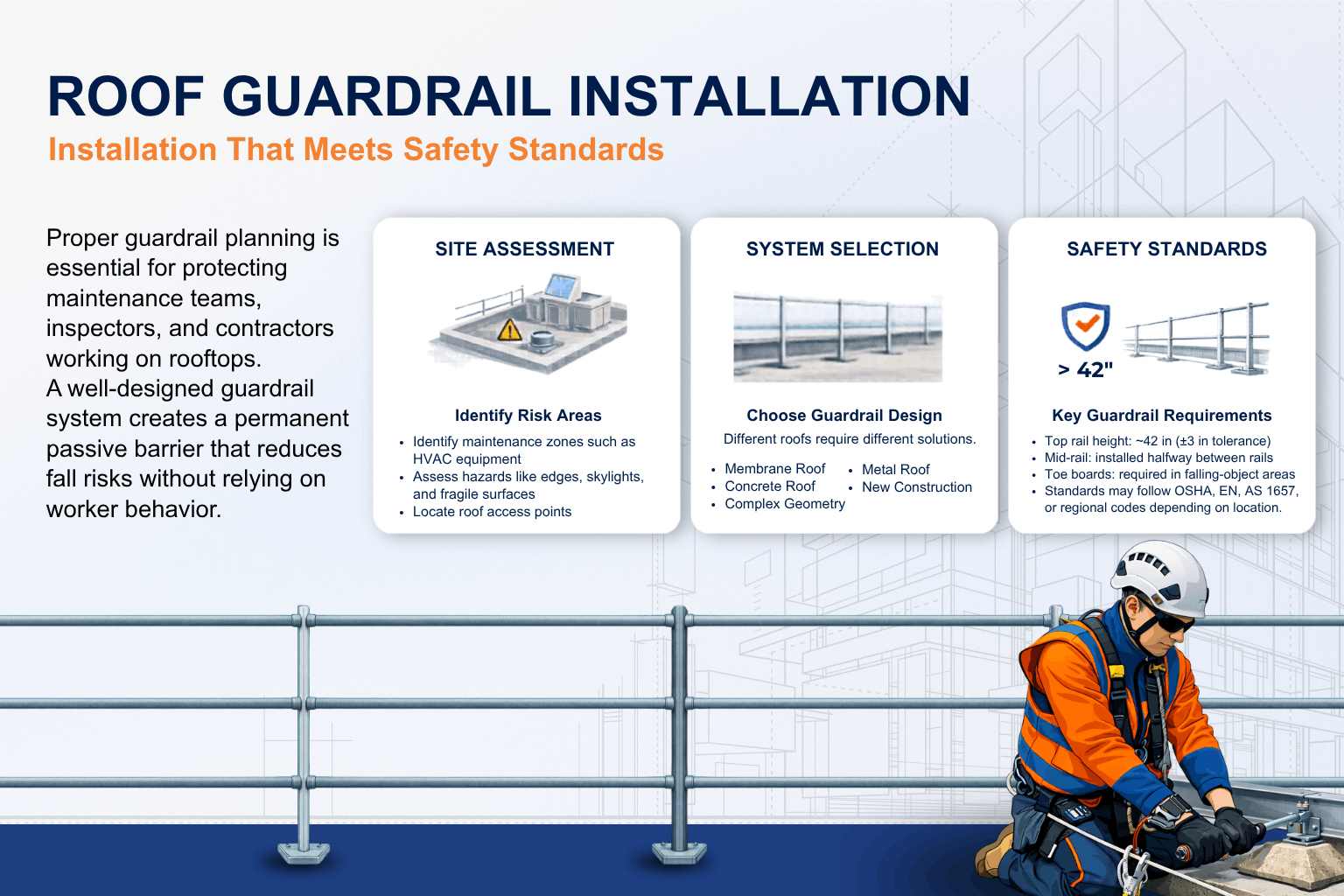
Start with a detailed site assessment. Identify all access points such as ladders, stairwells, and roof hatches. Then locate areas that require regular servicing, including HVAC units and mechanical zones. Mapping worker movement across the roof helps define where protection is most critical.
Next, assess fall hazards. Roof edges are the most obvious risk, but skylights, fragile surfaces, and elevation changes also present danger. Fall hazards at heights of approximately 2 meters (6–6.6 feet) or more must be addressed in accordance with applicable safety standards such as OSHA and EN 13374.
Structural capacity must also be verified. The roof must support the loads imposed by the guardrail system. Freestanding systems rely on counterweights, while fixed systems transfer loads through anchors. A structural engineer should confirm capacity, especially for older buildings.
System selection depends on the roof design. The table below provides a quick reference for choosing the right solution.
Guardrail System Selection by Roof Type
| Roof Type | Recommended System Type | Key Consideration |
|---|---|---|
| Membrane Roof | Freestanding | Protect waterproofing |
| Concrete Roof | Anchored | Strong support |
| Metal Roof | Freestanding/Engineered | Load distribution |
| Complex Geometry | Custom | Engineering required |
| New Construction | Integrated | Plan early |
Compliance is a critical part of any roof guardrail installation. While regulations vary by region, the core safety principles remain consistent.
OSHA standards define clear requirements for guardrail systems:
Globally, several standards govern roof guardrail systems. These include EN 13374, EN 14122-3, AS 1657, and regional building codes. Many Middle East projects follow OSHA or EN standards with local adaptations.
The table below provides a quick comparison across major standards.
Guardrail Requirements by Region
| Requirement | OSHA | EN | IBC | AS 1657 |
|---|---|---|---|---|
| Top Rail | 42 in. | 1.0m | 42 in. | 900–1100mm |
| Mid Rail | Yes | Yes | Yes | Yes |
| Force | 200 lbs | Varies | 200 lbs | Defined |
| Toe Board | 4 in. | Varies | Required | 100mm |
For a more technical comparison, the table below breaks down key design requirements.
Guardrail Design Requirements by Standard
| Feature | OSHA | EN 14122-3 | AS 1657 |
|---|---|---|---|
| Top Rail Height | 42 in. | 1100mm | 900–1100mm |
| Mid Rail | Yes | Yes | Yes |
| Toe Board | 4 in. | Required | 100mm |
| Load | 200 lbs | 0.3 kN | Defined |
Always confirm requirements with the local authority having jurisdiction before installation begins. Working with experienced providers such as Façade Access Solutions can also help ensure that guardrail systems align with both international standards and project-specific compliance requirements.
A structured approach ensures safe and compliant installation. Each stage contributes to the final system performance.
The table below compares the main installation methods.
Guardrail Installation Method Comparison
| Type | Description | Advantage | Limitation |
|---|---|---|---|
| Freestanding | Counterweights | No penetration | Heavy |
| Anchored | Fixed anchors | Secure | Requires drilling |
| Hybrid | Combination | Flexible | Complex |
Maintenance ensures that a roof guardrail system remains safe and compliant over time.
Inspect the system before each use and schedule formal inspections at least once a year. In demanding environments, inspections should be more frequent.
After severe weather, perform additional checks to ensure system stability. Inspect fasteners, look for corrosion, and verify that all components remain properly aligned.
The table below outlines a practical inspection checklist.
Guardrail Inspection Checklist
| Item | Check | Action |
|---|---|---|
| Alignment | Height | Adjust |
| Fasteners | Tightness | Retighten |
| Corrosion | Rust | Treat |
| Anchors | Integrity | Reinforce |
For long-term reliability, many building owners partner with service providers who can support inspections and maintenance. Façade Access Solutions, for example, delivers ongoing service through its global network, helping ensure that guardrail systems and related access equipment remain compliant throughout their lifecycle.
Guardrails are a critical layer of rooftop safety, but they work best as part of a complete system.
Rooftop Safety System Overview
| System | Purpose | Use |
|---|---|---|
| Guardrails | Edge protection | Perimeter |
| Fall Arrest | Personal safety | Complex areas |
| Lifelines | Movement | Large roofs |
| Davits | Suspended access | Facade work |
| BMUs | Full access | High-rise |
In areas where guardrails cannot be installed, fall arrest systems provide essential protection. These often include anchor points and personal safety equipment designed to secure workers during specific tasks.
Lifeline systems allow safe movement across large roof areas, while davit systems provide support for suspended platforms used in facade cleaning and inspection. Monorail systems enable equipment movement across the roof, improving operational efficiency.
For mid-rise and high-rise buildings, BMUs remain the primary solution for full facade access. Systems developed by brands such as CoxGomyl and Manntech are designed to operate alongside guardrails, lifelines, and anchors, creating a fully integrated rooftop safety environment.
A reliable roof guardrail installation depends on proper planning, compliance with safety standards, and careful execution. Each stage plays a role in ensuring long-term performance.
Guardrails should not be treated as a standalone solution. They must be part of a broader safety strategy that includes fall arrest systems, lifelines, and facade access equipment. When these systems are designed together, they create a safer and more efficient working environment.
Façade Access Solutions provides end-to-end support, from design consultation to installation and maintenance. With thousands of systems installed worldwide, their team brings the expertise needed to deliver compliant and durable solutions across a wide range of building types.
If you are planning a new project or upgrading an existing system, now is the time to act. A well-designed roof guardrail system protects people, reduces risk, and supports long-term building performance.
Work at height introduces dynamic risk conditions that must be addressed through engineered control measures. Within modern building design, fall arrest systems form part of permanent life safety infrastructure rather than temporary accessories. They are integrated into roof zones, façade access strategies, and maintenance planning to support long-term operational safety.
For structural engineers, façade consultants, and asset owners, the objective is not simply to define fall arrest but to understand how it performs under dynamic loading. Effective systems must manage energy transfer, maintain structural integrity, satisfy clearance geometry, and align with global regulatory frameworks.
Fall arrest is therefore best described as a performance-driven interface between user and structure, embedded within broader façade access and maintenance strategies.
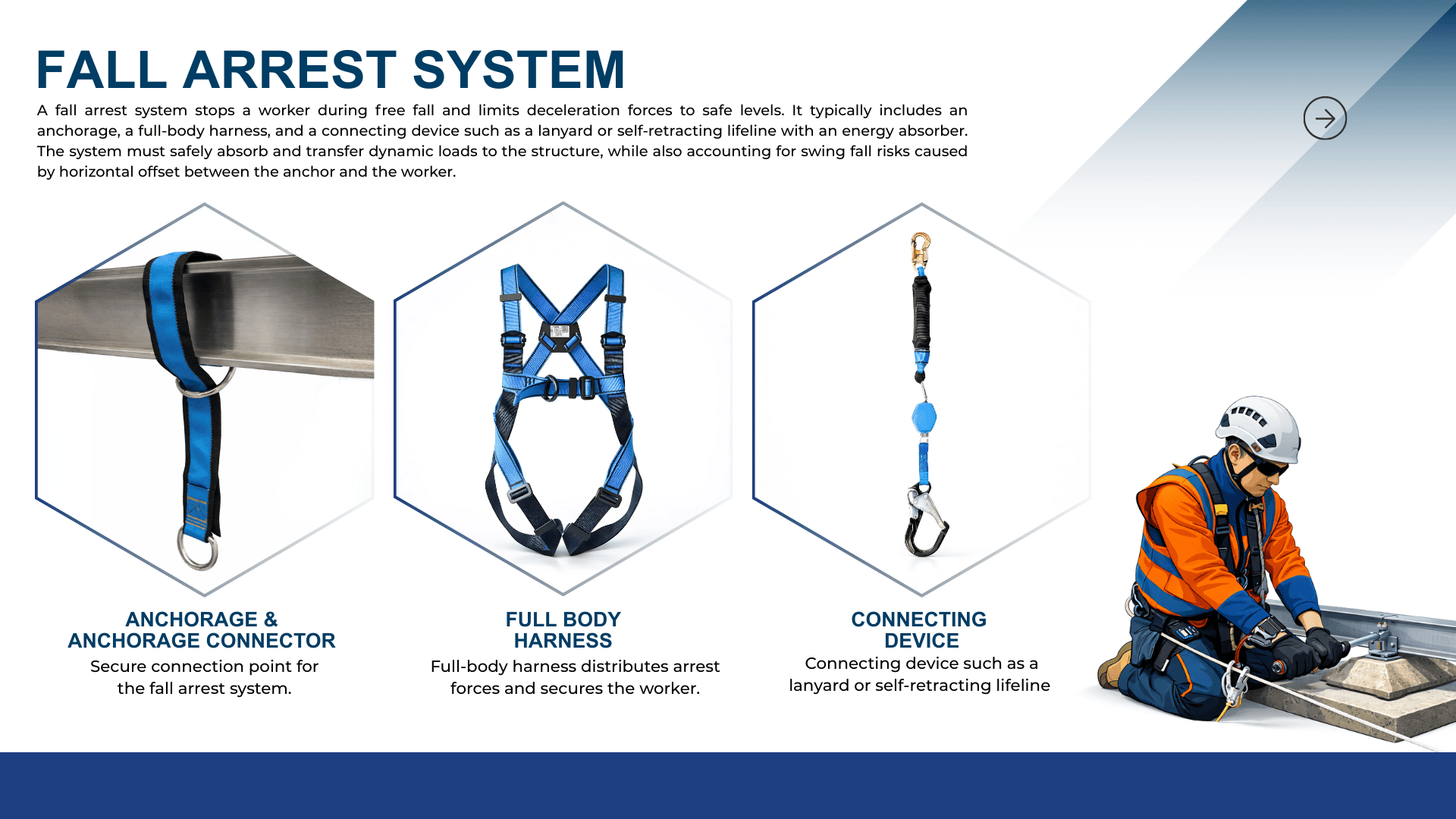
A fall arrest system is designed to stop a worker who has entered free fall and limit deceleration forces to survivable thresholds
A typical system includes:
The defining condition is the dynamic load event. The system must absorb and transfer energy safely into the structure without exceeding allowable force limits.
Swing fall must also be evaluated. Horizontal offset between anchor and user creates pendulum effects that may result in worker hitting the ground, side structures or severed suspension line due to abrasion against top edge of structure.
Early coordination with façade interfaces, waterproofing layers, and insulation systems ensures permanent integration without compromising envelope integrity.
Accurate clearance calculation is fundamental to safe design.
Fall Clearance = Lanyard Length + Deceleration Distance + Line Stretch + Worker Height + Safety Factor
Where:
Mounting height directly influences free fall distance. Self-retracting lifelines typically reduce free fall compared to fixed lanyards.
Fall arrest systems must comply with regulations in the jurisdiction of installation. Regulatory frameworks establish minimum performance thresholds, while engineering best practice frequently exceeds them.
Common global regulatory families include:
Region |
Primary Regulatory Framework |
| United States | Occupational Safety and Health Administration, American National Standards Institute |
| Canada | CSA Group |
| Europe | EN Standards |
| United Kingdom | BS Standards |
| Australia / New Zealand | AS/NZS Standards |
| Asia / Middle East | Local OHS frameworks often aligned with EN or BS |
Compliance ensures baseline safety. However, structural integration, multi-user loading verification, and façade coordination require performance-driven engineering beyond minimum code thresholds.
Permanent fall arrest systems must be integrated into the building envelope, not retrofitted as isolated attachments. Structural continuity, façade coordination, and long-term asset management planning are essential.
Effective systems:
When engineered as part of an integrated façade access strategy, fall arrest becomes a structural safety interface that protects both personnel and the asset lifecycle.
Permanent fall arrest systems require coordinated structural design, façade integration, and regulatory alignment.
Facade Access Solutions provides engineering-driven consultancy and equipment integration for permanent access and fall arrest systems across complex building typologies.
Contact our technical team to evaluate your project requirements and develop a performance-based solution aligned with structural and operational objectives.
In today’s construction and façade access industry, operational precision, teamwork, and reliable service are critical for success. For Jewel Zhu, Implementation Manager at Façade Access Solutions China, these principles guide both her daily work and long-term vision. During International Women’s Month, her career focuses the growing impact of women leaders in shaping China’s construction sector.
With seven years at Façade Access Solutions, Jewel has steadily expanded her responsibilities. She now plays a pivotal role across marketing, operational coordination, and key client support. This cross-functional work allows her to contribute to both business strategy and service delivery, ensuring projects run efficiently and meet client expectations.
Jewel works closely with service and cleaning teams to support major clients, including the Shanghai World Financial Center and Hang Seng Bank Tower. She also prepares strategic presentations and business review reports, aligning local operations with broader divisional goals. Her ability to bridge technical knowledge with strategic thinking makes her a key driver of the company’s growth in China.
Jewel’s background in mechanical engineering gives her a strong analytical foundation. This expertise informs her approach to operational challenges and strategic planning.
Before joining Façade Access Solutions, Jewel gained experience across multiple industrial sectors, including elevator components, security and access systems, and a Swedish gardening brand. Her roles involved marketing, public relations, and commercial strategy, helping her develop a unique perspective that blends technical knowledge with effective communication.
By combining engineering logic with collaboration skills, Jewel approaches every project with structured problem-solving while keeping teamwork and client needs at the forefront.
Today, Jewel’s responsibilities cover marketing, office operations, financial planning, and business reporting. This wide perspective allows her to understand how different teams interact to deliver operational excellence.
Managing after-sales operations for major clients gives her real-world insight into project performance, connecting strategic objectives with practical outcomes. Looking ahead, she is focused on strengthening teamwork, improving communication, and maintaining high service standards to support sustainable growth in China.
A: I am the Implementation Manager of FAS China. I joined seven years ago, and my role now supports multiple aspects of the business, from marketing to after-sales operations for key clients like Shanghai World Financial Center and Hang Seng Bank Tower. My engineering background drew me to an industry that values technical precision and long-term performance.
A: I studied mechanical engineering, which trained me to think analytically. My marketing journey began with an internship at an advertising agency. Since then, I have worked in elevator components, security systems, and commercial strategy. This combination helped me connect technical knowledge with business communication effectively.
A: I enjoy working across functions. Being involved in marketing, operations, budgeting, and reporting gives me a full understanding of the organization. Managing after-sales for key clients provides practical insight into our service performance.
A: I hope to strengthen collaboration across teams and ensure consistent service quality. Clear communication and alignment with divisional goals will help our China operations grow sustainably.
A: I enjoy traveling across China and abroad, exploring architecture, museums, and geography. Gardening has become a recent passion, reminding me that growth takes patience and structure.
Women like Jewel Zhu are redefining leadership in the construction and façade access industry. Their technical expertise, strategic insight, and collaborative approach help deliver safer and more efficient solutions for modern cities.
Façade Access Solutions is committed to building diverse teams that drive innovation and operational excellence. If you are passionate about engineering, construction, and global collaboration, explore opportunities to join a team that supports the people who build and maintain the world’s skylines.
The construction sector continues to evolve as more women take on leadership roles that shape the future of the industry. This International Women’s Month, we recognize Alicia Diaz Sanchez, a leader who helps guide people strategy behind a global façade access organization.
Alicia Diaz Sanchez serves as People and Culture Business Partner within the Façade Access division, leading the Training function. Since joining the company in 2014, she has supported talent development, strengthened collaboration, and helped teams grow across multiple international locations.
In an industry known for engineering and technical innovation, strong leadership in people development plays an equally critical role. Alicia’s work ensures that the professionals who design, manufacture, and service façade access systems have the training and support needed to perform at their best.
Alicia began her professional journey after completing a bachelor’s degree in Psychology and pursuing PhD training focused on Learning. She started her career with Eaton in Madrid as part of the Human Resources team at a manufacturing site employing more than 700 people.
She gained extensive experience in human resources while also developing knowledge in Lean Manufacturing and Six Sigma processes, during her 11 years with the department. These experiences helped shape her continuous improvement mindset and her ability to support complex industrial operations.
She later became Human Resources Director for the Spanish operations of Ascendum, the main dealer for Volvo heavy machinery. From this role, she gained valuable experience in decentralized operations and developed a deeper understanding of service activities and customer relationships in the construction equipment sector. After eight years Alicia joined CoxGomyl to contribute to a global organization that brings together engineering, manufacturing, and service expertise.
Today, Alicia works closely with teams across several countries within Façade Access Solutions. Her responsibilities include leading training initiatives, supporting leadership development, and aligning people strategies with the company’s business objectives.
A key focus of her work is helping employees grow within the organization. By strengthening communication and encouraging collaboration across locations, she supports a workplace culture where employees remain engaged and connected to the company’s goals.
Her efforts contribute to the success of teams that support façade access solutions.
In the construction industry, strong leadership is essential not only on project sites but also within the teams that support innovation and operational excellence. Alicia Diaz Sanchez believes that developing people and fostering collaboration are key to building resilient organizations. Through her work in Façade Access Solutions, she supports employees across multiple locations while helping align talent development with long-term business goals. Her perspective reflects a broader shift within the construction industry, where diverse leadership and inclusive workplaces are becoming critical drivers of progress. Alicia shares insights on her career journey, her leadership approach, and the evolving role of women in construction.
I joined the company in December 2014 as Human Resources Director for the factories located in Alovera and Meco near Madrid. Over the years I have taken on additional responsibilities beyond my initial role and now serve as People and Culture Business Partner for the Façade Access Division. Since last September I have also been leading the Training function for the division and I supervise the People and Culture Manager in France.
What inspired me most was the opportunity to work in an international environment within a market leading organization. I was also motivated by the chance to be part of a company that combines engineering, manufacturing, and service processes in one site, which is quite uncommon in Spain.
The constantly changing environment and the diversity within our division motivate me every day. I enjoy working with colleagues from many countries and supporting their professional growth.
One of my favorite aspects of the role is collaborating with different locations to keep employees engaged and committed. When people grow and feel connected to the company’s mission, the business can achieve greater success.
We have an incredible team in Façade Access Solutions. My goal is to continue expanding our network and sharing best practices between locations.
Improving communication through meetings, performance conversations, and engagement surveys will also be important. When employees understand the strategy and feel aligned with it, they can achieve stronger results.
I am a very active person. I do fitness several times a week and I enjoy travelling and diving whenever I can. I also participate in weekly charity projects through my church where I help support people with limited resources. In addition, I teach young people in an organization that trains future leisure time activity leaders.
The construction industry depends on strong collaboration and skilled professionals across engineering, manufacturing, and service operations. Leaders like Alicia Diaz Sanchez demonstrate how people focused leadership can strengthen organizations and support long term growth.
At Façade Access Solutions, teams work together across regions to support complex building projects around the world. If you are passionate about construction, innovation, and professional development, explore opportunities to join a global team shaping the future of façade access.
International Women’s Month is an opportunity to recognize professionals who are shaping the future of the construction and engineering industries. Women are bringing new perspectives to technical roles, leadership, and innovation, across the built environment.
At Façade Access Solutions, Laura Peinado represents this growing movement of women helping modernize construction through digital transformation. She closely works with teams across multiple countries as Digitalization Manager for the EMEAI region, to strengthen digital processes, improve operational efficiency, and support data driven decision making across the organization.
Her work demonstrates how digital leadership plays an important role in advancing construction technology, improving collaboration, and enabling smarter ways of working in complex engineering environments.
Before joining Façade Access Solutions, Laura developed her career in business and strategy consulting within the IT sector. Her work focused on change management, digital transformation, and operational improvement initiatives in complex organizations.
This experience provided a strong foundation for navigating the challenges of large scale transformation. Today, she applies these skills within the construction and façade access industry, where digital tools play an increasingly important role in supporting engineering teams, improving workflows, and strengthening project performance.
Laura was drawn to Façade Access Solutions because of the company’s culture and its focus on expertise, collaboration, and innovation across global teams.
Digital transformation is rapidly influencing how construction companies operate. Through her role, Laura works intently with colleagues across regions to help implement systems that improve efficiency and enable better decision making.
In this conversation, she shares insights into her career journey, what motivates her work, and how digitalization is shaping the future of the construction industry.
“I’m the Digitalization Manager for the EMEAI region at Façade Access Solutions, after leading the same role in the NAM region for several years.
What drew me to Façade Access Solutions, as part of the Alimak Group, was the opportunity to work in a culture that truly values expertise and encourages ideas. I’m proud to work with a team that drives impact, innovation, sustainability, and collaboration across the organization.”
“Before joining Façade Access Solutions, I built my experience in business and strategy consulting within the IT sector, working on change management, digital transformation, and operational improvement initiatives in complex environments.”
“I love the challenge and diversity of my work. No two projects are ever the same, and I enjoy delivering solutions that are both technically complex and highly practical, while improving ways of working and driving tangible impact across the business.
Working with talented colleagues across different countries is also rewarding, as everyone brings unique knowledge and fresh perspectives that keep me constantly learning.”
“In the year ahead, I look forward to supporting the team in delivering high quality solutions, enhancing efficiency, driving innovation, and strengthening data driven decision making to create measurable impact across the business.”
“Outside of work, I enjoy fitness, traveling, being outdoors, and spending time with family and friends. It’s a great way to recharge and keep a balanced perspective.”
As construction continues to evolve through digital technology and engineering innovation, professionals like Laura Peinado emphasize the important role women play in shaping the industry’s future.
At Façade Access Solutions, diverse expertise and new perspectives help drive innovation across global teams. Women in construction are contributing not only through engineering and project management but also through technology, strategy, and digital transformation.
Façade Access Solutions continues to support professionals who are passionate about advancing the built environment through engineering expertise and digital innovation.
For those interested in contributing to the future of construction, the company offers opportunities to collaborate with international teams and work on projects that support safer and more efficient buildings around the world.
Discover how you can be part of a team that is advancing façade access technology while supporting the growth of women in construction and engineering.
In the history of commercial real estate, facade access solutions grew in importance as structures grew in size. After all, maintenance on a glass exterior may be simple when the structure is only one or two stories, but as buildings grow in height, so must the access required to care for the property successfully and safely.
This same adaptable mindset applies to a building’s design, not merely its size. As your architects and contractors begin taking advantage of new tools and materials to realize ambitious structures, building façade designs must also change to ensure proper care for the finished product.
Making those alterations to facade access systems should also include developing solutions as early as possible in the building project—not to mention taking advantage of new resources that can help. When you partner with Integrated Design Services (IDS) experts from Facade Access NAM at the design stage, we can develop custom, forward-thinking facade equipment that empowers you to pursue both bold aesthetic visions and safe, efficient access for your contractors.
Trendsetting building design calls for next-gen façade equipment. The reason is simple: while rigid, prefabricated solutions once worked for all buildings, that was because structures didn’t necessarily include interplays of planes and angles or find influence from organic shapes, as with modern architectural marvels like The Gherkin in London.
These new building facade designs—combined with the inclusion of lighter or innovative materials including glass, mesh, and more—mean facade access systems also need to adjust to stay lightweight while maintaining durability and strength for safety purposes. In addition, you must ensure that your facade access solutions comply not only with OSHA and CCOHS regulations but also meet the ASME A120.1 Standards and other applicable industry guidelines to uphold the highest safety standards for your property.
Facade Access NAM’s IDS experts can help you navigate these necessities with recommendations that are built in partnership with your team at the design stage of the building project. By collaborating at these early stages, your finished structure can facilitate successful, safe, and efficient maintenance (or repair) processes without compromising on a striking and contemporary architectural vision.
The future of building facade designs is in your hands, and the time to start thinking about the access solutions that will help achieve your bold vision is now. By partnering with dedicated industry professionals like Facade Access NAM’s IDS experts early in the process, you can future-proof your efforts with systems made specifically for your needs.
Facade Access NAM’s Integrated Design Services are proven in numerous AEC and commercial maintenance applications across numerous sectors, including traditional and renewable energies, tower construction, educational institutions, and much more.
Having discussions about facade access systems early in a commercial building project’s design stage matters. Why? One reason is complexity. Tall commercial buildings, for example—and the teams who develop them—keep reaching even greater physical and aesthetic heights. As the sizes and forms of buildings grow more impressive (i.e. complicated), it becomes more and more challenging to integrate systems that accomplish regulatory compliance, architectural appeal, and efficient access for exterior building maintenance.
However, when architects, contractors, and other stakeholders come together early enough in a project’s design phase, the challenges that new buildings present are not only surmountable, but also wellsprings of possibility for what the project can achieve. Furthermore, by inviting experts like Facade Access NAM’s (North American) Integrated Design Services (IDS) team to those early meetings, you can facilitate a successful building project and ensure that exterior building maintenance will run smoothly in the long-term.
Completing an exceptionally tall building or intricate structure is a remarkable accomplishment, but getting there requires holistic, objective consideration of the necessities. A building like the Burj Khalifa, for instance, is a staggering achievement. However, the facade access systems needed to reach the tens of thousands of glass panels that would need cleaning or replacement—not to mention the hundreds of thousands of square meters of curtain wall cladding—requiring care themselves.
Without considering exterior building maintenance needs like these, similarly momentous projects could become costly in the long run. Discovering these necessities after construction could lead to massive retrofitting costs. The more innovative a building is, the more custom solutions their chosen façade access manufacturers will have to develop.
Focusing on these considerations at the design stage has multiple benefits, including:
By approaching Facade Access NAM’s IDS experts and facade access manufacturers at the design stage, we can work with you from the beginning to create custom solutions that help ensure this type of long-lasting success.
Including facade access discussions in a project’s design stage helps a building retain its beauty well past its completed construction. When implementing an exterior with full-height glazing, for instance, early conversations may reveal that the building also needs access to the interior for cleaning purposes (as was the case with The Edge building in Amsterdam, which solved for the issue by installing lightweight, customizable monorail paths).
By contacting Facade Access NAM’s IDS experts at the beginning of your commercial building project, we can facilitate conversations and design strategy with all your contractors while recommending custom solutions for your architectural vision. As a result, the completed project will maintain your architect’s aesthetic goals while helping curtain wall, glass, and facade repair contractors achieve:
Aesthetics and functionality are only two-thirds of the conversation your project team should have at a building’s design stage. You should always ensure your that all elements of your building project—including your facade access solutions—comply not only with OSHA regulations but also meet the guidance provided by CCOHS and the ASME A120.1 Industry Standard, along with other applicable industry guidelines, to uphold the highest safety standards for your building.
Guaranteeing that compliance, in addition to the structure’s aesthetics and efficiency, is most successful at the design stage, especially when you include Facade Access NAM’s IDS experts in the project team’s early conversations. With proven experience in multiple AEC and commercial maintenance applications across numerous sectors, like traditional and renewable energies, tower construction, educational institutions, and more, our experts can help you achieve the ambitious vision you’re working toward.
The push for sustainability is gaining momentum in the architectural landscape. Architects are incorporating renewable materials, energy-efficient systems, and green building practices. The focus squarely rests on creating Net Zero Energy buildings and carbon-neutral constructions. This shift directly responds to the urgency of combating climate change, leading to a more environmentally conscious and sustainable approach to architecture.
In response to the rising emphasis on energy efficiency in modern building design, Facade Access Solutions had a range of sustainability goals as part of Alimak Group. By developing a framework based on the United Nations Sustainable Development Goals, we commit to reducing our entire carbon footprint by 30% across the value chain by 2025.
Thanks to innovative technologies, Facade Access Solutions integrate sustainability into the manufacturing process, focusing on key aspects such as design, components, and materials. For instance, Facade Access Solutions emphasises the importance of designing lighter equipment, strategically placing facade access systems for efficient maintenance, and using energy-efficient features to power the systems.
Additionally, we prioritise sustainability through sourcing energy-efficient materials. This includes using highly insulated glass and efficient cladding materials to enhance system performance, decrease load capacity, and reduce energy consumption.
Architects increasingly turn to adaptive reuse and historic preservation in a conscientious effort to preserve cultural heritage. This trend breathes new life into ageing structures and aligns to minimise waste and maintain historical significance in ever-evolving cities.
A prime illustration of this trend is the restoration of the iconic Lloyds of London building. Designed by architect Richard Rogers, the building held a Grade 1 listed status, emphasising its historical importance. Manntech, leveraging our engineering expertise, was tasked with replacing the ageing facade access system without compromising the building’s aesthetic or disrupting daily operations.
The challenge lies in updating the building maintenance units (BMUs) while adhering to current design standards and health and safety regulations. Manntech’s custom facade access solution featured 17 BMUs strategically placed, respecting the building’s original design, and working within its loading limits. From underslung BMUs to crane-type units, the solution showcased innovative design to meet the architectural profile of Lloyds’s building.
This adaptive approach not only safeguarded the architectural legacy but also achieved a balance between historical significance and contemporary needs.
With a focus on adaptive reuse and historic preservation, the sustainable benefits of refurbishing existing facade access systems come to the forefront. Investing in a proactive refurbishment plan, Manntech provides customers with a cost-effective alternative to a full replacement.
One significant advantage lies in the improved performance achieved through a comprehensive inspection and evaluation report of the current equipment. This ensures the safe operation of facade access systems and minimises downtime, optimising overall productivity.
The use of genuine spare parts not only guarantees quality but also contributes to the long-term sustainability of the systems. This approach aligns with a broader commitment to reducing waste and promoting responsible resource utilisation.
Moreover, customised upgrades are an integral part of refurbishment solutions. Refurbishment contributes to the longevity and efficiency of facade access systems, whether focusing on increased cradle capacity, improved materials handling, or options for future building upgrades.
Manntech’s refurbishment services were highlighted in the Fashion House project in Munich, where the 59-year-old building maintenance unit faced challenges due to weight limitations on existing tracks. Opting for a cost-effective refurbishment instead of complete replacement, Manntech minimised system weight and utilised existing tracks. The refurbished system extended the unit’s life and showcased the advantages of Manntech’s refurbishment services.
Parametric and generative design tools reshape architectural aesthetics, allowing architects to create dynamic and organic forms. In 2024, these tools are expected to play a significant role in pushing the boundaries of architectural innovation.
The MSG Sphere at the Venetian is an example of this creative transformation. Standing tall at 110 metres, this sphere-shaped music and entertainment arena has the world’s largest LED screen. Manntech was tasked with delivering a custom access solution for maintaining the external LED light panels. This involved navigating a 2700-tonne steel roof and a steel compression ring that shaped the unique spherical structure.
To tackle these structural challenges, our team devised a Manntech Type 6 building maintenance unit equipped with an articulating arm for precise contact with the LED lights, also adding an Automatic Positioning System, enabling operators to select a location on the facade and be guided to that spot.
In essence, using parametric and generative design tools, coupled with Manntech’s innovative solutions, demonstrated the potential of technology to support the realisation of visionary architectural projects.
As the world becomes more urbanised, architects turn to biophilic design to reconnect people with nature. Incorporating green roofs, indoor gardens, and expansive windows with panoramic views, this trend promotes wellness and enhances air quality within urban spaces.
The Edge is a testament to biophilic design, earning recognition as the world’s greenest building. The architects’ vision was to create a social hub, taking the form of an atrium with bridges and lifts, creating a social environment.
Manntech was tasked with the responsibility of maintaining the building’s intricate facades, as well as a solution to mounting and preserving works of art. The challenges posed by sloping roofs and glass structures were met with access solutions that complemented the building’s design.