NAM - English
On any commercial or high-rise building, tieback anchors are not optional accessories. They are the structural link between workers, equipment, and a safe working system. Without correctly specified and load-rated anchor points, every suspended access task introduces avoidable risk.
Despite this, tieback anchors are often treated as secondary components rather than engineered systems. This is where gaps in safety, compliance, and long-term performance begin.
This guide explains what tieback anchors for fall protection are, how they function within facade access systems, and how to specify them correctly. It covers mounting methods, load requirements, and key compliance standards including OSHA, ANSI/IWCA, and CSA Z91. It also outlines how tieback anchors integrate with davit systems, lifelines, and fall arrest applications.
Facade Access Solutions supplies and installs the full range of tieback anchors as part of a complete building access strategy.
A tieback anchor, also known as a safety anchor, roof anchor point, U-bar anchor, or fall arrest anchor, is a permanent structural attachment point installed on a building’s roof, parapet, or facade. It is designed to secure workers and building maintenance equipment against uncontrolled movement or fall.
As part of the building structure, its performance depends on correct specification, load capacity, and structural integration.
In practice, tieback anchors serve two core functions. They provide personal fall arrest for workers using lanyards or lifelines, and they secure equipment such as davit arms and outrigger beams. These two roles work together to maintain both worker safety and system control.
The need for tieback anchors is defined by building use and applicable safety standards.
In the United States, OSHA 29 CFR 1910.66 governs powered platforms on building exteriors, while ANSI/IWCA I-14.1 provides detailed requirements for anchor placement and system design. In Canada, CSA Z91 establishes similar standards for suspended equipment and anchor systems.
These regulations determine not only when anchors are required, but also how they must be positioned to ensure safe operation.
Load requirements vary depending on how the anchor is used, but all configurations must meet minimum performance standards defined by applicable codes. These values define the baseline requirement. In all cases, structural verification is required to confirm the building can safely support the applied loads.
With load requirements established, the next step is selecting the appropriate mounting method. This is the most important specification decision, as it determines how loads are transferred into the building structure. The correct choice depends on the substrate, the stage of the project, and the installation location.
Facade Access Solutions provides a full range of mounting options designed to match these conditions.
Weld-to-steel anchors are fixed directly onto structural steel beams, creating a direct load path into the building frame. They are typically installed during construction when steel is exposed. This method is best suited to new builds and provides strong, reliable performance.
Where welding is not possible, bolt-to-structure anchors provide an effective alternative. They are secured using threaded rods and clamp plates onto steel or concrete elements. This approach is commonly used in retrofit projects, offering flexibility while maintaining required load performance.
Embedded anchors are installed during concrete construction, with the anchor cast directly into the slab. This creates a permanent structural connection. Because they are integrated into the building from the outset, they offer excellent durability and load transfer. This method is best specified during the design stage.
Adhesive anchors are used when embedded anchors were not installed. Threaded rods are bonded into drilled concrete using a chemical fixing system. All installations must be pull-tested to 4,000 lbs to confirm performance, making this a reliable retrofit solution when properly executed.
Wall-mounted anchors are installed on parapets or facade walls instead of the roof. Different configurations are available depending on the substrate. Proper sealing is required to maintain the integrity of the building envelope.
In projects where projecting anchors are not suitable, flush-mounted systems provide an alternative. These anchors sit level with the roof surface. They are often used in areas with pedestrian access or strict architectural requirements, offering full performance without visual impact.
Once the mounting method is defined, the focus shifts to how tieback anchors function within the wider access system. Tieback anchors are not standalone components. They form part of a coordinated system that enables safe and efficient facade access over the life of the building.
They support worker safety at rooftop level, secure access equipment, and contribute to safe maintenance operations.
Davit systems rely on two separate anchor points. The davit socket base carries the primary load, while the tieback anchor provides fall protection. Both must be correctly positioned and independently load-rated to ensure safe operation.
Tieback anchors can be linked together to create a horizontal lifeline system. This allows workers to move across the rooftop while remaining continuously connected. Each anchor supports the system at different points, depending on its position within the layout.
With a clear understanding of mounting methods and system integration, specification decisions can be aligned to the building itself.
The correct approach depends on the structure, height, and maintenance requirements. Early coordination is key to avoiding costly changes later.
For new high-rise buildings, anchors should be integrated into the structural design. Embedded or weld-to-steel systems are typically used, supported by stabilization anchors and coordinated access equipment.
In retrofit scenarios, flexibility becomes the priority. Bolt-on, adhesive, and wall-mounted anchors are selected based on existing conditions, with testing and verification ensuring compliance.
Architecturally sensitive projects often require flush-mounted systems to maintain visual consistency. Industrial and infrastructure projects, on the other hand, may require custom-engineered solutions to address non-standard conditions.
In all cases, early engagement ensures that anchor systems are aligned with both structural and operational requirements.
Every effective tieback anchor specification comes down to three decisions: selecting the correct mounting method, ensuring the appropriate load rating, and integrating the anchor into the wider access system.
These are permanent installations. Their performance affects not only immediate safety, but also long-term maintenance and compliance.
Facade Access Solutions designs, supplies, and installs the full range of tieback anchors across commercial, high-rise, and industrial projects worldwide. With over 16,000 systems installed across 39 locations, the company delivers proven expertise from design through installation.
For project-specific guidance, the team can support your anchor specification from early design to final implementation.
At height, facade maintenance becomes a controlled engineering operation rather than a routine task. Workers are suspended hundreds of metres above ground, operating across complex geometries that include setbacks, curved curtain walls, and constrained rooftops. In these conditions, safety is not dependent on operator judgement alone. It is defined by the design, redundancy, and performance of the access system itself. A BMU system is engineered to meet these demands. Unlike temporary solutions that rely on site conditions and manual setup, modern Building Maintenance Units are permanently integrated into the building’s structure. Permanently installed BMUs must comply with applicable standards based on system type, with OSHA requirements applied where relevant and EN 1808 governing suspended access equipment in European projects. This article examines how modern building maintenance unit system safety is achieved, the engineering principles behind it, and how it supports safe, consistent, and compliant high-rise facade maintenance.
A BMU system is a permanent mechanical access solution installed on a building to support facade cleaning, inspection, and maintenance. It is engineered specifically for the structure it serves, which means safety is integrated from the earliest design stage rather than added later. The system is made up of several interconnected components that work together to ensure safe operation. A roof-mounted BMU or track system enables horizontal movement across the building, while a telescopic or luffing jib positions the platform precisely where it is needed. The suspended platform carries workers and equipment, supported by independent galvanized steel wire ropes, and all movements are controlled through an operator panel that allows precise positioning. Steel components are protected by hot-dip galvanizing, multi-layer painting systems, or stainless steel depending on environmental exposure. Marine, coastal, and high-pollution environments require specific attention. Each of these elements has a defined safety function. Platforms are typically suspended on a working rope plus an independent secondary safety rope at each suspension point, so a twin-suspension platform commonly runs four lines: two working ropes and two safety ropes. The exact configuration depends on platform length, rated working load (SWL), and the redundancy provisions defined by governing standards. This level of design ensures consistent stability, even in high-risk environments.
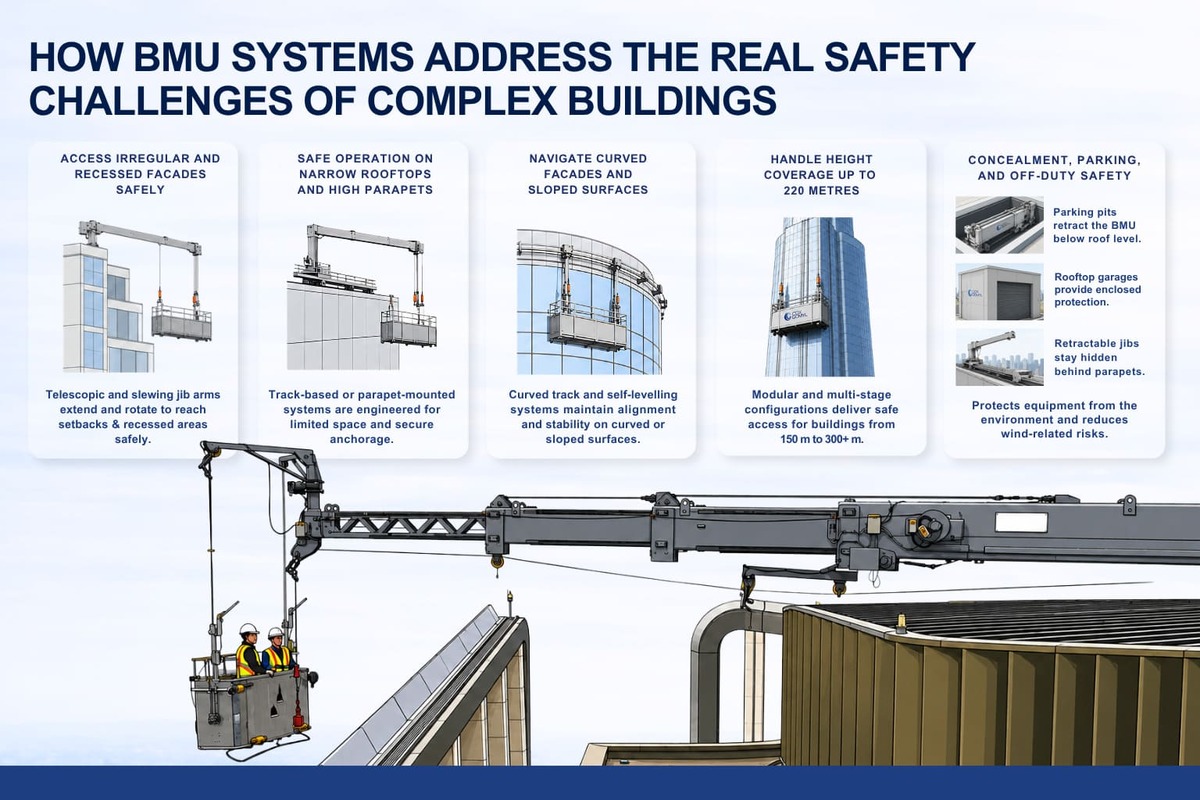
Modern architecture rarely follows simple geometry. Facades often include setbacks, curves, recessed sections, and varying elevations, while rooftops may present limited space or structural constraints. These conditions create access challenges that temporary systems cannot safely handle. A well-designed building maintenance unit safety system addresses these challenges through engineered movement, controlled positioning, and building-specific configuration.
Safety in a BMU system is achieved through multiple layers of protection working together rather than relying on a single feature.
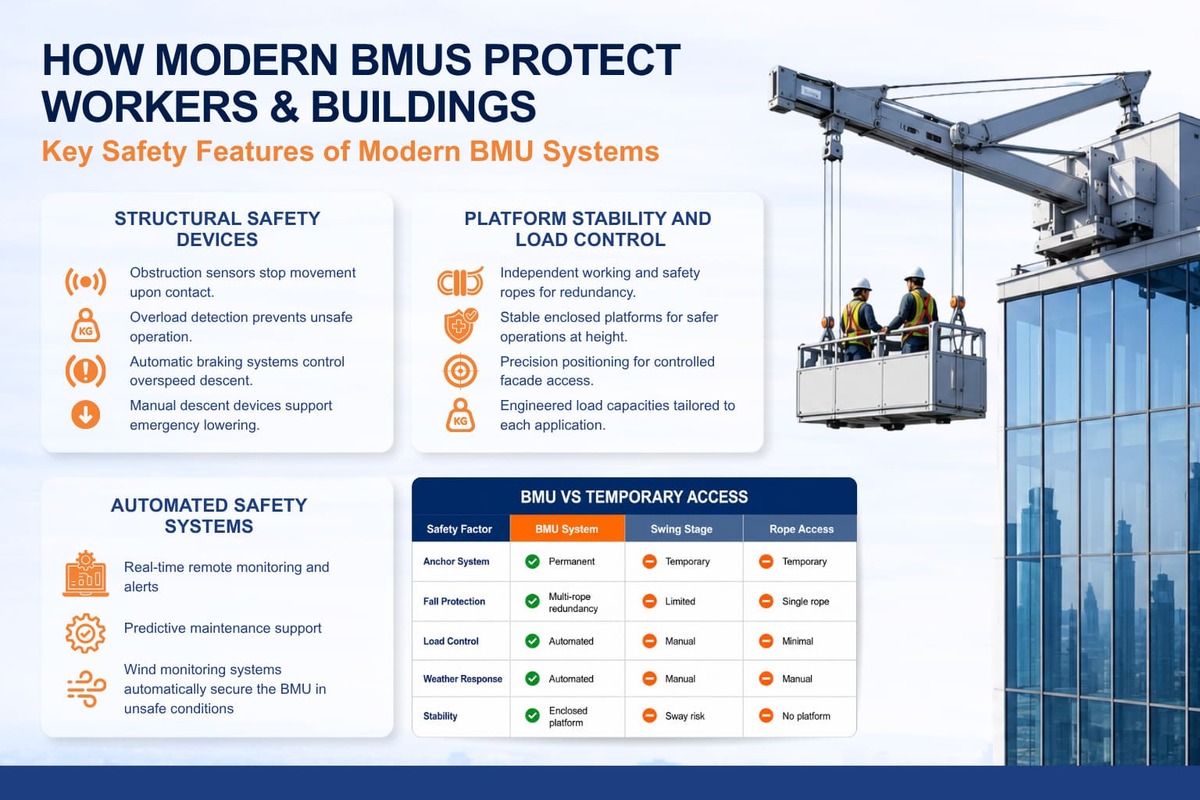
Modern BMU systems incorporate built-in safeguards designed to prevent incidents before they occur. Obstruction sensors detect contact with the facade and immediately stop movement to avoid damage or instability. Overload detection systems prevent operation when the platform exceeds its rated capacity, ensuring that load limits are never compromised. Additional safety mechanisms include centrifugal brakes that activate automatically during overspeed descent and electromagnetic brakes that hold the platform securely in position when not in motion. In the event of a power failure, manual descent devices allow operators to lower the platform safely to ground level.
Platform stability is central to safe operation at height. BMU platforms are suspended using a working rope with an independent secondary safety rope at each suspension point. In twin-suspension configurations, this typically results in four lines. Across Facade Access Solutions systems, rated working loads typically range from 240 kg to 1,000 kg, depending on the application. Rope diameters vary accordingly, ensuring that each system is tailored to its specific requirements. The addition of slewing functionality allows operators to adjust the platform position with precision, maintaining alignment with the facade without needing to reposition the entire system.
Modern BMU systems are defined by their advanced digital capabilities. Remote monitoring allows facilities managers to track system performance in real time, receive alerts, and plan maintenance proactively. Wind monitoring systems add another layer of protection by automatically stopping operation and securing the system when conditions exceed safe limits. This removes reliance on operator judgement during changing weather conditions and ensures a consistent safety response.
While temporary access methods may appear cost-effective initially, they introduce greater long-term safety risks and operational limitations.
| Safety Factor | BMU System | Swing Stage | Rope Access |
|---|---|---|---|
| Anchor System | Permanent, engineered | Temporary rigging | Temporary anchors |
| Fall Protection | Multi-rope redundancy | Limited | Single rope |
| Load Control | Automated | None | Minimal |
| Weather Response | Automated | Manual | Manual |
| Stability | Enclosed platform | Sway risk | No platform |
| Coverage | Full facade | Limited | Limited |
Swing stages rely heavily on manual setup and judgement, while rope access is limited in both load capacity and positioning control, particularly on complex facades. A BMU system provides a stable, enclosed working environment with integrated safety features and consistent performance.
Not every building requires the same solution. The right BMU system depends on height, facade complexity, rooftop configuration, and maintenance requirements. Buildings with standard facades and moderate height can benefit from compact or economical systems that offer reliable access with straightforward installation. More complex structures, particularly those with irregular geometry or significant height, require modular systems that provide greater flexibility and reach. Where architectural appearance is a priority, concealed parking solutions allow the system to remain hidden when not in use. For retrofit projects, structural feasibility assessments are essential to ensure that the building can safely support the system. Facade Access Solutions supports this process through integrated design services, ensuring that each system is engineered to meet both safety and operational requirements.
Facade Access Solutions has delivered more than 16,000 systems worldwide and operates across 39 locations. Its engineering teams support projects globally, including some of the most demanding high-rise developments. Facade access is not a secondary consideration. It is a critical component of building safety and long-term performance. From early design consultation through to installation and ongoing service, Facade Access Solutions provides a complete lifecycle approach to facade access systems. Contact the team to discuss your facade access and safety requirements.
Selecting the correct standard ladder dimensions is not just a design choice. In commercial, industrial, and high-rise environments, it is a critical safety and compliance requirement. Incorrect ladder width, spacing, or configuration can lead to failed inspections, operational delays, and serious risks to workers.
For architects, engineers, and facilities managers, ladder specifications must support a broader building access strategy. This means aligning ladder dimensions with global safety standards, site conditions, and long-term maintenance requirements.
This guide covers ladder width standards, dimensional requirements by ladder type, and how to choose the right ladder system for safe, compliant, and efficient access.
Understanding ladder width standards across regions is essential for ensuring compliance and avoiding redesigns. Many commercial projects require alignment with multiple regulations, particularly in global developments.
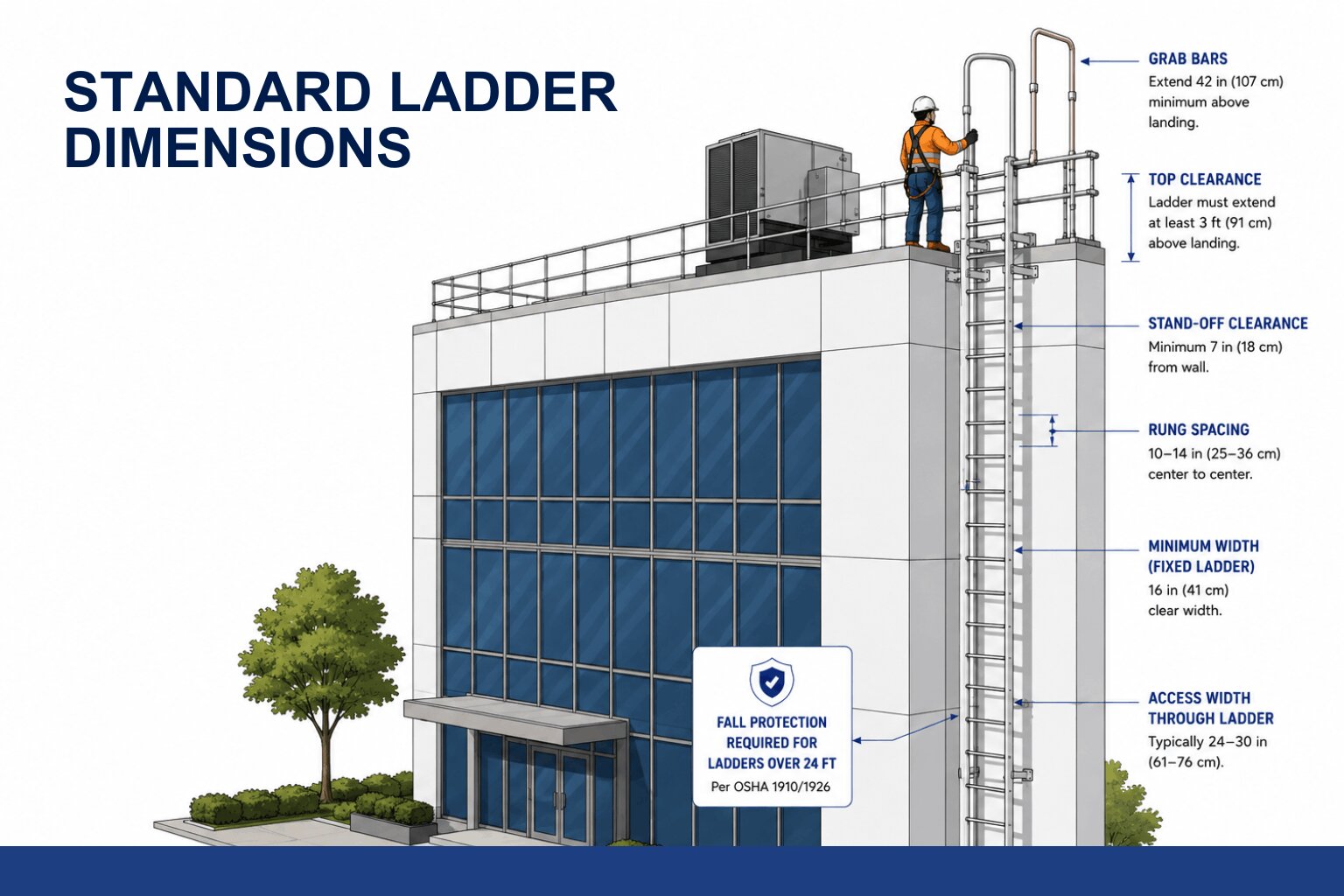
In the United States, OSHA defines the baseline for ladder safety compliance. Fixed ladders must have a minimum clear width of 16 inches (41 cm), while portable ladders must be at least 11.5 inches (29 cm) wide. Updated OSHA regulations also require ladders above 24 feet to include ladder safety systems or personal fall arrest systems. Safety cages are no longer accepted as the sole protection method, and all replacements before 2036 must comply with these updated requirements.
ANSI standards expand on OSHA by defining ladder load ratings and performance classes. Light-duty ladders require a minimum width of 11.5 inches, while heavy-duty applications require 12 inches or more. These classifications directly influence ladder design, durability, and load capacity.
Across Europe, EN 131 introduces usability requirements. Portable ladders must have a minimum width of 280 mm (11 inches), while platform ladders require a minimum standing area of 400 mm (16 inches).
In Australia and New Zealand, AS/NZS 1892 governs ladder design across materials and applications, with requirements varying by ladder type. Other global standards include CSA Z11 in Canada, which aligns with ANSI, and GB/T 17889 in China, which links ladder dimensions to load capacity. In the Middle East, projects typically reference OSHA, EN, or British Standards.
These frameworks show that standard ladder width is not universal. It must be selected based on region, application, and integration with safety systems.
Regulation |
Region |
Portable Ladder Min. Width |
Fixed Ladder Min. Width |
Platform Ladder Min. Width |
| OSHA 1910 / 1926 | United States | 11.5 in (29 cm) | 16 in (41 cm) | 16 in (41 cm) |
| ANSI A14 Series | United States | 11.5 in (29 cm) | 16 in (41 cm) | 12+ in (30+ cm) |
| EN 131 | Europe (EU) | 280 mm (11 in) | Per national annex | 400 mm (16 in) |
| AS/NZS 1892 | Australia / NZ | Verify by type | Per AS/NZS 1892.4 | Verify by type |
| GB/T 17889 | China | Per national standard | Per national standard | Per national standard |
| CSA Z11 | Canada | Similar to ANSI | Similar to ANSI | Similar to ANSI |
While regulations define minimum requirements, selecting the right ladder type ensures safe access, usability, and long-term performance. Each ladder type has specific ladder dimension requirements that must match the working environment.
Step ladders are self-supporting and commonly used for indoor maintenance tasks. Typical step ladder dimensions include a width of 12 to 20 inches and rung spacing between 10 and 12 inches. They are ideal for painting, lighting adjustments, and general facility work where mobility and compact design are essential.
Extension ladders are designed for vertical reach in construction and facade access. Standard extension ladder dimensions range from 14 to 18 inches in width, with rung spacing of 12 inches. For safe use, the ladder must extend at least 3 feet above the landing, follow a 4:1 angle ratio, and be placed on a stable base. These ladders are widely used for roof access, inspections, and temporary facade work.
Fixed ladders are a key component of roof access systems and facade maintenance strategies. Standard fixed ladder dimensions include a minimum width of 16 inches, rung spacing between 10 and 14 inches, at least 7 inches of stand-off clearance, and grab bars extending 42 inches above the landing. Access width through the ladder typically ranges from 24 to 30 inches.
For ladders exceeding 24 feet, fall protection systems are mandatory, and safety cages can no longer be used as the only protection method. These ladders are commonly integrated with BMUs, monorails, and rooftop equipment.
Platform ladders are designed for stability and worker comfort. Standard platform ladder dimensions range from 16 to 22 inches in width, providing a secure standing area for detailed tasks such as electrical work and inspections.
Industrial ladders are built for high-frequency use in demanding environments. Typical industrial ladder dimensions range from 20 to 30 inches in width, allowing for greater stability and load capacity. OSHA requires these ladders to support at least four times their intended load and to include handrails and stable rolling mechanisms.
Multi-position ladders offer flexibility across multiple configurations. Standard multi-position ladder dimensions range from 18 to 24 inches in width, making them suitable for uneven terrain, stairways, and renovation projects.
Ladder Type |
Typical Width |
Rung Spacing |
Height Range |
Load Rating |
Best Applications |
| Step Ladder | 12–20 in | 10–12 in | 4–14 ft | Type II–IA | Interior maintenance, painting |
| Extension Ladder | 14–18 in | 12 in | 16–40 ft | Type I–IA | Roof access, construction |
| Fixed Ladder | 16+ in | 10–14 in | Custom | Custom | Permanent building access |
| Platform Ladder | 16–22 in | 10–12 in | 4–16 ft | Type IA–IAA | Prolonged tasks, electrical work |
| Industrial/Rolling | 20–30 in | ≤10 in rise | 4–20 ft | Type IAA (375+ lbs) | Warehouses, facade maintenance |
| Multi-Position | 18–24 in | 12 in | 6–22 ft | Type IA | Stairways, uneven terrain |
Ladder width directly impacts stability, load capacity, and worker safety. Wider ladders distribute weight more effectively, reducing the risk of tipping in professional environments.
As a general rule, each additional inch of ladder width can increase load capacity by approximately 20 to 30 pounds. For example, a 16-inch ladder rated at 300 pounds offers significantly more stability than a 12-inch ladder rated at 200 pounds. In most commercial applications, a width of around 18 inches is recommended to allow safe movement, especially when workers use tools or wear PPE.
Environmental conditions also influence ladder selection. Wet or corrosive environments require slip-resistant materials, while confined spaces may require narrower ladders supported by additional safety systems.
Choosing the right ladder dimensions depends on application, environment, and frequency of use. In commercial and industrial facilities, wider ladders of 20 inches or more are often preferred for stability and repeated access. In high-rise buildings, fixed ladders typically range from 16 to 20 inches and must integrate with facade access systems.
Ladders exceeding 24 feet must include compliant fall protection systems, while all ladder designs should align with rooftop equipment such as BMUs, davits, and monorails. Construction environments must meet OSHA requirements, while confined spaces may require more compact solutions with additional safety controls.
Ladders are only one element of a complete building access system. They must integrate with fall protection systems, monorails, davits, and facade access equipment to ensure safe and efficient maintenance.
Fixed ladders provide access to rooftops and service areas, while BMUs enable full facade coverage. Proper coordination between these systems improves safety, reduces operational risk, and supports long-term maintenance efficiency.
Early collaboration between architects, engineers, and facade access specialists helps ensure compliance and prevents costly design changes later in the project.
Selecting the correct standard ladder dimensions ensures safe, compliant, and efficient building operations. Every detail, from width and rung spacing to clearance and fall protection, plays a role in long-term performance.
To achieve the best results, project teams should go beyond minimum standards and consider how ladders will be used over time. Integrating ladder systems with complete access solutions ensures better safety, smoother operations, and reduced lifecycle costs.
Facade Access Solutions NAM provides end-to-end expertise in ladder systems, facade access, and integrated building access design.
Contact our team today to discuss your project requirements and ensure full compliance with global ladder standards.
Every commercial and industrial building with rooftop access carries a level of risk. Maintenance teams, inspectors, and contractors rely on safe access to perform their work. Without the right protection in place, even routine tasks can expose workers to serious fall hazards. This is where a well-planned roof guardrail installation becomes essential.
A permanent roof guardrail system is one of the most effective forms of passive fall protection. It does not depend on user behavior. Once installed correctly, it creates a continuous barrier that reduces risk across the rooftop environment. However, not all systems deliver the same results. The difference lies in how the installation is planned, designed, and maintained.
This guide covers the full process, from planning and compliance to installation and maintenance. It also explains how guardrails fit into a broader rooftop safety strategy, where systems such as fall arrest, lifelines, and facade access equipment work together to support safe operations.
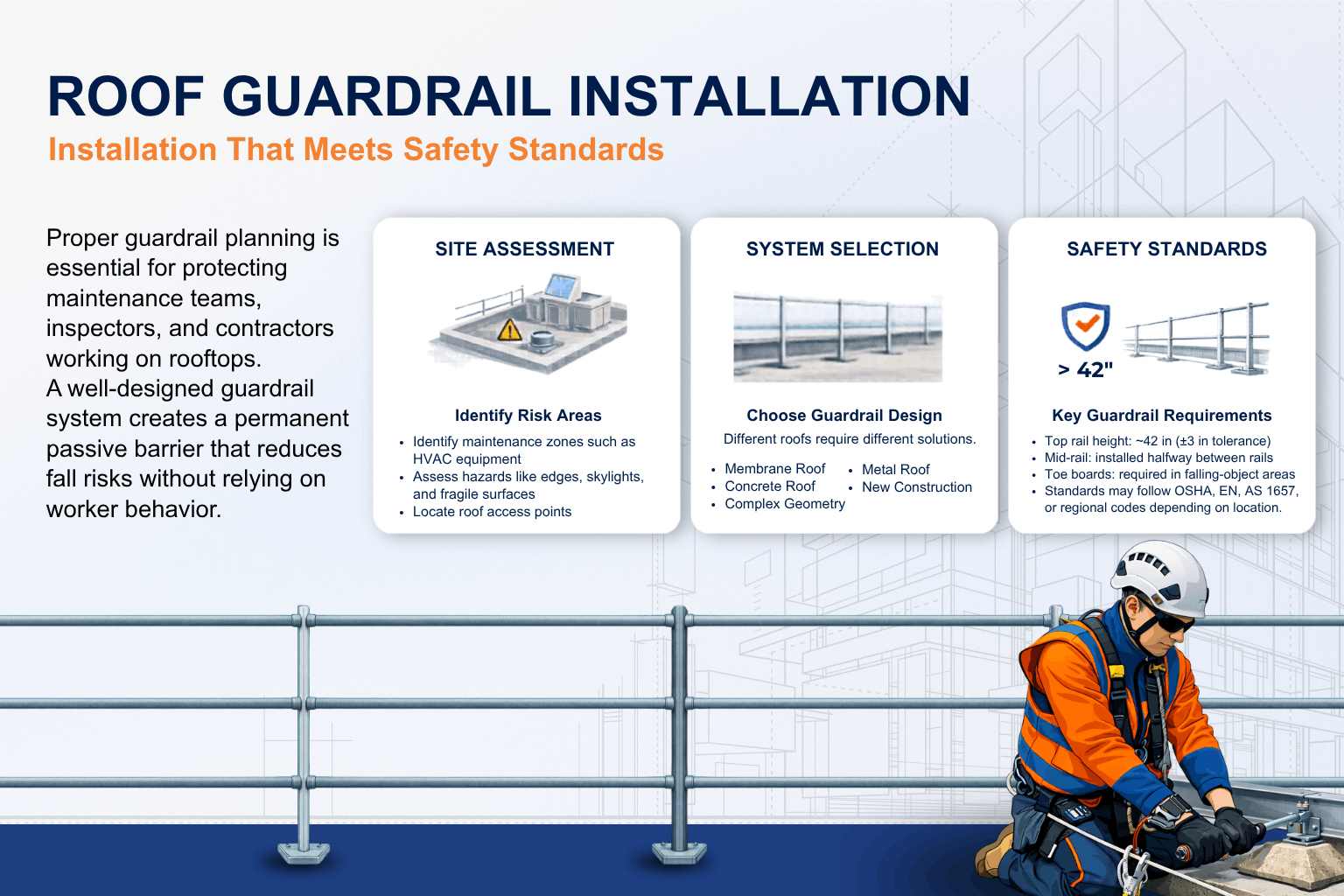
A successful roof guardrail installation begins well before equipment arrives on site. The planning phase determines system performance, compliance, and long-term reliability.
Start with a detailed site assessment. Identify all access points such as ladders, stairwells, and roof hatches. Then locate areas that require regular servicing, including HVAC units and mechanical zones. Mapping worker movement across the roof helps define where protection is most critical.
Next, assess fall hazards. Roof edges are the most obvious risk, but skylights, fragile surfaces, and elevation changes also present danger. Fall hazards at heights of approximately 2 meters (6–6.6 feet) or more must be addressed in accordance with applicable safety standards such as OSHA and EN 13374.
Structural capacity must also be verified. The roof must support the loads imposed by the guardrail system. Freestanding systems rely on counterweights, while fixed systems transfer loads through anchors. A structural engineer should confirm capacity, especially for older buildings.
System selection depends on the roof design. The table below provides a quick reference for choosing the right solution.
Guardrail System Selection by Roof Type
| Roof Type | Recommended System Type | Key Consideration |
|---|---|---|
| Membrane Roof | Freestanding | Protect waterproofing |
| Concrete Roof | Anchored | Strong support |
| Metal Roof | Freestanding/Engineered | Load distribution |
| Complex Geometry | Custom | Engineering required |
| New Construction | Integrated | Plan early |
Compliance is a critical part of any roof guardrail installation. While regulations vary by region, the core safety principles remain consistent.
OSHA standards define clear requirements for guardrail systems:
Globally, several standards govern roof guardrail systems. These include EN 13374, EN 14122-3, AS 1657, and regional building codes. Many Middle East projects follow OSHA or EN standards with local adaptations.
The table below provides a quick comparison across major standards.
Guardrail Requirements by Region
| Requirement | OSHA | EN | IBC | AS 1657 |
|---|---|---|---|---|
| Top Rail | 42 in. | 1.0m | 42 in. | 900–1100mm |
| Mid Rail | Yes | Yes | Yes | Yes |
| Force | 200 lbs | Varies | 200 lbs | Defined |
| Toe Board | 4 in. | Varies | Required | 100mm |
For a more technical comparison, the table below breaks down key design requirements.
Guardrail Design Requirements by Standard
| Feature | OSHA | EN 14122-3 | AS 1657 |
|---|---|---|---|
| Top Rail Height | 42 in. | 1100mm | 900–1100mm |
| Mid Rail | Yes | Yes | Yes |
| Toe Board | 4 in. | Required | 100mm |
| Load | 200 lbs | 0.3 kN | Defined |
Always confirm requirements with the local authority having jurisdiction before installation begins. Working with experienced providers such as Façade Access Solutions can also help ensure that guardrail systems align with both international standards and project-specific compliance requirements.
A structured approach ensures safe and compliant installation. Each stage contributes to the final system performance.
The table below compares the main installation methods.
Guardrail Installation Method Comparison
| Type | Description | Advantage | Limitation |
|---|---|---|---|
| Freestanding | Counterweights | No penetration | Heavy |
| Anchored | Fixed anchors | Secure | Requires drilling |
| Hybrid | Combination | Flexible | Complex |
Maintenance ensures that a roof guardrail system remains safe and compliant over time.
Inspect the system before each use and schedule formal inspections at least once a year. In demanding environments, inspections should be more frequent.
After severe weather, perform additional checks to ensure system stability. Inspect fasteners, look for corrosion, and verify that all components remain properly aligned.
The table below outlines a practical inspection checklist.
Guardrail Inspection Checklist
| Item | Check | Action |
|---|---|---|
| Alignment | Height | Adjust |
| Fasteners | Tightness | Retighten |
| Corrosion | Rust | Treat |
| Anchors | Integrity | Reinforce |
For long-term reliability, many building owners partner with service providers who can support inspections and maintenance. Façade Access Solutions, for example, delivers ongoing service through its global network, helping ensure that guardrail systems and related access equipment remain compliant throughout their lifecycle.
Guardrails are a critical layer of rooftop safety, but they work best as part of a complete system.
Rooftop Safety System Overview
| System | Purpose | Use |
|---|---|---|
| Guardrails | Edge protection | Perimeter |
| Fall Arrest | Personal safety | Complex areas |
| Lifelines | Movement | Large roofs |
| Davits | Suspended access | Facade work |
| BMUs | Full access | High-rise |
In areas where guardrails cannot be installed, fall arrest systems provide essential protection. These often include anchor points and personal safety equipment designed to secure workers during specific tasks.
Lifeline systems allow safe movement across large roof areas, while davit systems provide support for suspended platforms used in facade cleaning and inspection. Monorail systems enable equipment movement across the roof, improving operational efficiency.
For mid-rise and high-rise buildings, BMUs remain the primary solution for full facade access. Systems developed by brands such as CoxGomyl and Manntech are designed to operate alongside guardrails, lifelines, and anchors, creating a fully integrated rooftop safety environment.
A reliable roof guardrail installation depends on proper planning, compliance with safety standards, and careful execution. Each stage plays a role in ensuring long-term performance.
Guardrails should not be treated as a standalone solution. They must be part of a broader safety strategy that includes fall arrest systems, lifelines, and facade access equipment. When these systems are designed together, they create a safer and more efficient working environment.
Façade Access Solutions provides end-to-end support, from design consultation to installation and maintenance. With thousands of systems installed worldwide, their team brings the expertise needed to deliver compliant and durable solutions across a wide range of building types.
If you are planning a new project or upgrading an existing system, now is the time to act. A well-designed roof guardrail system protects people, reduces risk, and supports long-term building performance.
Work at height introduces dynamic risk conditions that must be addressed through engineered control measures. Within modern building design, fall arrest systems form part of permanent life safety infrastructure rather than temporary accessories. They are integrated into roof zones, façade access strategies, and maintenance planning to support long-term operational safety.
For structural engineers, façade consultants, and asset owners, the objective is not simply to define fall arrest but to understand how it performs under dynamic loading. Effective systems must manage energy transfer, maintain structural integrity, satisfy clearance geometry, and align with global regulatory frameworks.
Fall arrest is therefore best described as a performance-driven interface between user and structure, embedded within broader façade access and maintenance strategies.
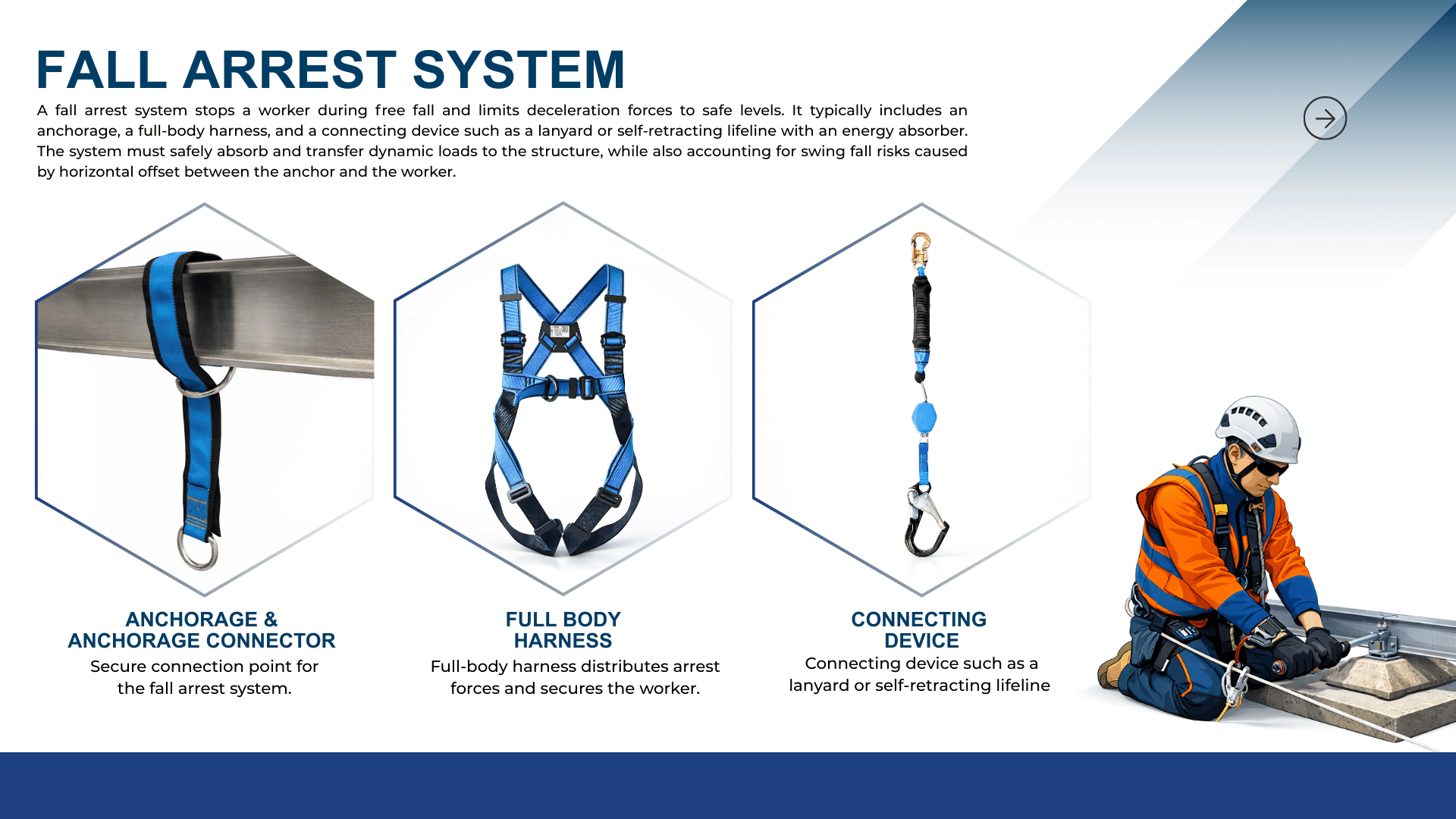
A fall arrest system is designed to stop a worker who has entered free fall and limit deceleration forces to survivable thresholds
A typical system includes:
The defining condition is the dynamic load event. The system must absorb and transfer energy safely into the structure without exceeding allowable force limits.
Swing fall must also be evaluated. Horizontal offset between anchor and user creates pendulum effects that may result in worker hitting the ground, side structures or severed suspension line due to abrasion against top edge of structure.
Early coordination with façade interfaces, waterproofing layers, and insulation systems ensures permanent integration without compromising envelope integrity.
Accurate clearance calculation is fundamental to safe design.
Fall Clearance = Lanyard Length + Deceleration Distance + Line Stretch + Worker Height + Safety Factor
Where:
Mounting height directly influences free fall distance. Self-retracting lifelines typically reduce free fall compared to fixed lanyards.
Fall arrest systems must comply with regulations in the jurisdiction of installation. Regulatory frameworks establish minimum performance thresholds, while engineering best practice frequently exceeds them.
Common global regulatory families include:
Region |
Primary Regulatory Framework |
| United States | Occupational Safety and Health Administration, American National Standards Institute |
| Canada | CSA Group |
| Europe | EN Standards |
| United Kingdom | BS Standards |
| Australia / New Zealand | AS/NZS Standards |
| Asia / Middle East | Local OHS frameworks often aligned with EN or BS |
Compliance ensures baseline safety. However, structural integration, multi-user loading verification, and façade coordination require performance-driven engineering beyond minimum code thresholds.
Permanent fall arrest systems must be integrated into the building envelope, not retrofitted as isolated attachments. Structural continuity, façade coordination, and long-term asset management planning are essential.
Effective systems:
When engineered as part of an integrated façade access strategy, fall arrest becomes a structural safety interface that protects both personnel and the asset lifecycle.
Permanent fall arrest systems require coordinated structural design, façade integration, and regulatory alignment.
Facade Access Solutions provides engineering-driven consultancy and equipment integration for permanent access and fall arrest systems across complex building typologies.
Contact our technical team to evaluate your project requirements and develop a performance-based solution aligned with structural and operational objectives.
Tractel Ltd., part of Alimak Group’s Infrastructure Access Solutions, is proud to announce it has signed its first Subcontract Order with Aecon Nuclear, a division of Aecon Construction Group Inc., in support of the Darlington New Nuclear Project (DNNP).
Construction is now underway on the first of four planned Small Modular Reactors (SMR) at the DNNP site, adjacent to the Darlington Nuclear Generating Station in Ontario. This will be the first commercial grid-scale SMR in the G7.
Under this subcontract, Tractel will support Aecon during the construction phase by delivering specialized Access Solutions and custom-designed Special Tooling. Leveraging decades of expertise in infrastructure and façade access solutions, our team will help ensure the highest standards of safety and efficiency on this critical project.
“We are honored to contribute to the Darlington SMR project and to partner with Aecon Nuclear on the delivery of innovative access solutions,” said Hervé Ros, Executive Vice President – Façade Access Solutions. “As a local Canadian partner backed by global experience, we are proud to play a role in advancing the deployment of next-generation nuclear technology in Canada.
“The DNNP will play a significant role in meeting Ontario’s growing clean energy needs. Our team is committed to supporting Aecon Nuclear in delivering projects that help drive the transition to a more sustainable energy future.”
A fit for purpose, facade access system offers a significant advantage by enhancing the value of a building. Keeping the building facade well-maintained and free from dirt, debris and hazards makes it more appealing to potential tenants and buyers. This increased attractiveness contributes to a higher perceived value of the building, making it a desirable investment or occupancy opportunity. A well-maintained facade can also increase the overall curb appeal of the building, which can positively impact the surrounding neighbourhood and property values.
Facade Access Solutions’ facade access systems assist in the long-term preservation of commercial and residential buildings worldwide. Not only do our facade access solutions enable the regular cleaning of large and complex building structures, they also provide a means of enhanced safety access for maintenance and repairs, which allows our clients to safeguard their investments.
Regarding safety, investing in a suitable building maintenance unit (BMU) over relying on abseilers is key. Using a BMU significantly reduces the risk of falls and accidentally dropping cleaning equipment, which could result in safety risks for pedestrians below. Additionally, abseilers are more vulnerable to sudden weather changes and lack the protective measures offered by a building maintenance unit.
At Facade Access Solutions, our facade access systems are designed with maximum safety in mind. Facade Access Solutions’ building maintenance units rely on precise engineering, rigorously tested safety equipment, and qualified workers to ensure the safe and effective execution of all maintenance procedures.
A facade access system can help reduce long-term maintenance and repair costs by identifying potential problems before they become major issues. Regular inspections and maintenance of the building facade can help identify and address issues such as water damage, cracks, and other forms of deterioration, which can help prevent costly repairs and replacements down the line.
In addition to providing our clients with the installation of facade access systems that allow for regular repairs and maintenance on their structures, Facade Access Solutions also offers prompt and effective repairs and maintenance services for our systems. This includes quickly responding to short-notice and emergency callouts, ensuring efficient operation and reliability of our systems.
A facade access system can help building owners and managers comply with regulatory requirements and avoid potential legal issues. Building owners can avoid potential liability issues and fines associated with non-compliance with safety regulations by ensuring that the building facade is well-maintained and free from hazards.
At Facade Access Solutions, we offer a range of inspection programs to support the safe operation of our facade access systems. We also work closely with organisations across multiple industries to promote best practices around inspecting and safely operating facade access equipment.
Facade access design often deals with how access systems will impact a commercial building’s exterior aesthetics, but during
the early stages of a construction project, owners, developers, architects, and other stakeholders also need to consider
functional requirements. These can include the space needed for access equipment to launch and, more importantly, how
operable an artistic design is for the access systems that may attach or be built into it.
Failing to consider facade access functionality at the beginning stage can lead to costly solutions later, which is why it’s a vital
topic to discuss early on. These conversations can also be much more successful when you invite Integrated Design Services
(IDS) consultants from Facade Access NAM to the table.
IDS consultants are experts who can balance architects’ and clients’ aesthetic concerns, as well as the safety managers’
cautionary and regulatory compliance needs, all while staying cognizant of the nuances various types of contractors (e.g.
facade repair, curtain wall, and commercial glass contractors) will face when completing their work.
To help you share with your teams why contacting IDS consultants is essential to design-stage discussions, we’ll walk you
through how our experts can facilitate custom commercial facade access solutions that are both effective and appealing.
Historically, facade access systems became more necessary when buildings began incorporating glass more and more as a
large-scale material. That’s why building design now needs to accommodate the functional and safety needs of curtain wall
contractors, commercial glass and glazing contractors, and facade repair contractors.
When you work with a facade access design team like Facade Access IDS experts in those early days, we can arrive at
conversations already understanding contractors’ functional needs, which can include (but are not limited to):
In addition to facade access functionality, these contractors also need to know the systems they’re working with are safe.
Organizations like OSHA and CCCOHS have fall protection regulations to ensure these safeties are present on job sites, and
building project teams should always evaluate their plans to ensure compliance.
Your team should also consider working with experts like Facade Access IDS consultants. When contacted at the design
stage, we can be your resource for both all regulatory information you need to know, and for custom access solutions built
with equipment that makes compliance part of your commercial building’s DNA.
The most successful commercial facade access solutions blend form and function seamlessly together. For architects, this
means a solution that delivers on all of the following:
Together, these qualities ensure that architects can achieve their goals of innovatively pushing artistic boundaries. When your
team contacts Facade Access IDS professionals, we can empower you and your architectural partners develop custom facade
access design solutions that achieve functional and safety needs without sacrificing your creative vision.
When you and your building’s project team integrate facade maintenance systems at the initial design stage, you demonstrate
a forward-thinking and strategic mindset capable of balancing the artistic, functional, and regulatory requirements such an
undertaking requires. By embracing this approach with the help of proven experts in facade access functionality and design,
you also make your end product exponentially more successful.
For years, Facade Access NAM has been at the forefront of custom solutions for complex commercial needs. This includes
facade access for both standard and unusual structures, and it’s why our team of Integrated Design Solutions consultants can
be the ideal resource to help you bring your creative vision to life while maintaining compliance and operational excellence.
To ensure your building’s facade is not only accessible and safe, but also maintained to the highest standards, contact us and
begin a conversation about your commercial facade access project with our expert consultants.