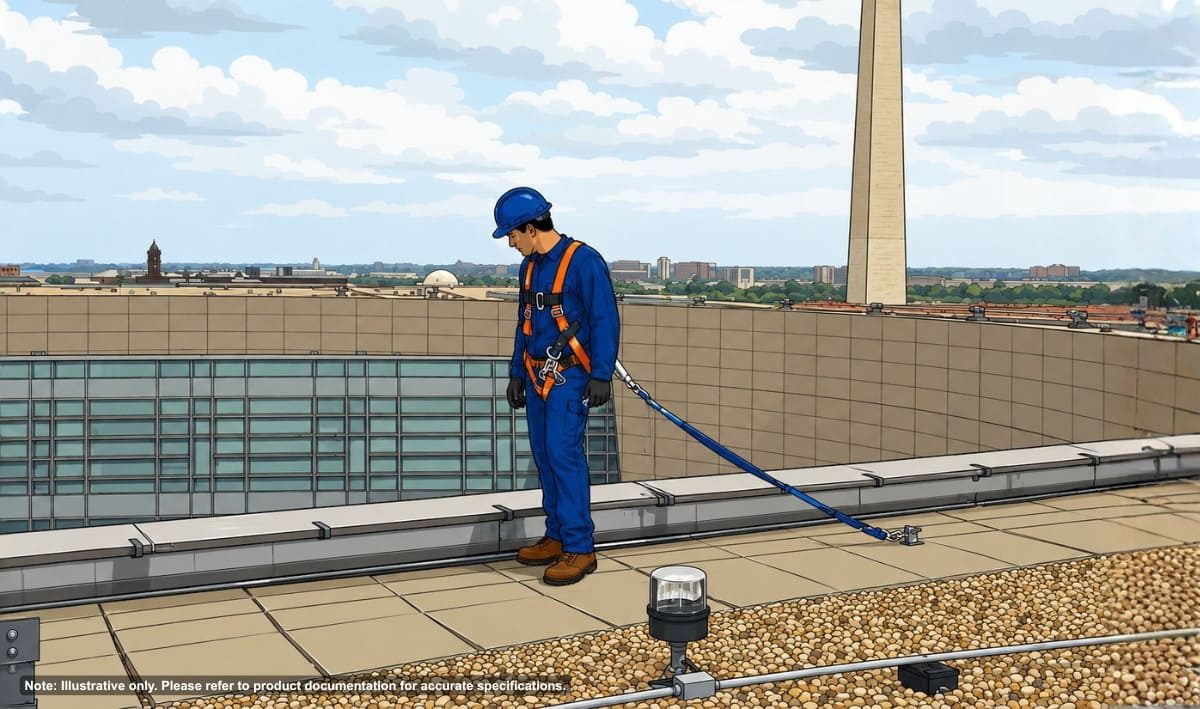
Working on a suspended platform several storeys above ground leaves no margin for error. When fall protection is poorly specified, the risk is immediate for building maintenance personnel operating at height. In facade access, safety is more layered than general construction. It relies on permanent engineered systems, not just PPE used on the day. This guide is written for architects, facade consultants, developers, and facilities managers responsible for safe access. It explores the core fall protection types used in facade maintenance and how they extend into specialized systems such as tieback anchors, horizontal lifelines, stabilization anchors, and permanent rooftop access infrastructure.
A fall protection system is a coordinated combination of engineered equipment, structural components, and operational procedures designed to prevent or control falls from height. In a building maintenance environment, fall protection extends far beyond harnesses and lanyards. It includes permanent anchor systems, horizontal lifelines, rooftop traversal systems, stabilization equipment, and integrated facade access solutions working together to create a controlled and compliant maintenance environment. The right system depends on the building height, facade geometry, maintenance frequency, worker access routes, and regional safety regulations. High-rise buildings rarely rely on a single solution. Most require multiple engineered systems working together across different areas of the structure.
Fall protection requirements vary by region and building type. There is no single global threshold governing all facade access work. In the United States, OSHA requires fall protection at 4 ft for general industry and 6 ft for construction environments. In the United Kingdom, the Work at Height Regulations 2005 apply at any height where injury could occur. Similar obligations exist across Europe, the Middle East, Singapore, Australia, and other APAC markets.
For high-rise facade maintenance, most jurisdictions require permanent engineered systems once buildings exceed approximately 130 ft or 40 m, although some regions apply different benchmarks depending on facade configuration, maintenance method, and local code interpretation. Regional regulations also influence how anchors, lifelines, suspended platforms, and access systems must be certified and inspected.
| Region | Regulatory Body | Standard / Code | Application |
|---|---|---|---|
| United States | OSHA | 29 CFR 1926.502 / 1910.28 | Construction and general industry rooftop / at-height work |
| United States | ANSI | ANSI Z359 Series | Personal fall arrest and restraint systems |
| United Kingdom | HSE | Work at Height Regulations 2005 | All work at height including facade maintenance |
| European Union | CEN | EN 363 / EN 365 | Personal fall protection systems and inspection intervals |
| Germany | DGUV | DGUV Regulation 38 / BGR 198 | Use of PPE against falls |
| France | INRS / Labour Code | Code du Travail R.4323-58 to R.4323-94 | Collective and individual fall protection |
| Netherlands | SZW / NEN | NEN-EN 363 / Arbeidsomstandighedenbesluit | Personal fall protection and platform safety |
| UAE / Dubai | Dubai Municipality | Dubai Building Code / GSO Standards | High-rise facade access and worker safety |
| Australia / NZ | Safe Work Australia | AS/NZS 1891 Series | Industrial fall arrest and horizontal lifeline systems |
| Singapore / APAC | MOM Singapore | WSH Regulations 2013 | Working at height and anchor certification |
| Canada | CSA Group | CSA Z259 Series | Fall arrest, travel restraint, and horizontal lifeline systems |
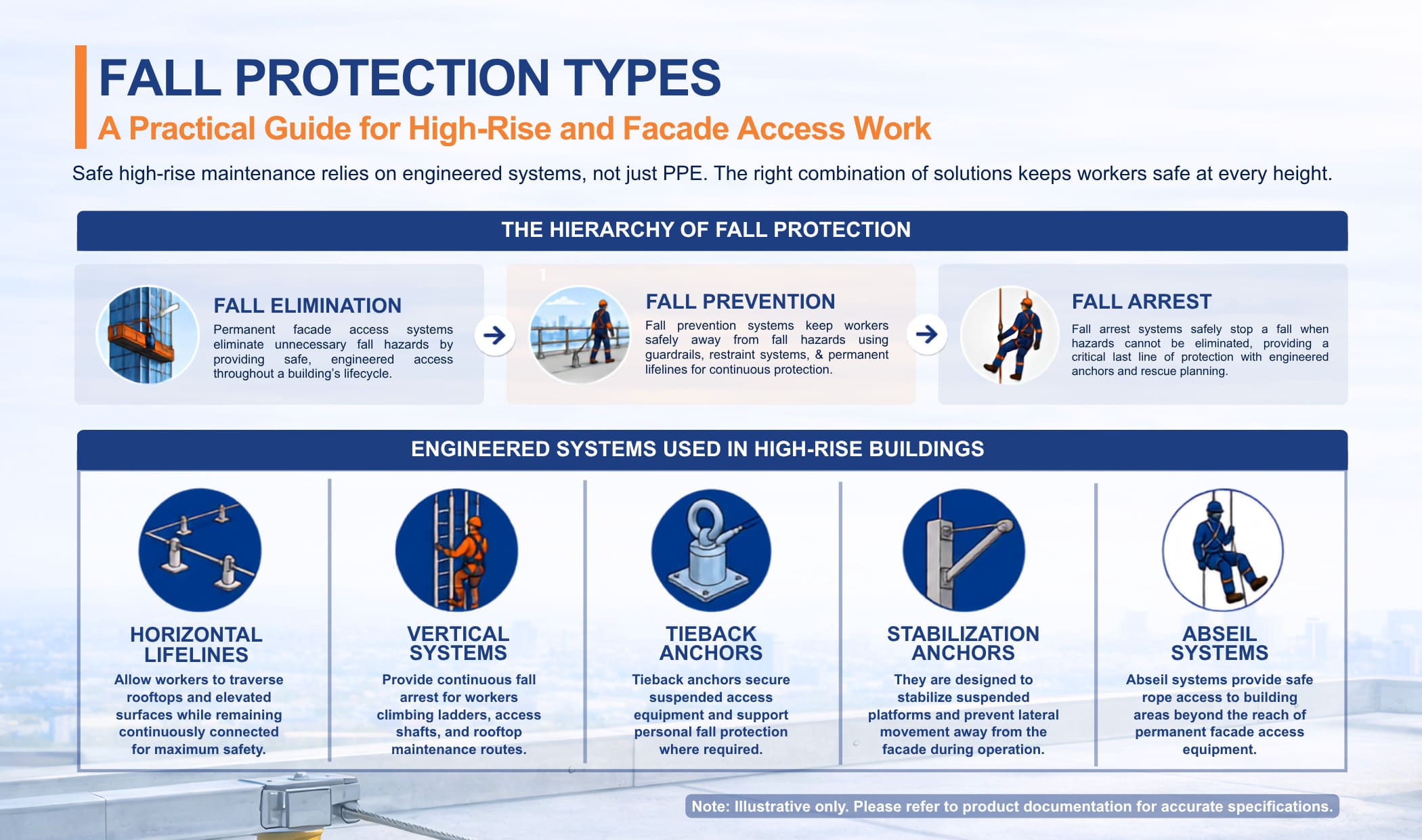
Fall protection follows a clear hierarchy used across OSHA, ISO, and EN safety frameworks. The safest approach is to eliminate the hazard first, prevent falls second, and rely on fall arrest only as a final layer of protection. In facade access, this hierarchy is integrated directly into the building design process. A properly engineered BMU system or permanent anchor network reduces dependence on last-resort fall arrest equipment while improving long-term maintenance safety.
Fall elimination removes the need for workers to be exposed to fall hazards in the first place. In facade access, this is achieved by integrating permanent systems such as Building Maintenance Units (BMUs), monorail systems, or engineered access platforms directly into the building design. These systems allow maintenance personnel to operate from stable, controlled working platforms instead of relying on temporary suspended platforms, improvised access methods, or extensive rope access operations.
Permanent facade access systems reduce repeated setup activities, minimize rooftop worker exposure, and create more predictable maintenance procedures throughout the building lifecycle. They also improve operational consistency by providing controlled positioning, engineered load paths, and repeatable access routes for maintenance teams. This level of fall elimination is most effective when considered during schematic design and structural planning. Retrofitting permanent systems after construction is significantly more complex and costly because anchor locations, roof loading requirements, and facade access routes may already be constrained. This is where partnering with Facade Access Solutions during the design phase through Integrated Design Services delivers the most value.
Fall prevention systems keep workers away from hazards or physically prevent them from reaching an exposed edge. In facade and rooftop environments, this includes guardrails, parapet systems, travel restraint systems, and permanent horizontal lifeline systems. Guardrails and parapet protection provide passive collective safety that does not rely heavily on operator interaction. Travel restraint systems use harnesses and fixed-length lanyards to prevent workers from physically reaching a fall edge. Horizontal lifeline systems allow workers to move laterally across rooftops while remaining continuously connected throughout the travel path.
Permanent rooftop lifeline systems are especially important on large podium roofs, setback towers, curved facades, and buildings with distributed maintenance zones. Continuous connection reduces the need for repeated disconnect and reconnect events, which are common sources of worker exposure. Travsafe is an example of a dual wire rope horizontal lifeline system engineered specifically for rooftop traversal. The system can incorporate curves, corners, and hands-free pass-through sections that support complex rooftop layouts commonly found on modern high-rise buildings. Tieback anchors form the foundation of these systems by supporting the lifeline infrastructure itself, not just an individual worker’s lanyard.
Fall arrest systems are used when exposure to a fall hazard cannot be fully eliminated or prevented. Unlike prevention systems, fall arrest does not stop the fall from occurring. Instead, it safely arrests the worker after the fall begins while limiting impact force and fall distance. A typical Personal Fall Arrest System (PFAS) includes a full-body harness, a connecting lanyard or self-retracting lifeline (SRL), and a certified anchor point. Depending on the application, systems may also incorporate vertical rope grabs, rail-guided fall arresters, or safety nets beneath work areas.
In facade maintenance, fall arrest systems should never replace a properly engineered permanent access solution. They act as a secondary layer of protection for technicians operating outside the primary coverage area of BMUs, suspended platforms, or rooftop access systems. Once a fall arrest event occurs, rescue planning becomes critical. Suspended workers may face suspension trauma if retrieval is delayed. This is particularly important in facade access where workers may remain suspended several storeys above ground until rescue personnel arrive. Because dynamic fall arrest loads can place substantial force on anchors and supporting structures, all permanent fall arrest systems must be engineered and certified to applicable regional standards.
In facade access and high-rise building maintenance, the three core fall protection types expand into engineered systems designed for complex building geometries and long-term maintenance operations. These systems are not alternatives to elimination, prevention, or arrest. They are the components through which those principles are implemented across rooftops, vertical access routes, suspended platforms, and facade maintenance zones.
Horizontal lifeline systems allow workers to traverse rooftops and elevated surfaces while remaining continuously connected across the entire travel path. These systems are commonly used on large rooftops, setback terraces, mechanical zones, podium structures, and buildings where maintenance personnel must move between multiple service locations.
Permanent systems such as Travsafe use dual wire rope configurations to provide redundancy and operational reliability. Modern systems can integrate curves, corners, intermediate supports, and hands-free pass-through functionality that reduces disconnect events during movement. Continuous tie-off is particularly important on high-rise rooftops where repeated reconnection increases worker exposure. Horizontal lifeline systems are commonly governed by EN 795 in Europe and ANSI Z359 and CSA Z259 standards across North America.
Vertical fall protection systems are used on ladders, access shafts, building risers, and rooftop access routes where workers move vertically through the structure. These systems typically consist of a fixed rail or cable connected to a travelling fall arrester that locks automatically during a fall event.
In facade access applications, vertical systems are frequently integrated into rolling ladders, BMU service ladders, machinery access zones, and rooftop maintenance routes. Unlike travel restraint systems, workers using vertical systems remain in a continuous fall arrest condition because fall exposure exists throughout the climb. Modern systems may use rail-guided or cable-guided fall arresters depending on the building layout and maintenance requirements.
Anchor systems form the foundation of every permanent fall protection strategy. Every horizontal lifeline, suspended access platform, personal fall arrest system, and rooftop restraint system ultimately depends on certified anchor infrastructure integrated into the building structure. Tieback anchors serve multiple functions in facade access operations. They secure suspended access equipment such as outriggers and bosun chairs while also supporting personal fall protection systems where permitted by code and engineering requirements.
These anchors are available in several configurations:
Stabilization anchors, also known as intermittent stabilization anchors (ISAs), serve a different purpose. They are designed to stabilize suspended platforms and prevent lateral movement away from the facade during operation. On buildings exceeding approximately 130 ft or 40 m, stabilization systems are commonly required by OSHA and related regional standards. The first stabilization anchor is typically installed within 50 ft of the roof level, with additional anchors positioned at defined intervals down the building facade.
Anchor systems must be engineered and certified to applicable regional standards, including OSHA, ANSI, CSA requirements, EN 795, and equivalent local codes. Depending on the application and system type, anchors are commonly designed around minimum 5,000 lb load criteria or equivalent engineered performance requirements. Facade Access Solutions supplies roof tieback anchors, stabilization anchors, and engineered lifeline systems designed for compliance across North America, Europe, the Middle East, and APAC markets.
All anchor systems must comply with applicable regional standards including OSHA, ANSI, CSA, and EN 795 requirements depending on project location and application.
| Anchor Type | Mounting Style | Common Application |
|---|---|---|
| Roof Tieback | Surface-mounted to roof deck | Securing outriggers, suspended access equipment, and lifelines |
| Flush Tieback | Recessed or flush with roof finish | High-traffic or visually sensitive rooftops |
| Wall-Mounted Tieback | Fixed to vertical facade | Conditions where roof mounting is not feasible |
Abseil systems are used when primary facade access equipment cannot safely reach specific building areas. In these situations, trained rope access technicians descend from certified rooftop anchor systems using controlled abseil techniques. Abseil systems are commonly used for:
In most markets, rope access personnel must hold certification under IRATA or equivalent rope access standards. The supporting anchor systems must also be independently engineered and certified. For high-rise buildings requiring regular maintenance, abseil systems are typically used as a complementary access solution rather than a replacement for permanent facade access infrastructure.
Selecting the right fall protection strategy for a high-rise building is not simply a product decision. It is an engineering and lifecycle planning decision that should happen early in the project development process. Systems specified too late often result in structural retrofits, facade coordination conflicts, operational inefficiencies, and long-term compliance risk. For architects, facade consultants, developers, and facilities managers, the goal is not only to achieve compliance. The system must also support safe, repeatable, and cost-effective maintenance throughout the building lifecycle.
Before specifying any permanent or temporary fall protection solution, project teams should evaluate the following factors.
| Factor | What to Assess | Why It Matters |
|---|---|---|
| Building height | Height above ground, parapet configuration, number of storeys | Determines regulatory thresholds and permanent system requirements |
| Facade geometry | Curves, setbacks, recesses, overhangs, glazing systems | Impacts access strategy and anchor placement |
| Access frequency | Daily cleaning, scheduled maintenance, emergency access | Influences investment in permanent systems |
| Worker roles | Operators, maintenance teams, rope access specialists | Defines training and equipment certification requirements |
| Regional regulation | OSHA, HSE, DGUV, Dubai Code, WSH, AS/NZS | Determines legal compliance obligations |
Permanent fall protection systems are engineered directly into the building structure and are intended for ongoing facade maintenance operations. These systems provide long-term operational consistency, lower lifecycle risk, and improved maintenance efficiency. Although they involve higher upfront investment, permanent systems reduce reliance on temporary PPE-based workflows and support better regulatory compliance over the building lifespan. Temporary systems are more appropriate for short-duration work, isolated repairs, emergency access, or supplementary protection. These systems rely heavily on correct operator use and ongoing procedural compliance.
For high-rise buildings with regular maintenance requirements, long-term dependence on temporary solutions can increase operational risk, liability exposure, and insurance concerns. Modern building codes and insurance requirements increasingly favor integrated permanent facade access and rooftop fall protection systems for complex high-rise projects.
Buildings that integrate facade access and fall protection planning during schematic design avoid many of the structural and operational compromises that emerge later in construction. Early coordination allows anchor locations, rooftop traversal systems, BMU tracks, and maintenance routes to be integrated cleanly into the architecture and structural framework.
This approach improves:
Facade access specialists can work alongside architects and engineers to develop systems that remain largely invisible in the finished building while still providing fully functional maintenance access. Engaging Facade Access Solutions during the design phase allows project teams to coordinate permanent access infrastructure before structural constraints limit available options.
Fall protection in facade access extends far beyond harnesses and portable PPE. Safe high-rise maintenance depends on coordinated permanent systems that combine engineered anchors, lifelines, suspended access equipment, rooftop traversal infrastructure, and operational planning. As buildings become taller and facade geometry becomes more complex, early-stage integration of permanent fall protection systems is becoming increasingly important for compliance, operational efficiency, and worker safety.
Properly engineered systems reduce long-term maintenance risk, improve rooftop accessibility, and support safer building operations throughout the structure’s lifecycle. Facade Access Solutions works with architects, consultants, developers, and facilities teams to engineer permanent facade access and fall protection systems tailored to complex high-rise environments.
Disclaimer: Graphics shown are illustrative only and do not represent actual products, equipment, or real-life conditions.
Speak with our specialists to explore the right solution for your building.
ContactFall prevention systems stop workers from reaching a fall hazard in the first place. Examples include guardrails, travel restraint systems, and rooftop lifeline systems designed to limit exposure. Fall arrest systems allow exposure to occur but safely stop the worker after a fall begins. These systems typically include a harness, connecting device, and certified anchor point.
Requirements vary by jurisdiction. OSHA thresholds begin at 4 ft for general industry and 6 ft for construction. For high-rise facade maintenance, permanent engineered systems are commonly required once buildings exceed approximately 130 ft or 40 m, although regional variations apply.
Yes. Many tieback anchors are engineered to support both suspended access equipment restraint and personal fall protection applications where permitted by code and engineering design. However, anchor certification requirements vary depending on whether the system supports equipment stabilization, fall arrest, or worker restraint.
A horizontal lifeline system is a cable-based safety system that allows workers to move laterally across rooftops or elevated surfaces while remaining continuously connected. These systems are commonly used on high-rise rooftops, setback terraces, podium structures, and maintenance routes where workers must traverse large areas safely.
Inspection frequency depends on regional regulations, manufacturer requirements, and usage conditions. Workers should perform visual checks before each use, while formal inspections should be completed periodically by qualified personnel. Most permanent systems also require documented annual inspections to maintain regulatory compliance and operational safety.