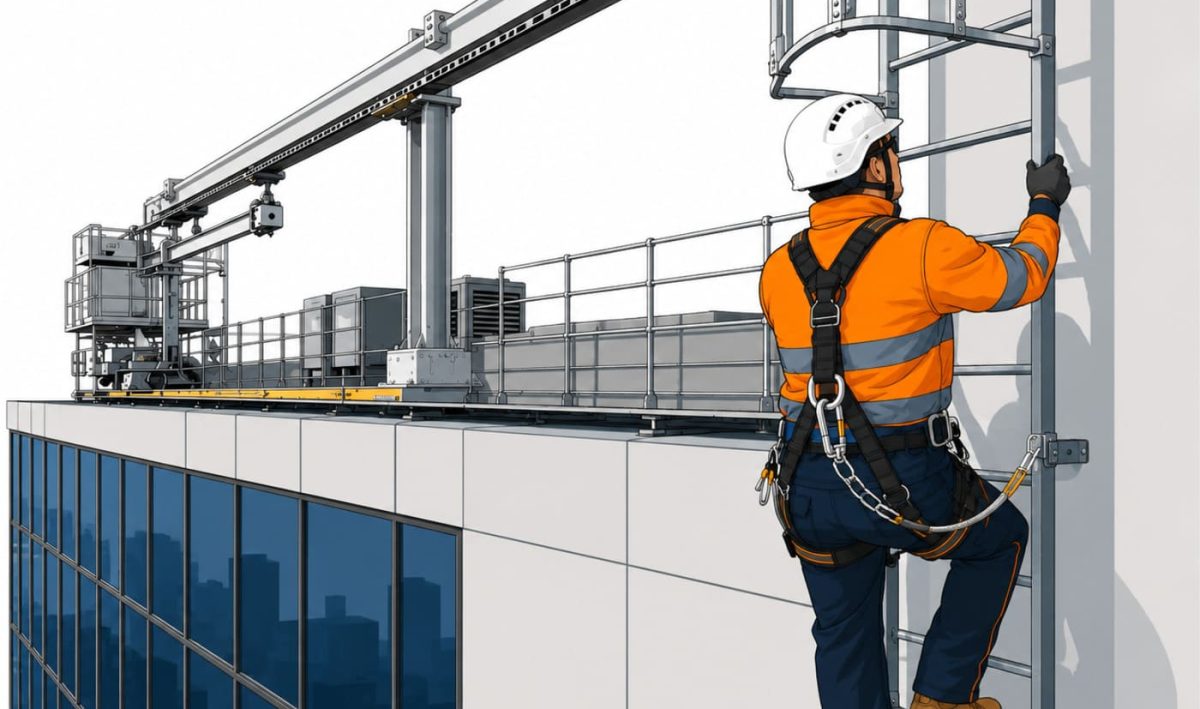
Selecting the correct standard ladder dimensions is not just a design choice. In commercial, industrial, and high-rise environments, it is a critical safety and compliance requirement. Incorrect ladder width, spacing, or configuration can lead to failed inspections, operational delays, and serious risks to workers.
For architects, engineers, and facilities managers, ladder specifications must support a broader building access strategy. This means aligning ladder dimensions with global safety standards, site conditions, and long-term maintenance requirements.
This guide covers ladder width standards, dimensional requirements by ladder type, and how to choose the right ladder system for safe, compliant, and efficient access.
Understanding ladder width standards across regions is essential for ensuring compliance and avoiding redesigns. Many commercial projects require alignment with multiple regulations, particularly in global developments.
In the United States, OSHA defines the baseline for ladder safety compliance. Fixed ladders must have a minimum clear width of 16 inches (41 cm), while portable ladders must be at least 11.5 inches (29 cm) wide. Updated OSHA regulations also require ladders above 24 feet to include ladder safety systems or personal fall arrest systems. Safety cages are no longer accepted as the sole protection method, and all replacements before 2036 must comply with these updated requirements.
ANSI standards expand on OSHA by defining ladder load ratings and performance classes. Light-duty ladders require a minimum width of 11.5 inches, while heavy-duty applications require 12 inches or more. These classifications directly influence ladder design, durability, and load capacity.
Across Europe, EN 131 introduces usability requirements. Portable ladders must have a minimum width of 280 mm (11 inches), while platform ladders require a minimum standing area of 400 mm (16 inches).
In Australia and New Zealand, AS/NZS 1892 governs ladder design across materials and applications, with requirements varying by ladder type. Other global standards include CSA Z11 in Canada, which aligns with ANSI, and GB/T 17889 in China, which links ladder dimensions to load capacity. In the Middle East, projects typically reference OSHA, EN, or British Standards.
These frameworks show that standard ladder width is not universal. It must be selected based on region, application, and integration with safety systems.
Regulation |
Region |
Portable Ladder Min. Width |
Fixed Ladder Min. Width |
Platform Ladder Min. Width |
| OSHA 1910 / 1926 | United States | 11.5 in (29 cm) | 16 in (41 cm) | 16 in (41 cm) |
| ANSI A14 Series | United States | 11.5 in (29 cm) | 16 in (41 cm) | 12+ in (30+ cm) |
| EN 131 | Europe (EU) | 280 mm (11 in) | Per national annex | 400 mm (16 in) |
| AS/NZS 1892 | Australia / NZ | Verify by type | Per AS/NZS 1892.4 | Verify by type |
| GB/T 17889 | China | Per national standard | Per national standard | Per national standard |
| CSA Z11 | Canada | Similar to ANSI | Similar to ANSI | Similar to ANSI |
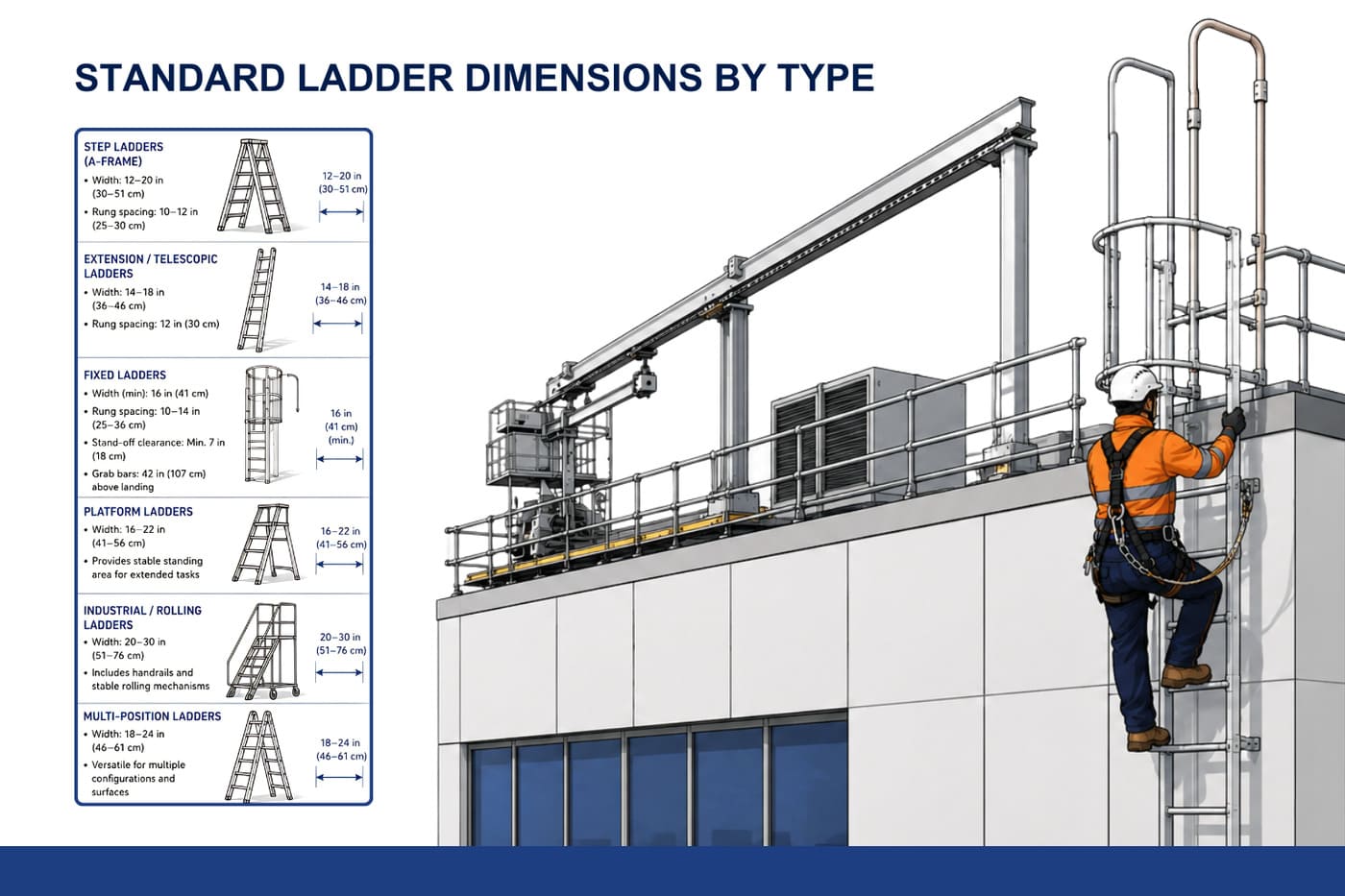
While regulations define minimum requirements, selecting the right ladder type ensures safe access, usability, and long-term performance. Each ladder type has specific ladder dimension requirements that must match the working environment.
Step ladders are self-supporting and commonly used for indoor maintenance tasks. Typical step ladder dimensions include a width of 12 to 20 inches and rung spacing between 10 and 12 inches. They are ideal for painting, lighting adjustments, and general facility work where mobility and compact design are essential.
Extension ladders are designed for vertical reach in construction and facade access. Standard extension ladder dimensions range from 14 to 18 inches in width, with rung spacing of 12 inches. For safe use, the ladder must extend at least 3 feet above the landing, follow a 4:1 angle ratio, and be placed on a stable base. These ladders are widely used for roof access, inspections, and temporary facade work.
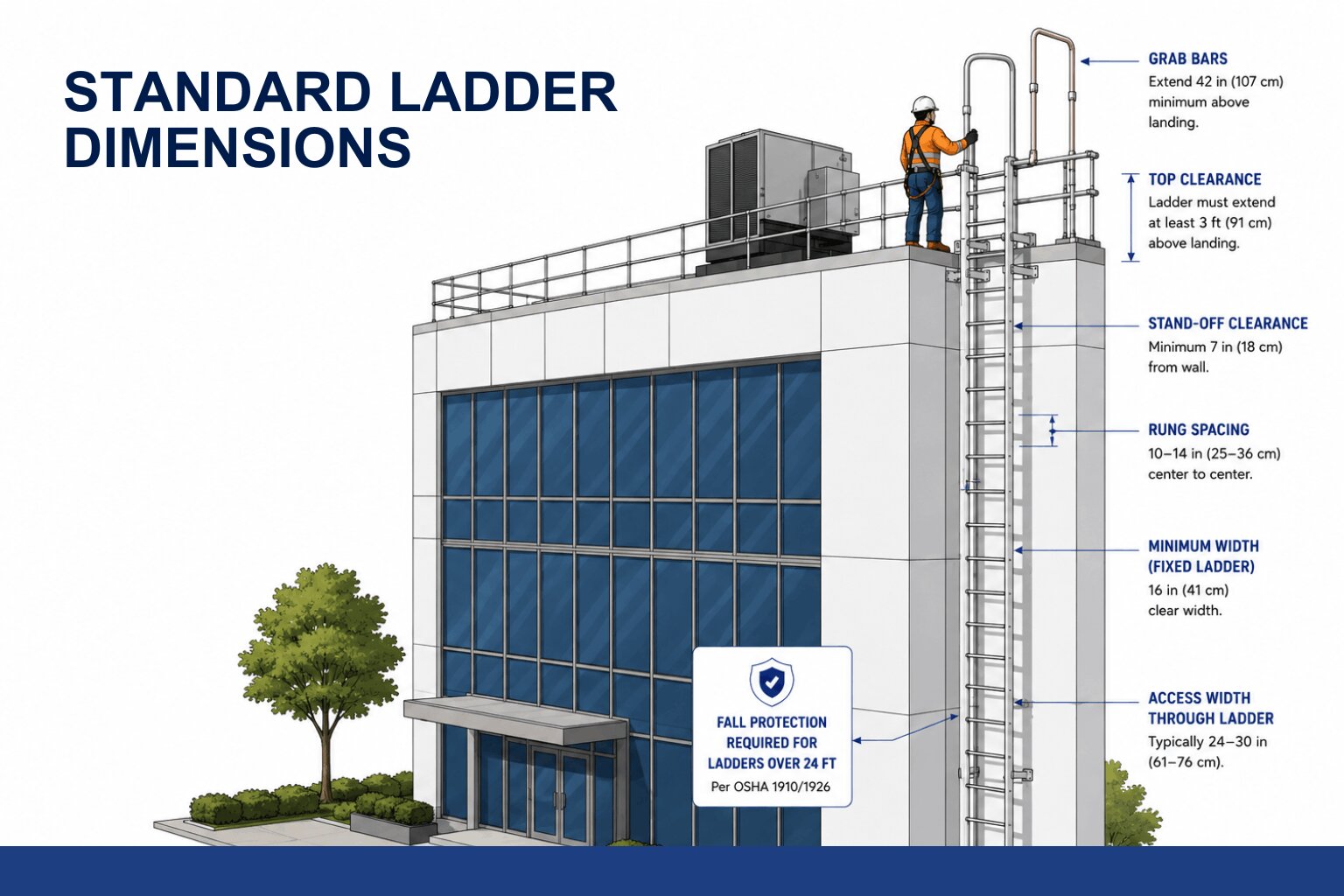
Fixed ladders are a key component of roof access systems and facade maintenance strategies. Standard fixed ladder dimensions include a minimum width of 16 inches, rung spacing between 10 and 14 inches, at least 7 inches of stand-off clearance, and grab bars extending 42 inches above the landing. Access width through the ladder typically ranges from 24 to 30 inches.
For ladders exceeding 24 feet, fall protection systems are mandatory, and safety cages can no longer be used as the only protection method. These ladders are commonly integrated with BMUs, monorails, and rooftop equipment.
Platform ladders are designed for stability and worker comfort. Standard platform ladder dimensions range from 16 to 22 inches in width, providing a secure standing area for detailed tasks such as electrical work and inspections.
Industrial ladders are built for high-frequency use in demanding environments. Typical industrial ladder dimensions range from 20 to 30 inches in width, allowing for greater stability and load capacity. OSHA requires these ladders to support at least four times their intended load and to include handrails and stable rolling mechanisms.
Multi-position ladders offer flexibility across multiple configurations. Standard multi-position ladder dimensions range from 18 to 24 inches in width, making them suitable for uneven terrain, stairways, and renovation projects.
Ladder Type |
Typical Width |
Rung Spacing |
Height Range |
Load Rating |
Best Applications |
| Step Ladder | 12–20 in | 10–12 in | 4–14 ft | Type II–IA | Interior maintenance, painting |
| Extension Ladder | 14–18 in | 12 in | 16–40 ft | Type I–IA | Roof access, construction |
| Fixed Ladder | 16+ in | 10–14 in | Custom | Custom | Permanent building access |
| Platform Ladder | 16–22 in | 10–12 in | 4–16 ft | Type IA–IAA | Prolonged tasks, electrical work |
| Industrial/Rolling | 20–30 in | ≤10 in rise | 4–20 ft | Type IAA (375+ lbs) | Warehouses, facade maintenance |
| Multi-Position | 18–24 in | 12 in | 6–22 ft | Type IA | Stairways, uneven terrain |
Ladder width directly impacts stability, load capacity, and worker safety. Wider ladders distribute weight more effectively, reducing the risk of tipping in professional environments.
As a general rule, each additional inch of ladder width can increase load capacity by approximately 20 to 30 pounds. For example, a 16-inch ladder rated at 300 pounds offers significantly more stability than a 12-inch ladder rated at 200 pounds. In most commercial applications, a width of around 18 inches is recommended to allow safe movement, especially when workers use tools or wear PPE.
Environmental conditions also influence ladder selection. Wet or corrosive environments require slip-resistant materials, while confined spaces may require narrower ladders supported by additional safety systems.
Choosing the right ladder dimensions depends on application, environment, and frequency of use. In commercial and industrial facilities, wider ladders of 20 inches or more are often preferred for stability and repeated access. In high-rise buildings, fixed ladders typically range from 16 to 20 inches and must integrate with facade access systems.
Ladders exceeding 24 feet must include compliant fall protection systems, while all ladder designs should align with rooftop equipment such as BMUs, davits, and monorails. Construction environments must meet OSHA requirements, while confined spaces may require more compact solutions with additional safety controls.
Ladders are only one element of a complete building access system. They must integrate with fall protection systems, monorails, davits, and facade access equipment to ensure safe and efficient maintenance.
Fixed ladders provide access to rooftops and service areas, while BMUs enable full facade coverage. Proper coordination between these systems improves safety, reduces operational risk, and supports long-term maintenance efficiency.
Early collaboration between architects, engineers, and facade access specialists helps ensure compliance and prevents costly design changes later in the project.
Selecting the correct standard ladder dimensions ensures safe, compliant, and efficient building operations. Every detail, from width and rung spacing to clearance and fall protection, plays a role in long-term performance.
To achieve the best results, project teams should go beyond minimum standards and consider how ladders will be used over time. Integrating ladder systems with complete access solutions ensures better safety, smoother operations, and reduced lifecycle costs.
Facade Access Solutions APAC provides end-to-end expertise in ladder systems, facade access, and integrated building access design.
Contact our team today to discuss your project requirements and ensure full compliance with global ladder standards.
Disclaimer: Graphics shown are illustrative only and do not represent actual products, equipment, or real-life conditions.
Speak with our specialists to explore the right solution for your building.
ContactThe OSHA standard requires a minimum of 16 inches for fixed ladders and 11.5 inches for portable ladders.
Rung spacing typically ranges from 10 to 14 inches, depending on ladder type.
A minimum clearance of 7 inches is required for safe use.
Ladders should be placed near access points and aligned with rooftop systems for efficient movement.
OSHA focuses on safety requirements, while EN 131 includes usability and design considerations.