Every commercial and industrial building with rooftop access carries a level of risk. Maintenance teams, inspectors, and contractors rely on safe access to perform their work. Without the right protection in place, even routine tasks can expose workers to serious fall hazards. This is where a well-planned roof guardrail installation becomes essential.
A permanent roof guardrail system is one of the most effective forms of passive fall protection. It does not depend on user behavior. Once installed correctly, it creates a continuous barrier that reduces risk across the rooftop environment. However, not all systems deliver the same results. The difference lies in how the installation is planned, designed, and maintained.
This guide covers the full process, from planning and compliance to installation and maintenance. It also explains how guardrails fit into a broader rooftop safety strategy, where systems such as fall arrest, lifelines, and facade access equipment work together to support safe operations.
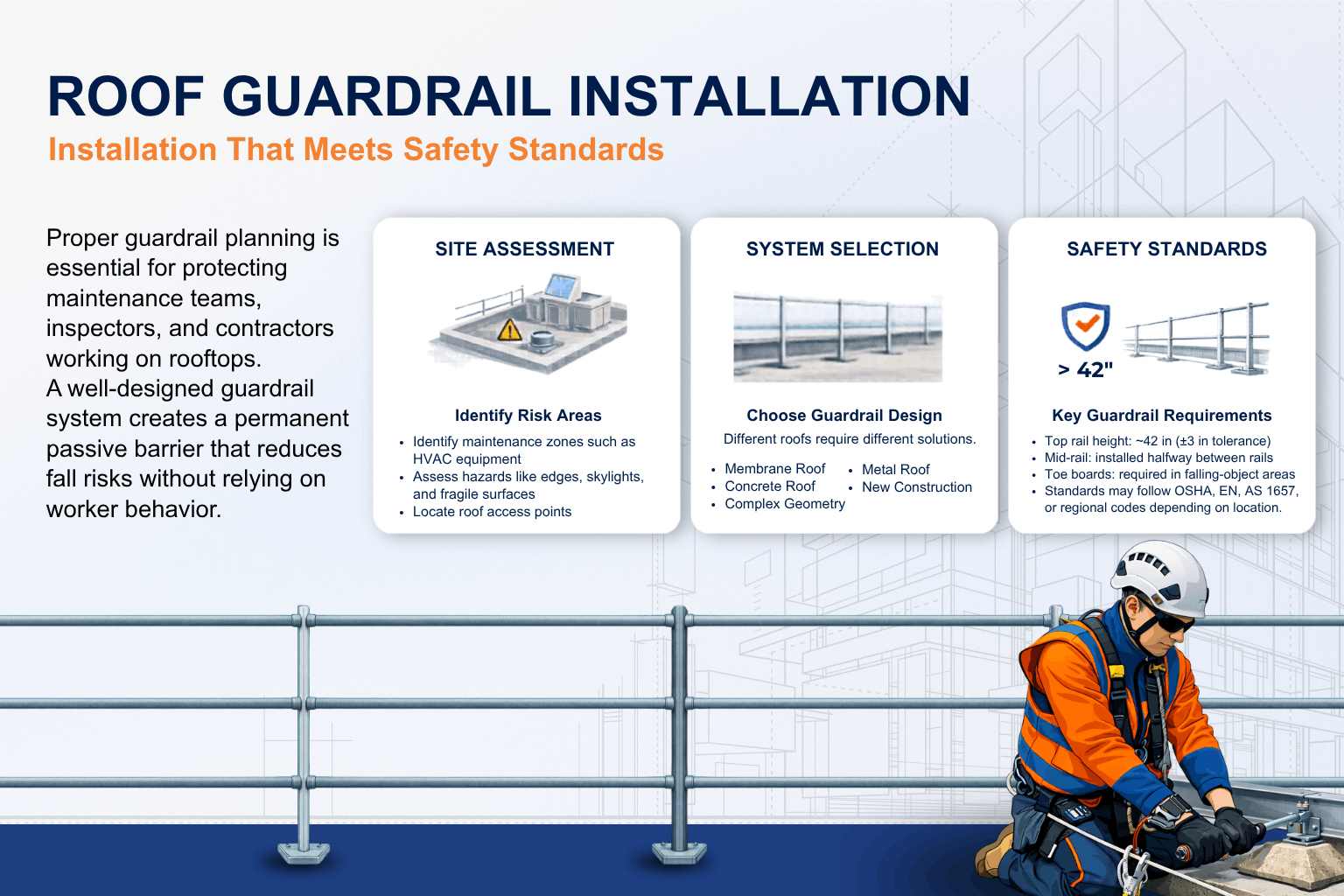
A successful roof guardrail installation begins well before equipment arrives on site. The planning phase determines system performance, compliance, and long-term reliability.
Start with a detailed site assessment. Identify all access points such as ladders, stairwells, and roof hatches. Then locate areas that require regular servicing, including HVAC units and mechanical zones. Mapping worker movement across the roof helps define where protection is most critical.
Next, assess fall hazards. Roof edges are the most obvious risk, but skylights, fragile surfaces, and elevation changes also present danger. Fall hazards at heights of approximately 2 meters (6–6.6 feet) or more must be addressed in accordance with applicable safety standards such as OSHA and EN 13374.
Structural capacity must also be verified. The roof must support the loads imposed by the guardrail system. Freestanding systems rely on counterweights, while fixed systems transfer loads through anchors. A structural engineer should confirm capacity, especially for older buildings.
System selection depends on the roof design. The table below provides a quick reference for choosing the right solution.
Guardrail System Selection by Roof Type
| Roof Type | Recommended System Type | Key Consideration |
|---|---|---|
| Membrane Roof | Freestanding | Protect waterproofing |
| Concrete Roof | Anchored | Strong support |
| Metal Roof | Freestanding/Engineered | Load distribution |
| Complex Geometry | Custom | Engineering required |
| New Construction | Integrated | Plan early |
Compliance is a critical part of any roof guardrail installation. While regulations vary by region, the core safety principles remain consistent.
OSHA standards define clear requirements for guardrail systems:
Globally, several standards govern roof guardrail systems. These include EN 13374, EN 14122-3, AS 1657, and regional building codes. Many Middle East projects follow OSHA or EN standards with local adaptations.
The table below provides a quick comparison across major standards.
Guardrail Requirements by Region
| Requirement | OSHA | EN | IBC | AS 1657 |
|---|---|---|---|---|
| Top Rail | 42 in. | 1.0m | 42 in. | 900–1100mm |
| Mid Rail | Yes | Yes | Yes | Yes |
| Force | 200 lbs | Varies | 200 lbs | Defined |
| Toe Board | 4 in. | Varies | Required | 100mm |
For a more technical comparison, the table below breaks down key design requirements.
Guardrail Design Requirements by Standard
| Feature | OSHA | EN 14122-3 | AS 1657 |
|---|---|---|---|
| Top Rail Height | 42 in. | 1100mm | 900–1100mm |
| Mid Rail | Yes | Yes | Yes |
| Toe Board | 4 in. | Required | 100mm |
| Load | 200 lbs | 0.3 kN | Defined |
Always confirm requirements with the local authority having jurisdiction before installation begins. Working with experienced providers such as Façade Access Solutions can also help ensure that guardrail systems align with both international standards and project-specific compliance requirements.
A structured approach ensures safe and compliant installation. Each stage contributes to the final system performance.
The table below compares the main installation methods.
Guardrail Installation Method Comparison
| Type | Description | Advantage | Limitation |
|---|---|---|---|
| Freestanding | Counterweights | No penetration | Heavy |
| Anchored | Fixed anchors | Secure | Requires drilling |
| Hybrid | Combination | Flexible | Complex |
Maintenance ensures that a roof guardrail system remains safe and compliant over time.
Inspect the system before each use and schedule formal inspections at least once a year. In demanding environments, inspections should be more frequent.
After severe weather, perform additional checks to ensure system stability. Inspect fasteners, look for corrosion, and verify that all components remain properly aligned.
The table below outlines a practical inspection checklist.
Guardrail Inspection Checklist
| Item | Check | Action |
|---|---|---|
| Alignment | Height | Adjust |
| Fasteners | Tightness | Retighten |
| Corrosion | Rust | Treat |
| Anchors | Integrity | Reinforce |
For long-term reliability, many building owners partner with service providers who can support inspections and maintenance. Façade Access Solutions, for example, delivers ongoing service through its global network, helping ensure that guardrail systems and related access equipment remain compliant throughout their lifecycle.
Guardrails are a critical layer of rooftop safety, but they work best as part of a complete system.
Rooftop Safety System Overview
| System | Purpose | Use |
|---|---|---|
| Guardrails | Edge protection | Perimeter |
| Fall Arrest | Personal safety | Complex areas |
| Lifelines | Movement | Large roofs |
| Davits | Suspended access | Facade work |
| BMUs | Full access | High-rise |
In areas where guardrails cannot be installed, fall arrest systems provide essential protection. These often include anchor points and personal safety equipment designed to secure workers during specific tasks.
Lifeline systems allow safe movement across large roof areas, while davit systems provide support for suspended platforms used in facade cleaning and inspection. Monorail systems enable equipment movement across the roof, improving operational efficiency.
For mid-rise and high-rise buildings, BMUs remain the primary solution for full facade access. Systems developed by brands such as CoxGomyl and Manntech are designed to operate alongside guardrails, lifelines, and anchors, creating a fully integrated rooftop safety environment.
A reliable roof guardrail installation depends on proper planning, compliance with safety standards, and careful execution. Each stage plays a role in ensuring long-term performance.
Guardrails should not be treated as a standalone solution. They must be part of a broader safety strategy that includes fall arrest systems, lifelines, and facade access equipment. When these systems are designed together, they create a safer and more efficient working environment.
Façade Access Solutions provides end-to-end support, from design consultation to installation and maintenance. With thousands of systems installed worldwide, their team brings the expertise needed to deliver compliant and durable solutions across a wide range of building types.
If you are planning a new project or upgrading an existing system, now is the time to act. A well-designed roof guardrail system protects people, reduces risk, and supports long-term building performance.
Work at height introduces dynamic risk conditions that must be addressed through engineered control measures. Within modern building design, fall arrest systems form part of permanent life safety infrastructure rather than temporary accessories. They are integrated into roof zones, façade access strategies, and maintenance planning to support long-term operational safety.
For structural engineers, façade consultants, and asset owners, the objective is not simply to define fall arrest but to understand how it performs under dynamic loading. Effective systems must manage energy transfer, maintain structural integrity, satisfy clearance geometry, and align with global regulatory frameworks.
Fall arrest is therefore best described as a performance-driven interface between user and structure, embedded within broader façade access and maintenance strategies.
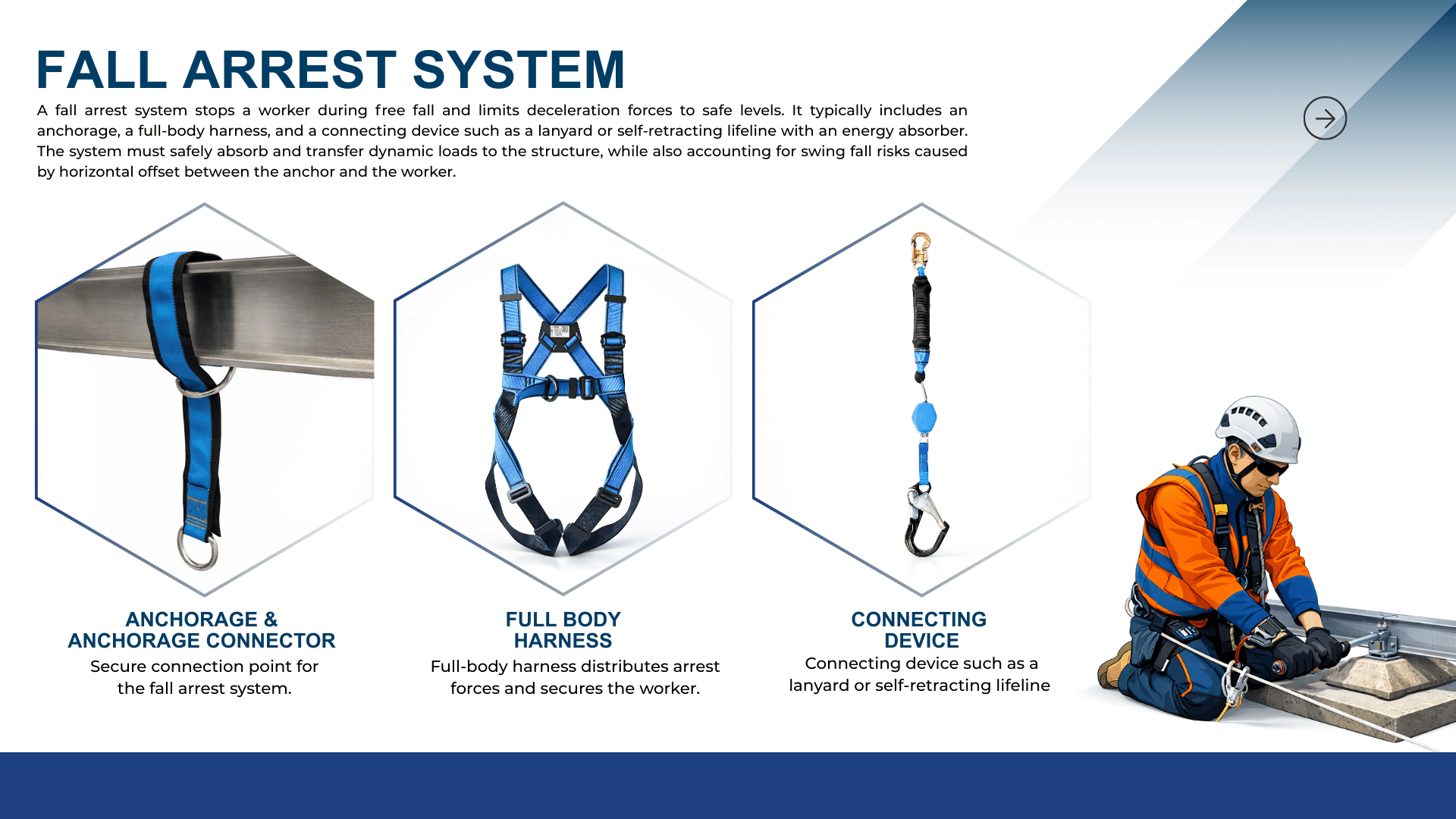
A fall arrest system is designed to stop a worker who has entered free fall and limit deceleration forces to survivable thresholds
A typical system includes:
The defining condition is the dynamic load event. The system must absorb and transfer energy safely into the structure without exceeding allowable force limits.
Swing fall must also be evaluated. Horizontal offset between anchor and user creates pendulum effects that may result in worker hitting the ground, side structures or severed suspension line due to abrasion against top edge of structure.
Early coordination with façade interfaces, waterproofing layers, and insulation systems ensures permanent integration without compromising envelope integrity.
Accurate clearance calculation is fundamental to safe design.
Fall Clearance = Lanyard Length + Deceleration Distance + Line Stretch + Worker Height + Safety Factor
Where:
Mounting height directly influences free fall distance. Self-retracting lifelines typically reduce free fall compared to fixed lanyards.
Fall arrest systems must comply with regulations in the jurisdiction of installation. Regulatory frameworks establish minimum performance thresholds, while engineering best practice frequently exceeds them.
Common global regulatory families include:
Region |
Primary Regulatory Framework |
| United States | Occupational Safety and Health Administration, American National Standards Institute |
| Canada | CSA Group |
| Europe | EN Standards |
| United Kingdom | BS Standards |
| Australia / New Zealand | AS/NZS Standards |
| Asia / Middle East | Local OHS frameworks often aligned with EN or BS |
Compliance ensures baseline safety. However, structural integration, multi-user loading verification, and façade coordination require performance-driven engineering beyond minimum code thresholds.
Permanent fall arrest systems must be integrated into the building envelope, not retrofitted as isolated attachments. Structural continuity, façade coordination, and long-term asset management planning are essential.
Effective systems:
When engineered as part of an integrated façade access strategy, fall arrest becomes a structural safety interface that protects both personnel and the asset lifecycle.
Permanent fall arrest systems require coordinated structural design, façade integration, and regulatory alignment.
Facade Access Solutions provides engineering-driven consultancy and equipment integration for permanent access and fall arrest systems across complex building typologies.
Contact our technical team to evaluate your project requirements and develop a performance-based solution aligned with structural and operational objectives.
Facade access is no longer an afterthought in modern building design. As structures grow taller and more complex the need for safe and efficient access systems becomes critical. This Continuing Education Unit course explores how facade access systems support long term building performance while protecting workers and owners alike. Designed for architects, designers, and building professionals, this course delivers practical insight you can apply to real world projects.
Participants will gain a clear understanding of why permanent engineered maintenance equipment is essential for both interior and exterior facades. From routine window cleaning to inspections and repairs facade access systems play a vital role in keeping buildingoperations compliant and visually maintained. This course explains how early planning can reduce future costs while improving safety outcomes.
This CEU course is designed to deliver practical knowledge that supports better decision making throughout the design process. Each learning outcome focuses on real world considerations that impact safety compliance and long term building performance. Participants will walk away with a clearer understanding of how facade access systems influence both design and maintenance planning.
This CEU course emphasizes a key takeaway. Facade access should be considered from the start. By addressing maintenance and safety during the design phase professionals can avoid costly redesigns and retrofits and ensure safer working conditions over the life of the building.
Enroll to gain valuable knowledge earn one HSW credit and strengthen your approach to facade access system design.
The façade access industry continues to move forward as buildings grow taller and more architecturally ambitious. Throughout 2025, several major projects showed how facade access solutions support long term building care, safe maintenance work, and architectural performance. From implementing its first AMS in North America to supporting complex hospitality and commercial developments, the year reinforced the value of well-planned façade maintenance.
The North American landscape in 2025 demanded a versatile approach to building maintenance, ranging from the restoration of heritage-standard skyscrapers to the integration of access systems in sloped, modern hospitality structures. Facade Access Solutions NAM addressed these challenges by prioritizing engineering precision and safety. The following projects represent the pinnacle of maintenance efficiency, highlighting how customized engineering ensures that even the most complex architectural visions remain serviceable and safe for decades to come.
The Engineering Blueprint:
1900 Lawrence features a modern commercial design where maintenance readiness was integrated from the outset. Facade Access Solutions NAM designed, delivered and installed a telescopic pedestal CoxGomyl BMU capable of glass replacement and façade cleaning across multiple elevations. The system remains discreet when stowed yet provides long outreach and lifting capacity for heavy glazing. Pre-tested components allowed installation in just three days.
Spacious work floors, private terraces, and sustainability goals make this tower a premium workplace in Denver, supported by façade access systems designed for long-term maintenance efficiency.
Innovation Intel:
1201 Third Avenue required a façade access solution adaptable to curtain wall curves and varied elevations. Facade Access Solutions collaborated with Manntech engineers to install four BMUs at building corners, providing complete reach without structural interference. Encoder-based positioning ensures precise, safe movement, reducing collision risk. Rooftop assembly was completed via service elevators, avoiding crane use, and night work minimized tenant disruption.
Precision Profile:
Park Hyatt Chicago demanded a BMU replacement compatible with the existing track system and tight rooftop clearance. Facade Access Solutions NAM together with Manntech engineers designed a Type 4.1 BMU with a luffing mast and two-stage telescopic jib, enabling access to terraces and recessed façade areas. One turn automated launch and return replaced the former multi step manual process, improving safety, efficiency and energy use. By reusing the existing track system and upgrading to a modern AMS solution, the project reduced material waste and extended the building’s maintenance asset life.
The BMU was delivered by helicopter lift which prevented major construction impact on the building. The result supports long term, sustainable facade maintenance while preserving the clean visual profile expected in a luxury hotel environment.
Core Specifications:
The Snoqualmie Casino expansion included a 210-room hotel, spa, indoor pool, restaurants, entertainment hall, and parking structure. The building’s 10° sloped roof presented challenges for standard BMUs. Facade Access Solutions NAM worked with Tractel engineers to implement a customized solution combining Railscaf, Travsmart, and tieback systems. Friction-driven trolleys and powered platforms ensured secure movement along the inclined façade, while continuous lifelines on the roof provided safe operator access. Laser leveling and modified Railscaf tracks ensured precise installation and architectural integration.
This innovative approach balanced safety, efficiency, and design harmony, enabling long-term maintenance without compromising the building’s aesthetics.
Throughout 2025, Facade Access Solutions NAM together with Tractel, Manntech and CoxGomyl delivered innovative, safe, and reliable façade access systems across high-rise, commercial, and hospitality projects. From restoring BMUs at 1 Bloor to enabling maintenance-ready towers, luxury hotels, and complex resort developments, these collaborations highlighted the importance of maintenance planning, advanced engineering, and OEM expertise.
As buildings grow taller and more complex, safe and efficient access remains essential. With Facade Access Solutions leading the way alongside its trusted partners, the industry enters 2026 with smarter systems, stronger maintenance strategies, and long-term support for building care worldwide.
Integrating facade access systems into the early design phases of a building is crucial for long-term success, ensuring safety, cost-effectiveness, and aesthetic integrity throughout the structure’s lifespan. Modern buildings are designed to last for decades, making it essential to consider their maintenance needs from the outset.
Proactive planning involving facade access specialists and architects allows for the seamless integration of access systems, such as Building Maintenance Units (BMUs) or davit systems, into the building’s structure and aesthetics, rather than being tacked on as an afterthought. This prevents the need for costly and often suboptimal retrofits later on. This proactive approach yields a solution that meets maintenance needs efficiently, economically, and with minimal visual impact.
By incorporating facade access systems early, the access strategy can be aligned with the building’s architectural design. For instance, if a glass curtain wall uses lighter materials, architects can specify lighter-weight access equipment, so the facade isn’t overstressed. Essential structural supports like roof beams, parapets, or embedded plates for BMU tracks can be planned in advance, preserving the building’s visual appeal. This foresight ensures access equipment fits seamlessly, with tracks following building curves and BMUs potentially having hidden parking bays or recesses so they’re hidden when not in use. The outcome is a building that maintains its design integrity while ensuring safe access to all exterior surfaces for maintenance.
Early coordination with facade access experts during schematic design optimizes engineering efficiency. This collaboration helps determine the ideal locations and types of equipment (e.g., rooftop BMUs, monorail systems, or davit systems) before finalizing structural and facade elements, thereby preventing conflicts and expensive modifications. An industry example highlights how integrating mullion guides and restraint tracks for BMUs into the initial facade design eliminated the need for later exterior alterations. This approach significantly controls both construction and maintenance costs.
Designing for maintenance extends beyond equipment installation; it ensures that a building can be serviced efficiently for decades. A comprehensive facade maintenance plan, developed simultaneously with design documents, should outline the frequency of tasks such as window cleaning, facade inspections, and sealant replacements, ensuring the access system supports those needs. For example, a high-rise office with large glass panels might require a BMU with a higher load capacity to facilitate both cleaning and the replacement of facade elements or window panels. Investing in robust, adaptable equipment initially can prevent the need for major upgrades or replacements of the access system in the future.
Building owners who cut corners on facade access during construction often face expensive replacements, potentially costing millions, due to inadequate coverage or premature system failure. Conversely, a well-chosen system implemented from the start will “stand the test of time,” remaining safe and effective as the building ages and its maintenance requirements evolve.
Furthermore, early planning future-proofs the building against evolving regulations and technologies. A well-integrated access infrastructure can be more easily adapted as safety codes are updated, or new maintenance techniques emerge. Ensuring fall protection anchors and tie-ins are ample and code-compliant from the outset provides secure working points for maintenance crews, even if standards become more stringent. Planning with flexibility also allows for future upgrades, such as incorporating advanced BMU attachments or robotic cleaning tools, without requiring a complete system overhaul. This adaptability is vital to long-term resilience, as owners and facility managers increasingly view facade access not as a one-time installation, but as a critical asset that requires periodic upkeep and potential enhancement over the building’s lifespan.
Achieving the benefits of early integration necessitates strong collaboration among architects, engineers, facade consultants, and facade access solution providers. Engaging specialists (like FAS’s Integrated Design Services team) during design can lead to custom access solutions tailored to the project’s unique geometry and maintenance objectives. This collaborative process might involve evaluating various options, such as comparing a fixed BMU with a davit arm system for a particular roof configuration, to select the most balanced solution in terms of safety, aesthetics, and cost.
Stakeholders should address key questions during early design reviews, including: “What facade tasks need to be supported?”, “Where can equipment be stored or parked?”, and “How will it attach without detracting from the design?”. Addressing these questions ensures nothing is overlooked.
Early integration and long-term maintenance planning also align with sustainability goals and asset longevity. Modern buildings often feature complex facades like solar panels, double-skin systems, and green walls that demand specialized care. Incorporating appropriate access equipment ensures these green features can be maintained in optimal condition, thereby preserving the building’s environmental performance.
Planning for facade access upfront is more than a best practice; it’s a forward-looking strategy that protects the building’s value, appearance, and functionality for decades. By treating maintenance access as a core design element rather than an afterthought, architects and owners set their projects up for long-term success, reinforcing FAS’ mantra: “Build it right today, maintain it with ease tomorrow”.
Innovative architecture often presents unique challenges when it comes to maintenance and window cleaning. Davit systems have emerged as a practical and versatile solution for safely accessing building facades, particularly when permanent equipment is either impractical or visually intrusive.
A davit system consists of a permanent base or pedestal, which is typically welded to the building’s structural steel or attached via embedded plates in a concrete slab, and a removable arm that cantilevers over the edge of the building to suspend a work platform or bosun’s chair. In essence, it functions like a lightweight crane arm that can be installed as needed and stored away when not in use. Due to their simplicity and flexibility, davits are widely used on everything from mid-rise office buildings to high-rises with difficult-to-reach areas, offering a safe facade access solution without permanent visual impact on the skyline.
Not all buildings require a full-fledged roof car or Building Maintenance Unit (BMU). In many cases, davit systems offer a more practical alternative. Here are a few scenarios where davits excel:
In densely built urban areas or sites with landscaping and high foot traffic, ground-based access like boom lifts or scaffolding may not be feasible. Roof-mounted davit arms provide facade access without disturbing ground-level activity. This makes them ideal for buildings situated in tight city blocks where minimizing street-level disruption is essential.
Structures with irregular geometries, setbacks, or delicate parapets often pose challenges for fixed facade access systems. Davit systems offer flexibility—their removable arms can be shifted between multiple pedestal bases, allowing comprehensive coverage of various facade sections. Since they transfer loads to the roof structure, davits are especially suited for buildings with fragile elements like decorative cornices or glass railings, where heavy cradles from BMUs may pose a risk.
For buildings requiring periodic but not frequent facade work—such as window cleaning or minor repairs—davits offer a cost-effective solution. They fulfill OSHA safety requirements while eliminating the need for costly permanent equipment that might remain idle for much of the year. As a result, many mid-size commercial and residential buildings opt for davit systems.
Early consultation with facade access experts is key. They can assess the roof’s suitability and plan pedestal placements to ensure full facade coverage. Proper structural coordination ensures load reinforcement under each pedestal and includes anchor points or tie-backs on the facade below.
Davit systems offer secure, anchor-supported suspension for platforms, reducing fall risks for workers at height. Each component—base, mast, and arm—is engineered to meet rigorous safety standards. When paired with certified platforms and fall protection gear, davits provide a safe, compliant solution. Involving experts early helps ensure alignment with OSHA and other regulatory requirements, giving building owners confidence in ongoing maintenance operations.
Designed for quick assembly and ease of use, davit systems typically include modular components that bolt or pin together rapidly. For example, a davit arm can be inserted into a rooftop sleeve and a platform deployed within minutes—far faster than constructing a scaffold. Their efficiency minimizes building downtime during maintenance and encourages more frequent facade cleaning or inspection. Systems can be fabricated using lightweight materials like aluminum alloys, streamlining handling and setup.
Architects appreciate davit systems for their low profile. Unlike bulky rooftop equipment, davits are removable, leaving only discreet base pedestals on the roof. This maintains the building’s original design integrity, a major advantage for historic or high-profile buildings. During operation, davits are temporary and visually unobtrusive—once removed, the structure’s architectural lines remain untouched.
To maximize the benefits of a davit system, early design integration is essential. Structural engineers must account for load-bearing requirements and pedestal placements from the outset. Concrete rooftops, for instance, may require embedded plates or steel subframes to accommodate the davit bases. Early planning also helps coordinate with other rooftop elements like HVAC units, terraces, or green roofs to prevent layout conflicts.
Facade access consultants can assist by developing a davit layout drawing that maps the location and coverage of each unit, ensuring full reach with redundancy built in. They also help address practical considerations—such as where to store the davit arms when not in use, how workers will safely access the roof, and how to stabilize platforms using tie-backs or suction anchors in windy conditions.
Crucially, all davit systems must be certified and meet safety standards. A certified OSHA consultant or maintenance safety team should be involved in design reviews to preempt compliance issues. The result is a building that’s not only aesthetically impressive but also equipped with a robust, efficient, and safe maintenance system.
Davit systems are a flexible, cost-effective, and architecturally considerate approach to facade maintenance. When integrated early and paired with expert planning, they transform the way buildings are maintained—offering easy, safe access to even the most challenging exteriors. For many projects, this means no more compromise between bold architectural vision and practical upkeep—thanks to smart davit technology.
Designing and installing a facade access system is a crucial step in preserving a building’s exterior. But the work doesn’t stop once the davits, tracks, or building maintenance units (BMUs) are in place. Just like the facade itself, the equipment enabling access needs regular maintenance and attention.
Think of it this way: we plan for buildings to be maintained—windows cleaned, seals re-caulked, panels replaced—but we must also maintain the very systems that make this upkeep possible. When access equipment falls into disrepair, it undermines the entire facade maintenance program, leading to increased costs, safety risks, and potential damage to the building envelope.
Forward-thinking architects and building managers include facade access maintenance in their design strategy from day one. Facade Access Solutions (FAS) often advises project teams to ensure that access equipment is not only properly placed but also easily reachable for inspections and tune-ups. Treating facade access systems as long-term assets supports a building’s overall performance and longevity.
The most effective time to plan for facade access system maintenance is during the initial design phase. This proactive approach addresses key questions: How will technicians reach the roof-mounted BMU for inspections? Are track systems or anchor points easily accessible for service?
A common mistake is integrating access equipment so discreetly that it becomes hard to maintain. While aesthetics are important, they shouldn’t come at the expense of maintainability.
One smart strategy is to incorporate built-in service access. For example, a monorail track along the roof perimeter should be paired with safe walkways or ladders for technician access. If components are concealed behind architectural features, include hidden hatches or removable panels for maintenance.
During design reviews, FAS experts conduct “serviceability checks,” offering recommendations such as repositioning anchors or adding catwalks. These small adjustments ensure that routine tasks—like tightening a bolt or replacing a motor—can be done quickly, safely, and without invasive construction.
We also recommend planning for smart monitoring. Modern systems can be equipped with sensors or usage counters that alert facility managers to wear and tear. Integrating these tools early on promotes good maintenance habits and reduces the risk of overlooked issues.
Regular servicing isn’t just about equipment longevity—it’s about minimizing risk. Neglected facade access systems can lead to:
Hoists, motors, and locks can break down without routine care. A stalled platform mid-ascent isn’t just an inconvenience—it’s a major safety issue. Preventive maintenance, like lubricating cables and replacing worn components, significantly reduces these risks. Design decisions that prioritize accessibility help technicians complete service tasks more efficiently.
Poorly maintained equipment can harm the facade itself. For example, degraded seals around roof anchors can lead to water intrusion. Misaligned guide wheels might scratch panels or stress window mullions. Choosing corrosion-resistant materials and designing with drainage in mind are ways FAS ensures long-term system performance and facade protection.
The safety of workers who rely on facade access systems is paramount. Even minor issues like frayed cables or loose anchors increase the chance of accidents. Systems should include backup anchors, secondary brakes, and undergo routine certification. Many jurisdictions require annual inspections, so building owners should incorporate those checks into their ongoing management plans to ensure compliance.
New developments come with countless design decisions, but incorporating a facade access maintenance plan from the start sends a clear message: this building is built to last. Early consultation with FAS allows stakeholders to select reliable, low-maintenance systems backed by real-world servicing experience.
Preserving a building’s appearance and performance is a long-term commitment. A custom facade access solution isn’t just a one-time investment—it’s a partnership. FAS not only delivers innovative equipment but also supports clients with ongoing system care.
We’ve seen firsthand how iconic buildings remain in top condition thanks to proactive maintenance practices. Whether you’re launching a new project or retrofitting an existing structure, plan beyond installation. Ask: what will it take for this system to run smoothly 10 or 20 years from now?
With guidance from FAS, you can ensure your facade access system supports your building’s health and appearance for decades. In facade maintenance, an ounce of prevention truly is worth a pound of cure—and regular service planning is the key to long-term success.
For over a century, maintaining building facades has been a task involving human workers at significant heights, a process both perilous and labor-intensive. Today, advancements in engineering and mechatronic systems are transforming how skyscrapers and large buildings are sustained. The introduction of intelligent, automated façade access solutions is already making an impact, with cutting-edge technology enhancing efficiency, safety, and sustainability within the industry. As the sector embraces new approaches, innovative Building Maintenance Units (BMUs) and articulated systems are redefining capabilities. Technologies such as Manntech’s Articulated Mechatronic System (AMS) are spearheading this shift, optimizing efficiency, reducing environmental impact, and improving building maintenance operations.
Several factors are driving the rise of automation in facade maintenance. Buildings are becoming increasingly complex and taller, with irregular shapes and the usage of delicate materials making traditional maintenance methods more challenging. Additionally, the labor market faces shortages of skilled workers willing to undertake high-risk façade maintenance roles. These challenges have fueled the demand for advanced access systems that prioritize efficiency and safety. The global construction and building maintenance industry is vast, and even incremental improvements in operational efficiency can have a significant impact. By incorporating more advanced mechatronic solutions into BMUs, manufacturers are finding ways to enhance safety, reduce costs, and improve long-term building maintenance strategies.
Companies at the forefront of this movement, such as Manntech, are integrating articulated systems into their BMUs to improve maneuverability and streamline façade access. These advancements facilitate smoother operations, greater adaptability to complex architecture, and reduced structural impact compared to conventional systems. The AMS, for example, represents a significant leap forward by eliminating the slow movements of traditional elbow jib designs while also reducing the system’s overall weight and footprint.
One of the most recognized advancements in façade automation is robotic window cleaning. Systems like Skyline Robotics’ Ozmo demonstrate how automated window-washing platforms can clean building facades more efficiently while minimizing human risk. These robots are designed to integrate with existing BMU infrastructure, enabling them to clean windows up to three times faster than traditional methods. By utilizing precise control systems, robotic arms, and automated sensors, these systems ensure consistent cleaning results while reducing labor demands. Although human operators remain involved in guiding and overseeing robotic cleaning systems, the technology is helping to shift the role of workers toward monitoring and maintenance rather than direct, high-risk labor. As robotic solutions continue to develop, they will complement existing façade access systems rather than replacing them entirely.
While robotic window cleaners are gaining attention, substantial advancements are also being made in BMU technology itself. Manntech’s Articulated Mechatronic System (AMS) is a prime example of how the industry is evolving to meet modern demands.
Key Benefits of the AMS:
The AMS represents the future of BMU technology, demonstrating that façade maintenance can be both efficient and sustainable without compromising safety or accessibility. By incorporating predictive maintenance and remote monitoring, systems like the AMS help building owners optimize maintenance schedules and extend the lifespan of their assets.
While full-scale automation may still be on the horizon, the industry is making steady progress toward more advanced, technology-driven solutions. Façade maintenance is becoming safer, more efficient, and more sustainable through the adoption of intelligent BMUs, robotic cleaning systems, and predictive maintenance technologies. For architects, developers, and building owners, integrating these advancements during the design phase is crucial. Planning for modern façade access solutions, such as the AMS, ensures that buildings remain easier to maintain, safer for workers, and aligned with sustainability goals for decades to come. As buildings continue to evolve in design and height, the maintenance systems used to preserve them must also advance. By investing in innovative mechatronic solutions, the industry is paving the way for smarter, more efficient building maintenance where access systems are designed with both functionality and sustainability in mind.
When launching a new building project, the creative possibilities feel endless, the excitement of bold architecture coming to life, the anticipation of a striking skyline, and a defining facade. Amid this energy, however, lies a vital responsibility that can shape the success of the entire project: ensuring your facade access strategy complies with all relevant safety regulations and industry standards from day one.
Forward-thinking architects and developers understand that regulatory compliance isn’t a final checkbox; it’s a foundational design element. By integrating facade access requirements into the early design phase, you safeguard both your creative vision and the safety of those who construct and maintain it.
At first glance, “compliance” might seem like a creative constraint. But in reality, incorporating facade access regulations early in the design phase can enhance innovation. Familiarity with requirements, such as local codes and international standards like OSHA 1910.66, provides your team with a clear framework for creative problem-solving.
Bringing in facade access experts at the outset makes this process easier. For example, Façade Access Solutions (FAS) regularly supports project teams by translating complex regulations into practical, design-aligned solutions. Whether it’s a glass atrium, a curved facade, or a wrap-around terrace, early collaboration ensures your vision remains intact while maintaining safety and compliance from the start.
With code compliance integrated early, architects are empowered to explore bold, imaginative designs, confident that their concepts remain both viable and safe.
Planning for facade access safety standards at the design stage isn’t just the right thing to do; it offers tangible benefits in cost, schedule, and design outcomes. Here’s how:
Early facade access planning doesn’t just benefit the finished building; it also has a real-world impact during construction and throughout the building’s lifespan.
When contractors know from the start that safe, certified access systems are in place, such as roof anchors, suspended platforms, or permanent cradles, they can plan installations more effectively. Crane operations, staging, and fall protection all benefit from a clear access strategy.
The advantages extend to the building’s operational life. Well-designed access systems allow maintenance teams to perform tasks, like glass replacement or seal inspections, quickly and safely. Imagine future technicians using an OSHA-compliant BMU or monorail to reach any point on the facade with minimal disruption. That’s the power of innovative, compliant design.
By prioritizing facade safety from the beginning, you create a legacy of safe, efficient maintenance practices that serve the building for decades.
Navigating complex building codes and facade access standards is far easier with an experienced partner. FAS has built a strong reputation for delivering custom facade access systems that satisfy regulatory requirements and elevate architectural design. From modernizing heritage buildings to solving for futuristic skyscrapers, FAS brings deep expertise and a collaborative approach to every challenge.
Our process is simple: engage early, listen to every stakeholder, and deliver a facade access strategy that works seamlessly with your design vision, while ensuring long-term safety and compliance.
In today’s commercial development landscape, regulatory compliance isn’t a barrier; it’s a blueprint. Prioritizing facade access regulations from the outset doesn’t just avoid costly issues; it opens doors to greater efficiency, cost savings, and design innovation.
Most importantly, it creates safer environments for everyone involved, from the construction team to future maintenance crews. That’s the hallmark of a truly successful project.
As codes and standards continue to evolve, one principle remains constant: the value of foresight. By embracing compliance as a core design strategy, your project doesn’t just meet the minimum requirements; it sets a new benchmark. And with a trusted partner like FAS by your side, navigating facade access regulations becomes an opportunity to lead with excellence. Now that’s staying ahead of the curve.
In the world of towers and high-rise structures, design has always been of the utmost importance. Beyond just structural integrity, the visual look-and-feel of a building has come to symbolize not just the identity of the building, but often the city in which it resides. Think of the Dubai skyline without the Burj Khalifa, or New York City without the Empire State Building…it is not possible.
As architectural design continues to evolve and become more complex, new challenges for facade access and maintenance teams have emerged. The good news is that new innovations like the Articulated Mechatronic System (AMS) have been developed to help overcome these obstacles and with them have come new efficiencies in weight, assembly time, and overall carbon footprint. Combined with advanced automation, IoT connectivity, and optimized movement control, AMS is now setting new standard for Building Maintenance Unit (BMU) in the 21st century.
As buildings evolve into more complex and dynamic structures, traditional facade access solutions have struggled to keep pace. Some common challenges that facade maintenance teams face with these structures include:
Lightweight and Modular Design – AMS reduces structural demands by minimizing system weight by 20%, decreasing the need for reinforced rooftops. Unlike a conventional BMU, AMS components can be transported using standard building elevators, eliminating reliance on cranes or helicopters and reducing installation costs and carbon emissions.
Automated Precision and IoT Integration – AMS leverages automated path planning and smart mechatronic controls to navigate façades with unparalleled precision. This ensures:
Sustainability and Green Building Compliance – AMS directly supports sustainable building initiatives by:
AMS allows architects to push the boundaries of design, as its lightweight and optimized movement paths eliminate traditional BMU constraints. This enables:
By significantly lowering emissions and material use, AMS contributes to greener urban developments:
AMS delivers practical, long-term benefits for building operators and contractors:
Designed for both new constructions and retrofits, AMS extends the lifespan of existing high-rises while integrating seamlessly with evolving Building Management Systems (BMS). This adaptability makes it a key component in future smart city developments, ensuring buildings remain efficient, cost-effective, and technologically advanced for decades to come.
The Future of Facade Access Starts Now
AMS redefines facade maintenance by removing design limitations, reducing environmental impact, and enhancing operational efficiency. By adopting AMS, architects, developers, and city planners can push the boundaries of tower and skyscraper design, ensuring that the next generation of buildings is not only visually striking, but also smarter, more efficient, and environmentally sustainable.