At height, facade maintenance becomes a controlled engineering operation rather than a routine task. Workers are suspended hundreds of metres above ground, operating across complex geometries that include setbacks, curved curtain walls, and constrained rooftops. In these conditions, safety is not dependent on operator judgement alone. It is defined by the design, redundancy, and performance of the access system itself.
A BMU system is engineered to meet these demands. Unlike temporary solutions that rely on site conditions and manual setup, modern Building Maintenance Units are permanently integrated into the building’s structure. Permanently installed BMUs must comply with applicable standards based on system type, with OSHA requirements applied where relevant and EN 1808 governing suspended access equipment in European projects. This article examines how modern building maintenance unit system safety is achieved, the engineering principles behind it, and how it supports safe, consistent, and compliant high-rise facade maintenance.
A BMU system is a permanent mechanical access solution installed on a building to support facade cleaning, inspection, and maintenance. It is engineered specifically for the structure it serves, which means safety is integrated from the earliest design stage rather than added later. The system is made up of several interconnected components that work together to ensure safe operation. A roof-mounted BMU or track system enables horizontal movement across the building, while a telescopic or luffing jib positions the platform precisely where it is needed. The suspended platform carries workers and equipment, supported by independent galvanized steel wire ropes, and all movements are controlled through an operator panel that allows precise positioning. Steel components are protected by hot-dip galvanizing, multi-layer painting systems, or stainless steel depending on environmental exposure. Marine, coastal, and high-pollution environments require specific attention.
Each of these elements has a defined safety function. Platforms are typically suspended on a working rope plus an independent secondary safety rope at each suspension point, so a twin-suspension platform commonly runs four lines: two working ropes and two safety ropes. The exact configuration depends on platform length, rated working load (SWL), and the redundancy provisions defined by governing standards. This level of design ensures consistent stability, even in high-risk environments.
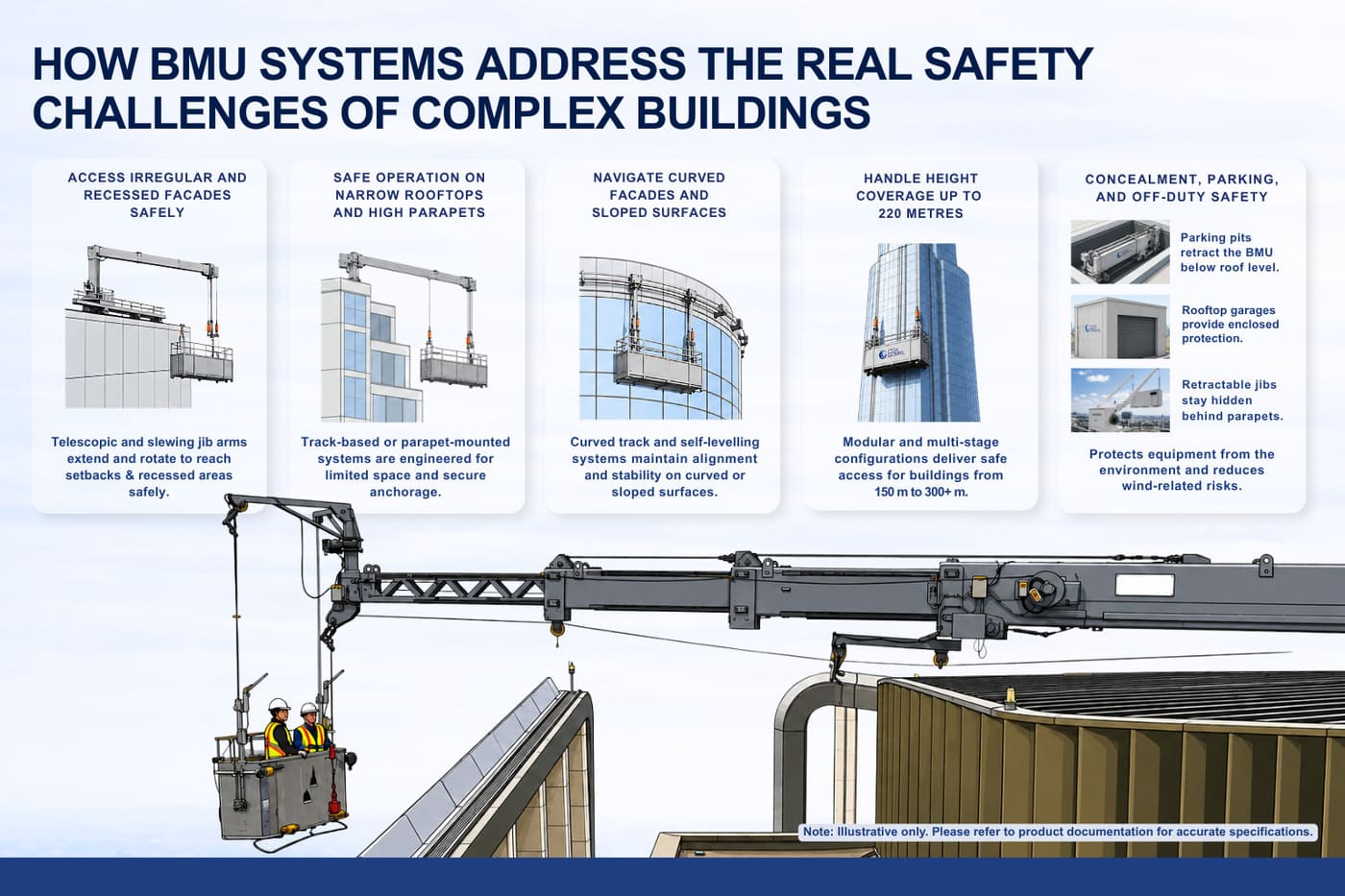
Modern architecture rarely follows simple geometry. Facades often include setbacks, curves, recessed sections, and varying elevations, while rooftops may present limited space or structural constraints. These conditions create access challenges that temporary systems cannot safely handle.
A well-designed building maintenance unit safety system addresses these challenges through engineered movement, controlled positioning, and building-specific configuration.
Safety in a BMU system is achieved through multiple layers of protection working together rather than relying on a single feature.
Modern BMU systems incorporate built-in safeguards designed to prevent incidents before they occur. Obstruction sensors detect contact with the facade and immediately stop movement to avoid damage or instability. Overload detection systems prevent operation when the platform exceeds its rated capacity, ensuring that load limits are never compromised. Additional safety mechanisms include centrifugal brakes that activate automatically during overspeed descent and electromagnetic brakes that hold the platform securely in position when not in motion. In the event of a power failure, manual descent devices allow operators to lower the platform safely to ground level.
Platform stability is central to safe operation at height. BMU platforms are suspended using a working rope with an independent secondary safety rope at each suspension point. In twin-suspension configurations, this typically results in four lines. Across Facade Access Solutions systems, rated working loads typically range from 240 kg to 1,000 kg, depending on the application. Rope diameters vary accordingly, ensuring that each system is tailored to its specific requirements. The addition of slewing functionality allows operators to adjust the platform position with precision, maintaining alignment with the facade without needing to reposition the entire system.
Modern BMU systems are defined by their advanced digital capabilities. Remote monitoring allows facilities managers to track system performance in real time, receive alerts, and plan maintenance proactively. Wind monitoring systems add another layer of protection by automatically stopping operation and securing the system when conditions exceed safe limits. This removes reliance on operator judgement during changing weather conditions and ensures a consistent safety response.
While temporary access methods may appear cost-effective initially, they introduce greater long-term safety risks and operational limitations.
| Safety Factor | BMU System | Swing Stage | Rope Access |
|---|---|---|---|
| Anchor System | Permanent, engineered | Temporary rigging | Temporary anchors |
| Fall Protection | Multi-rope redundancy | Limited | Single rope |
| Load Control | Automated | None | Minimal |
| Weather Response | Automated | Manual | Manual |
| Stability | Enclosed platform | Sway risk | No platform |
| Coverage | Full facade | Limited | Limited |
Swing stages rely heavily on manual setup and judgement, while rope access is limited in both load capacity and positioning control, particularly on complex facades. A BMU system provides a stable, enclosed working environment with integrated safety features and consistent performance.
Not every building requires the same solution. The right BMU system depends on height, facade complexity, rooftop configuration, and maintenance requirements. Buildings with standard facades and moderate height can benefit from compact or economical systems that offer reliable access with straightforward installation. More complex structures, particularly those with irregular geometry or significant height, require modular systems that provide greater flexibility and reach. Where architectural appearance is a priority, concealed parking solutions allow the system to remain hidden when not in use. For retrofit projects, structural feasibility assessments are essential to ensure that the building can safely support the system. Facade Access Solutions supports this process through integrated design services, ensuring that each system is engineered to meet both safety and operational requirements.
Facade Access Solutions has delivered more than 16,000 systems worldwide and operates across 39 locations. Its engineering teams support projects globally, including some of the most demanding high-rise developments. Facade access is not a secondary consideration. It is a critical component of building safety and long-term performance. From early design consultation through to installation and ongoing service, Facade Access Solutions provides a complete lifecycle approach to facade access systems.
Contact the team to discuss your facade access and safety requirements.
Disclaimer: Graphics shown are illustrative only and do not represent actual products, equipment, or real-life conditions.
Speak with our specialists to explore the right solution for your building.
ContactA BMU system is a permanent facade access solution designed for high-rise buildings, providing safe and controlled access for cleaning, inspection, and maintenance tasks.
BMU systems comply with EN 1808 and OSHA regulations, which define strict requirements for design, load capacity, and operational safety.
Falls are prevented through multiple safety layers, including independent wire ropes, braking systems, and enclosed platforms that ensure stability at height.
Yes, modern systems are engineered to navigate curved, recessed, and irregular facades using telescopic jibs and specialized track systems.
Wind monitoring systems automatically stop operation and secure the unit when conditions exceed safe limits, protecting both workers and equipment.