Facade access systems fall into several broad categories, each suited to a different building height, facade geometry, and maintenance requirement. For mid-rise and high-rise buildings, these systems are essential to support safe and efficient facade cleaning, inspection, and repair.
From permanent Building Maintenance Units (BMUs) to davit systems, monorails, suspended platforms, rope access, and supporting systems, each solution plays a distinct role in building facade cleaning and long-term maintenance planning. The right system depends on structural design, access frequency, and operational demands. This article covers all major categories and outlines the structural, regulatory, and design factors that influence selection.
Facade access systems directly affect worker safety, regulatory compliance, and long-term maintenance cost. Failing to integrate an appropriate system during the design phase often leads to non-compliance, unsafe temporary solutions, or expensive retrofits later in the building lifecycle.
In many regions, buildings above certain height thresholds are legally required to include permanent facade access systems. These systems significantly reduce risk by incorporating engineered safety mechanisms such as dual-line suspension, stabilization, and controlled operation. They also ensure complete coverage for external facade cleaning, eliminating maintenance gaps that can lead to long-term deterioration or warranty issues.
Facade access systems fall into two primary categories: permanent and temporary. Permanent systems, including BMUs, monorails, davit base networks, and tieback anchors, are integrated into the building and available year-round. They require periodic inspection and certification, rather than repeated setup approvals, making them more efficient over time.
Temporary systems, such as mobile elevated work platforms, scaffolding, outrigger, and rope-based setups, are installed per job and must be recertified before each use. While useful for short-term tasks, they are less efficient for buildings requiring regular commercial facade cleaning or inspection. For most mid-rise and high-rise buildings, permanent systems provide better compliance, improved safety, and lower lifecycle cost.
A permanent facade access system becomes necessary based on several key factors. Building height is the primary driver. Facade complexity is another critical consideration. Buildings with curved, recessed, or cantilevered designs typically require engineered access solutions that temporary systems cannot safely accommodate. Frequency of maintenance also plays a role, as buildings requiring regular cleaning or inspection benefit from systems that are always ready for use. In addition, many facade contractors require a permanent access system before issuing warranties, making early integration essential.
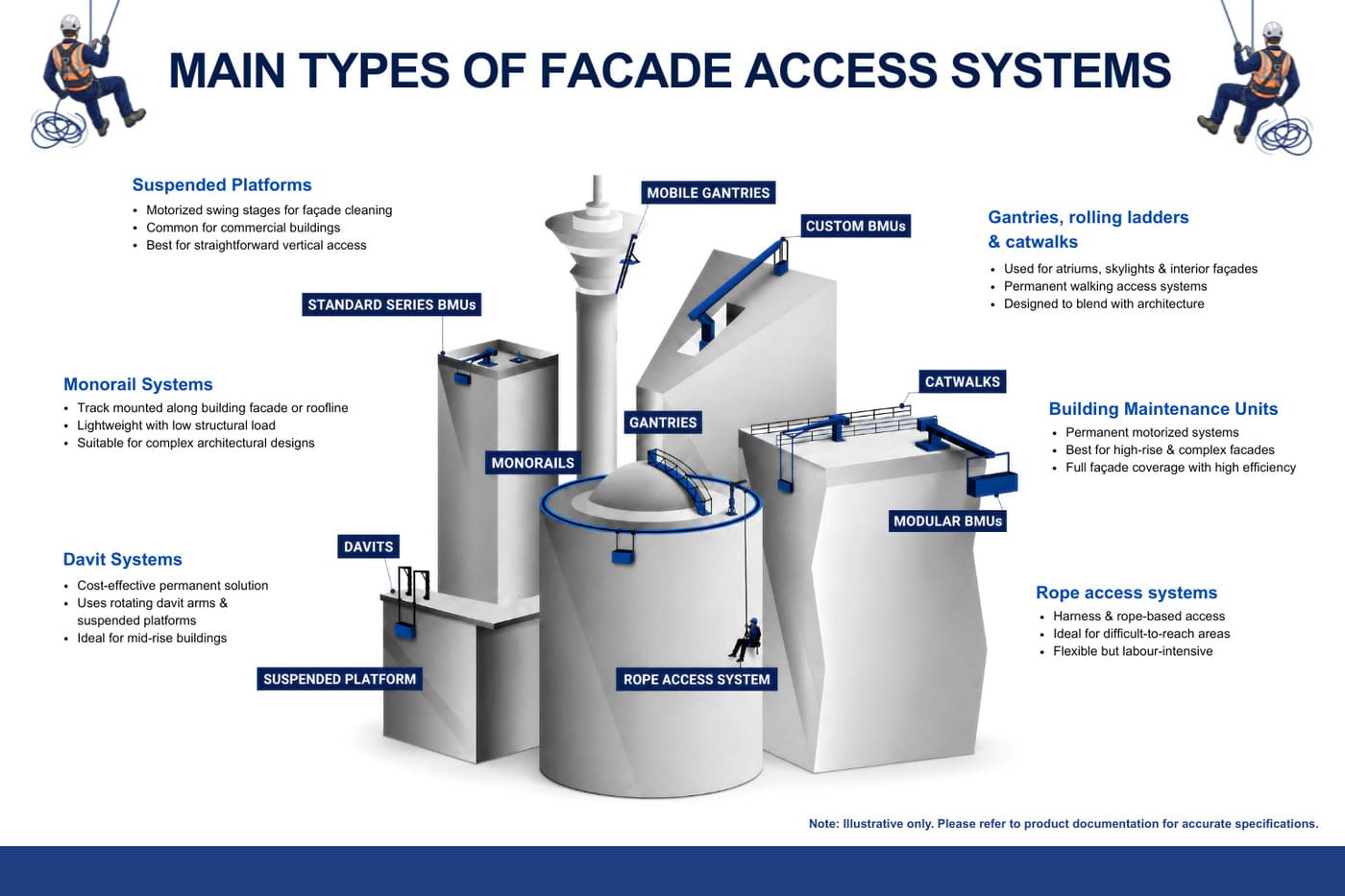
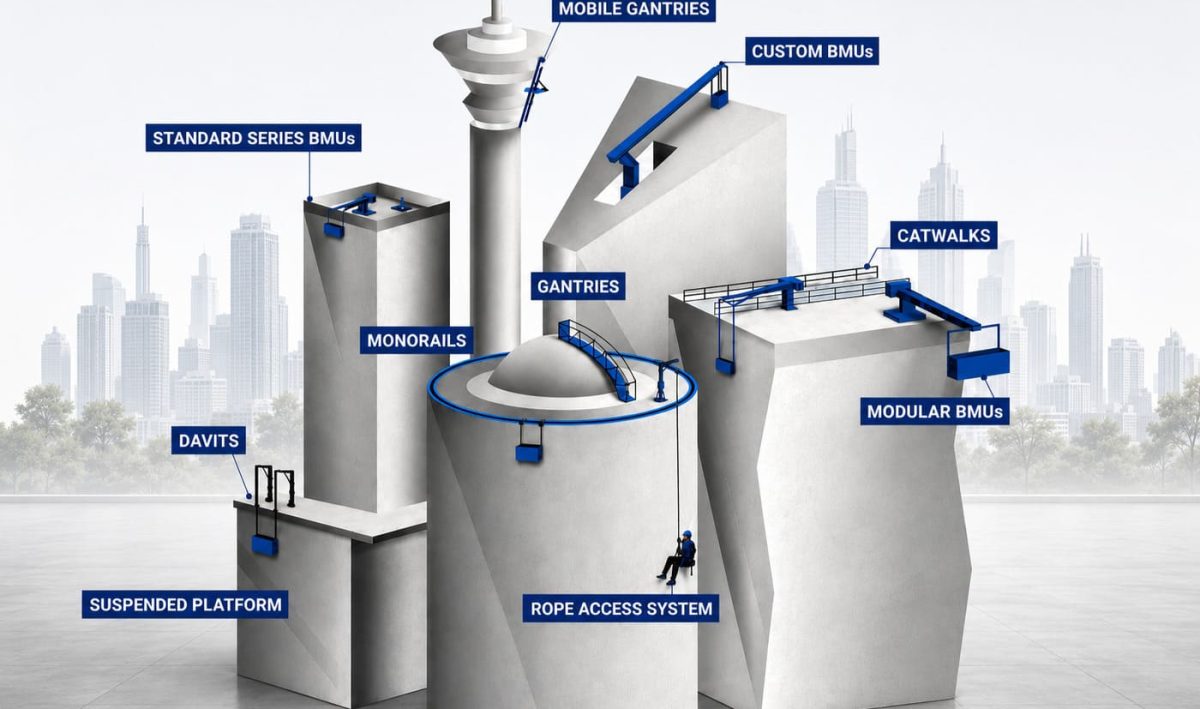
Facade access systems range from large, permanently installed motorized units to lightweight track-based systems, davit, monorail and rope-based solutions. These systems support a wide range of applications, from routine building facade cleaning services to complex inspection and repair tasks. Each system has distinct capabilities, structural requirements, and operational advantages.
A Building Maintenance Unit is a permanently installed, motorized system that allows a suspended platform to travel vertically and horizontally across a building facade. BMUs are the standard solution for high-rise and complex buildings, offering full coverage and efficient operation. Facade Access Solutions, part of Alimak Group, has delivered BMU systems on landmark projects including the Burj Khalifa, Shanghai Tower, and Merdeka 118 through its CoxGomyl and Manntech brands.
Compact BMUs are designed for buildings with simple facades and limited roof space. They operate on roof tracks or concrete runways and offer low visual impact while remaining easy to maintain. Modular BMUs provide greater flexibility for mid-rise to high-rise buildings with more complex geometry. Their configurable design allows adjustments without requiring full system replacement. Custom and telescopic roof cars are engineered for architecturally complex or supertall buildings. These systems can include telescoping arms, articulating platforms, and concealed parking solutions that integrate with the building design.
Davit systems are a traditional and cost-effective solution for facade cleaning equipment in permanent installations. They consist of fixed bases, rotating davit arms, suspended platforms, and safety lifelines. Portable davit arms are a cost-effective solution typically used on buildings up to ~90 m (300 ft), where manual repositioning is operationally acceptable. With powered davit carriages on roof tracks, the same equipment family can service high-rise buildings when properly engineered for the project requirements. Powered davit carriage systems eliminate manual repositioning by allowing the davit system to travel along a fixed track. This significantly improves efficiency for mid-rise and high-rise buildings with frequent maintenance needs.
Monorail systems use a track mounted along the building facade or roofline, allowing a trolley and suspended platform to move horizontally. These systems are particularly effective for buildings with recessed facades, atriums, or areas inaccessible to roof-mounted equipment. Standard monorail tracks are lightweight and impose minimal structural load. Advanced configurations can include intersections to expand coverage. Climbing monorail systems allow movement along inclined or curved surfaces, making them suitable for complex architectural designs such as sloped roofs or glazed atriums.
Suspended platforms, also known as swing stages, are motorized cradles supported by roof-mounted systems. They are widely used for external facade cleaning across commercial buildings. These platforms typically support two operators and allow vertical movement along the facade. However, horizontal repositioning requires detachment and repositioning before use, making them less efficient for large or complex structures. For taller buildings, BMUs or powered davit systems are generally more suitable.
Rope access systems allow technicians to ascend and descend a building facade using harnesses and ropes secured to structural anchors. Rope access friendly systems can be designed utilizing tieback placement conducive to application and design or rope access procedures. These systems are best suited for short-duration tasks or difficult-to-reach areas. Labour-intensive operation can lead to higher long-term costs compared to permanent systems.
Gantries, rolling ladders, and catwalks are specialized systems used for accessing glass roofs, atriums, and interior facades. Gantries move along tracks and allow safe walking access, while rolling ladders provide angled positioning for maintenance work. Catwalks are permanent walkways integrated into the building structure, enabling safe inspection and light maintenance. These systems are typically designed to align with architectural aesthetics while supporting safe access.
The most effective approach is to utilize FAS Integrated Design Service (IDS) or involve a facade access specialist early in the design process. This ensures that structural requirements, roof loads, and system integration are considered from the outset. The following factors determine the most appropriate solution.
Building height and facade geometry are the primary factors in system selection.
| Building Type | Recommended System | Key Consideration |
|---|---|---|
| Low-rise (under 130 ft (39.6 m)) | Tieback anchors, portable davits | Confirm roof anchor load requirements; rope access requires recertification per use |
| Mid-rise (130 ft (39.6 m) to 300 ft) | Davit system with powered platform | Stabilization anchors required above 130 ft; base spacing aligned with structural grid |
| High-rise (300 ft to 490 ft) | Powered davit carriage or compact BMU | Eliminates manual repositioning; confirm roof load capacity |
| Supertall or complex geometry | Modular or custom BMU, telescopic roof car | Early design integration required; custom engineering needed |
| Limited roof space | Monorail system | Lightweight profiles reduce structural load; can be concealed within architecture |
| Glazed atrium or glass roof | Gantry, rolling ladder, or catwalk | Track follows roof profile; manual or motorized options available |
| Retrofit or existing building | Davit system or monorail | Structural assessment required before specification |
Facade geometry further influences system choice. Buildings with curves, setbacks, or irregular profiles often require custom-engineered solutions or a combination of systems to achieve full access coverage.
Buildings with frequent cleaning schedules benefit from permanent systems that minimize setup time and operational cost. Systems used for building facade cleaning services on a weekly or monthly basis must be efficient and easily deployable. Buildings with lower maintenance frequency may rely on simpler systems, but lifecycle cost should always be considered. Davit systems and anchor networks also provide flexibility for multiple maintenance functions, including inspections and repairs.
Each facade access system imposes specific loads on the building structure. These loads must be validated by a structural engineer during the design phase. Davit systems apply localized loads at base points, while BMUs can weigh several tons depending on configuration. Monorail systems offer a lower-load alternative and are often used where roof capacity is limited. For retrofit applications, all mounting methods must be carefully assessed to ensure compatibility with the existing structure.
All facade access systems must comply with applicable safety standards. In North America, this includes OSHA and local regulations, while Canada follows CSA standards and Europe adheres to EN 1808. Permanent systems require a periodic inspection by a competent person under OSHA 1910.66(g)(2), EN 1808 §9, and ASME A120.1 §10. Load testing is performed at commissioning and after any modification, repair affecting the load path, or relocation — not annually.
Facade Access Solutions, part of the Alimak Group, has over 80 years of experience and more than 16,000 systems installed worldwide. With engineering teams across Germany, Spain, Luxembourg, Toronto, Dubai, and Singapore, the company supports projects from early design through to installation, ensuring compliance and long-term performance. We also offer Integrated Design Services (IDS) which will help with design of the safest, most practical and economical solution. Speak to a Facade Access Solutions engineer about your building.
Disclaimer: Graphics shown are illustrative only and do not represent actual products, equipment, or real-life conditions.
Speak with our specialists to explore the right solution for your building.
ContactBuilding Maintenance Units are the most commonly used system for high-rise buildings because they provide full facade coverage, efficient operation, and high safety standards for ongoing maintenance.
Permanent systems must be inspected at a frequency prescribed by local regulations with additional checks required after major events or structural changes to ensure continued compliance.
Yes, many buildings can be retrofitted with systems such as davits or monorails. A structural assessment is required to confirm load capacity and determine appropriate mounting methods.
A davit system uses fixed bases with portable or track-mounted arms, while a BMU is a fully integrated motorized system capable of moving across the building automatically.
Yes, all systems must be certified to meet safety standards. Certification includes inspection, load testing, and documentation by a qualified professional.