Not all lifts used for facade work serve the same purpose. Some are designed to solve short-term access challenges during construction. Others are engineered to support a building’s full maintenance lifecycle over decades. For architects, engineers, and building owners, understanding that distinction is the real starting point for proper specification.
This article breaks down the different types of lifts used for facade access, from temporary mobile platforms to permanent engineered systems. It also explains how to choose the right solution based on building height, facade complexity, maintenance frequency, and compliance requirements.
Facade access systems generally fall into two categories: temporary suspended access equipment used during construction and permanent facade access systems designed for long-term building maintenance. The appropriate solution depends on building height, facade geometry, access frequency, and compliance requirements.
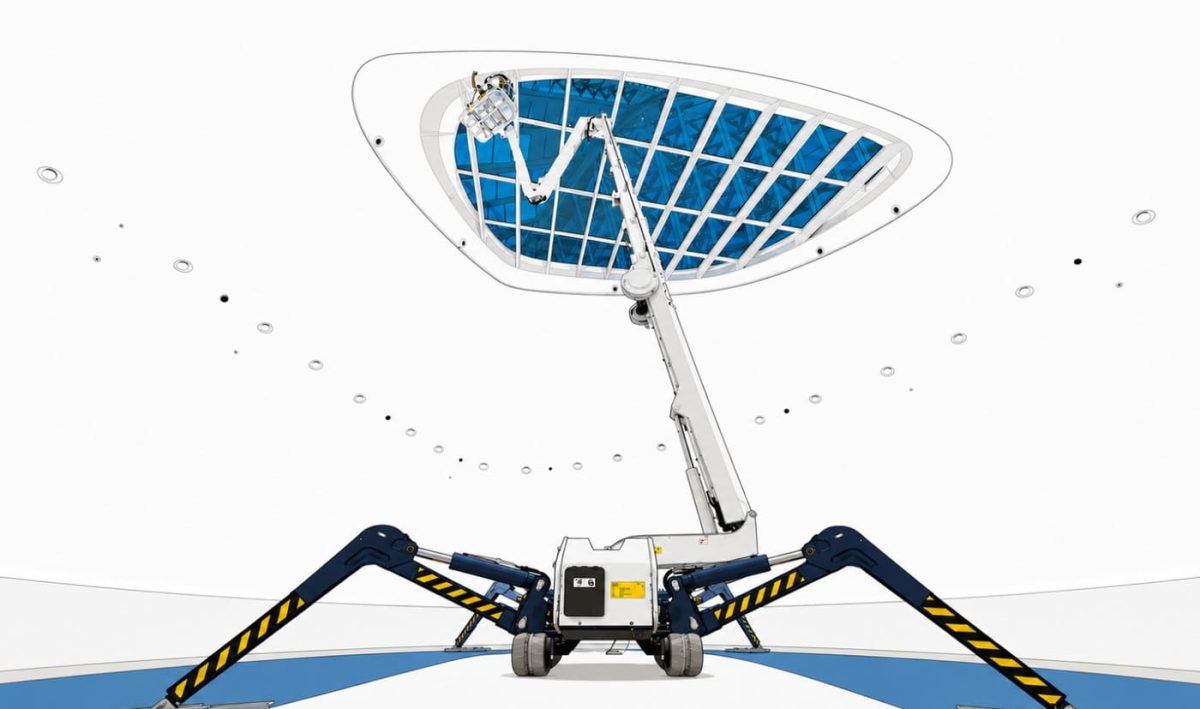
Temporary lifts, commonly referred to as mobile elevating work platforms (MEWPs), include boom lifts, scissor lifts, and mast climbers. These systems are not fixed to the building. They are deployed for specific tasks and removed once work is complete. They are cost-effective for construction and short-term access. However, their reach limits, dependence on ground-level setup, and exposure to wind make them unsuitable for routine maintenance on mid-rise and high-rise buildings.
Governed by EN 1495, mast climbers can exceed 100 m in height and are commonly used for projects requiring extended vertical access and material handling efficiency. However, they are temporary systems erected specifically for construction or large-scale facade refurbishment projects and are not intended for routine facade maintenance on occupied buildings.
Once a building is complete, temporary lifts are no longer viable for routine maintenance. Permanent facade access systems are engineered into the building structure and designed to provide safe, efficient access throughout the building’s lifecycle. These systems are not off-the-shelf solutions. They are custom-designed to match building geometry, rooftop configuration, and structural constraints. They must also comply with key standards such as EN 1808, OSHA 1926, and CAN/CSA-Z271 and CSA Z91.
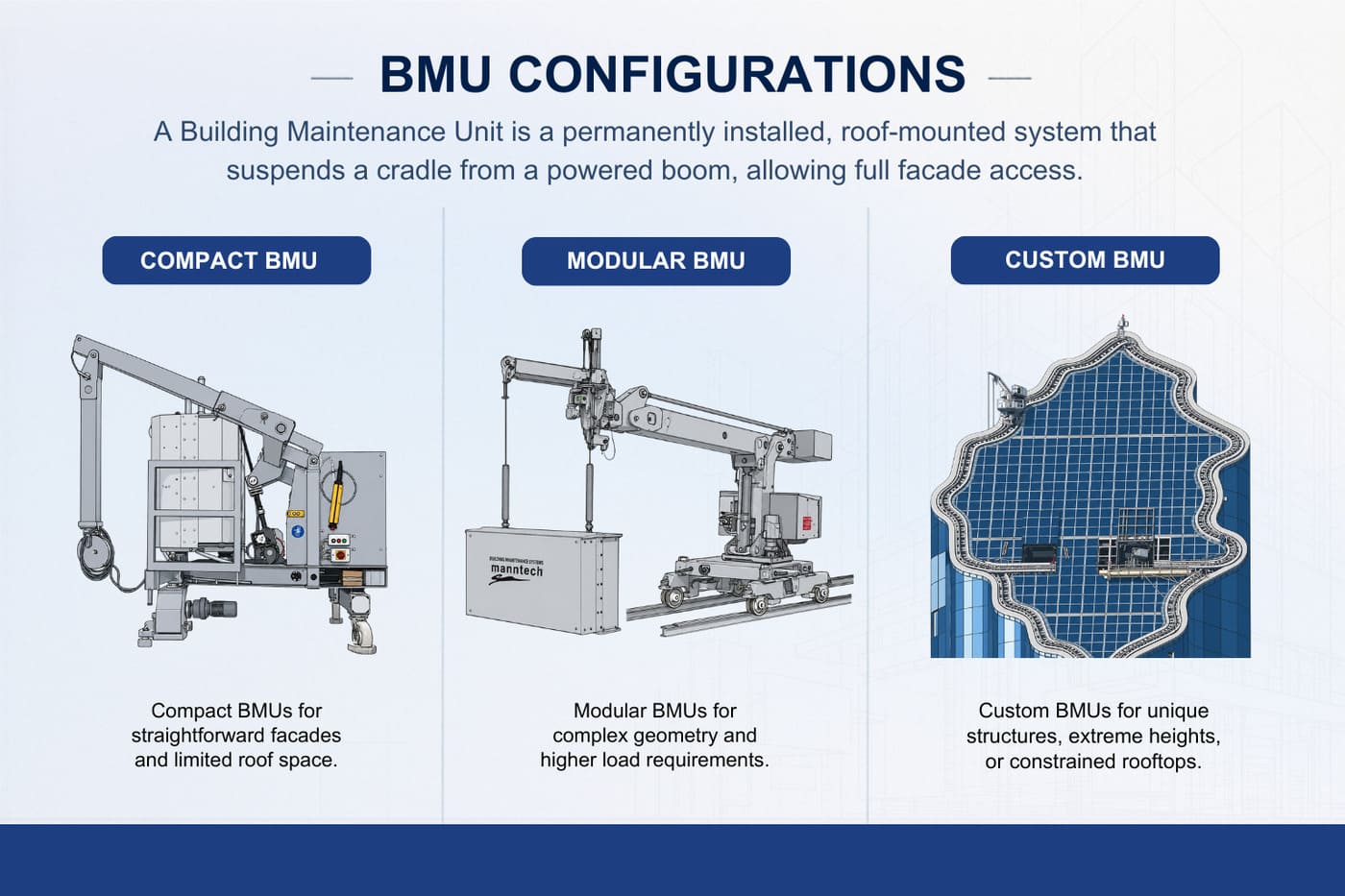
Facade Access Solutions offers three BMU configurations:
Compact BMUs typically service buildings up to approximately 150 m. Modular BMUs extend coverage to approximately 300 m. Custom multi-stage drum-hoist BMUs are engineered for supertall buildings. Alimak Group brands have delivered systems on landmark projects including the Burj Khalifa (828 m), Merdeka 118 (679 m), and Shanghai Tower (632 m). Safety is fully integrated into system design. Cradles are typically suspended on a working rope plus an independent secondary safety rope at each suspension point — so a twin-suspension cradle commonly runs four lines (two working + two safety). The exact configuration depends on cradle length, SWL, and EN 1808 redundancy provisions.
Davit systems provide a cost-effective permanent access solution using fixed rooftop bases and portable davit arms. In operation, the davit boom rotates over the parapet, while a suspended platform travels along the boom via a trolley system. Powered davit carriages improve efficiency by moving along a roof track system. This removes manual repositioning and allows faster deployment across larger buildings. These systems can service structures up to 200 metres.
Davit systems also support multiple configurations, including work cages and bosun chairs, making them adaptable across different maintenance tasks.
Selecting the right facade access system is not a single-variable decision. It requires a structured assessment of building height, facade geometry, frequency of access, and compliance obligations. Each factor influences not only the type of system that can be installed, but also how effectively it will perform over the building’s lifecycle.
A solution that appears cost-effective at specification stage may introduce operational inefficiencies, increased labour requirements, or compliance risks once the building is in use. For this reason, system selection should be approached as part of the building’s long-term asset strategy rather than a short-term construction decision. In practice, this means evaluating how the system will be used over time, not just how it is installed.
Buildings with complex geometries or frequent maintenance cycles benefit from fully integrated systems that reduce setup time and improve access consistency. At the same time, regulatory requirements such as anchor placement and load capacity must be designed into the structure early. Engaging facade access specialists during the design phase ensures the selected system is technically viable, compliant, and aligned with long-term operational efficiency.
Building height sets the baseline for selecting the appropriate access system. For buildings up to approximately 15 to 18 metres, mobile elevating work platforms such as boom lifts or scissor lifts may be sufficient for construction-phase access and light maintenance. Once a building exceeds this range — especially for mid-rise or high-rise structures in regular use — a permanent facade access system becomes necessary.
Complexity must be evaluated alongside height. A six-storey building with deep recesses, stepped setbacks, or overhangs may require a monorail or custom BMU, while a taller building with a flat facade may not. Both height and geometry must be assessed together to ensure complete and safe access.
Facade geometry determines how access must be delivered once system type is broadly defined. A flat facade with a consistent parapet is the simplest condition and can typically be serviced by a compact BMU operating on a horizontal track system. This setup allows efficient coverage with minimal system complexity. As geometry becomes more complex, access solutions must adapt. Curves, overhangs, setbacks, fins, and recesses require systems that can safely reach or follow these features, including telescopic jibs, articulating platforms, or curved tracks. For interior atria or enclosed spaces, monorails are often required.
The frequency of facade maintenance directly impacts system selection and long-term efficiency. For buildings that require access only once or twice a year, a davit system paired with a self-powered cradle is often the most economical permanent solution. These systems are lightweight, require minimal rooftop infrastructure, and have low visual impact when not in use. For buildings with frequent maintenance cycles, such as regular cleaning or inspections, a fully tracked BMU system offers greater efficiency. It reduces setup time, eliminates manual repositioning, and enables faster, more consistent coverage. Over time, the higher upfront investment can result in lower operational costs.
Compliance is a structural requirement that directly affects which systems can be specified and installed. Key standards include EN 1808, OSHA 29 CFR 1926, and CAN/CSA-Z271 and Z91, alongside local codes depending on project location. These regulations define safety requirements, system design parameters, and operational constraints for facade access equipment. For buildings above 40 metres, intermittent stabilisation anchors must be integrated into the facade when suspended platforms are used. These requirements must be incorporated during design, as retrofitting is complex and costly. Proper planning ensures systems are compliant, safe, and aligned with long-term building performance.
Facade Access Solutions supports project teams through an IDS-led approach that integrates facade access requirements early in the building design process. With over 16,000 systems installed globally and engineering teams across key regions, the company provides integrated design support (IDS) from concept development and system specification through installation and long-term lifecycle service. The portfolio includes BMUs, davit systems, monorails, self-powered suspended platforms, and fall protection systems, ensuring coordinated facade access solutions for a wide range of building types and maintenance requirements.
Contact the team to discuss your facade access requirements.
Disclaimer: Graphics shown are illustrative only and do not represent actual products, equipment, or real-life conditions.
Speak with our specialists to explore the right solution for your building.
ContactA BMU is a fully integrated, roof-mounted system that automates facade access across the entire building. A davit system relies on fixed bases and movable arms, requiring more manual setup and repositioning during operation.
Temporary suspended platforms and mast climbing work platforms are commonly used during construction, facade installation, and restoration projects before permanent facade access systems are commissioned.
Standards such as EN 1808, OSHA regulations, and CSA codes define the safety, design, and operational requirements for facade access systems, depending on the region.
The correct system depends on building height, facade geometry, and maintenance frequency. Early consultation with a specialist ensures the system is properly integrated into the building design.
Yes but retrofitting requires detailed structural assessment. Load capacity, anchorage points, and compliance requirements must be carefully evaluated before installation.