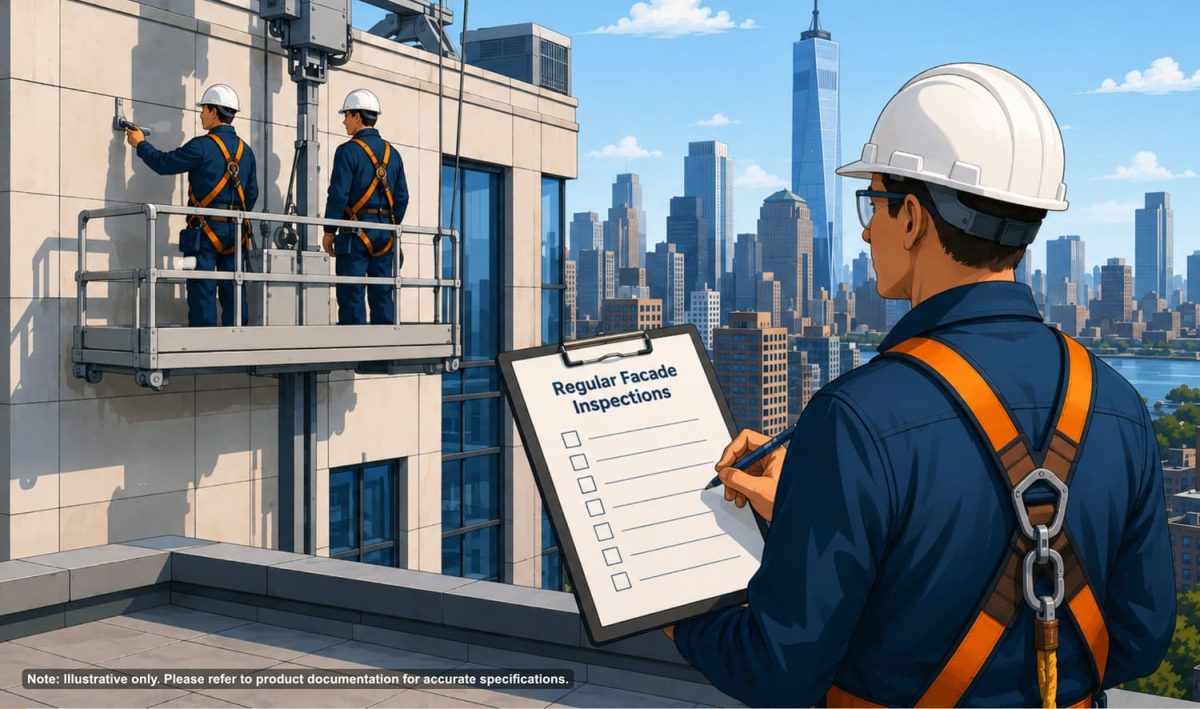
Facade inspection requirements are becoming stricter across many regions as governments respond to aging buildings, facade failures, and growing public safety concerns. What was once considered routine maintenance is now a critical compliance responsibility that affects building safety, operations, insurance, and long-term asset performance. For building owners, developers, and facilities teams, facade inspection regulations continue to evolve. Many jurisdictions now require close-range inspections, detailed reporting, and safe working-at-height access systems that allow inspectors to physically assess facade conditions.
Non-compliant buildings may face financial penalties, unsafe classifications, operational disruption, insurance complications, and increased liability exposure. For developers and asset managers, these risks can also affect long-term maintenance planning and overall asset value. A closer look at facade inspection requirements across major regions helps building teams better understand their compliance obligations. It explains who is responsible, what facade inspections typically cover, and how permanent facade access systems help support safe and efficient compliance throughout the building lifecycle.
Governments introduced facade inspection laws in response to real public safety incidents involving falling debris, facade failure, and structural collapse. These events changed how authorities approach long-term building safety and led to stricter inspection requirements across many regions. In New York City, a 1979 masonry fatality in Manhattan led to the creation of the city’s first facade inspection law, which later became the current Facade Inspection Safety Program (FISP). More recently, the 2021 Surfside condominium collapse in Florida accelerated renewed focus on aging buildings and facade safety across North America. Similar incidents in Europe, Asia, and the Middle East have also influenced local inspection regulations.
Building facades naturally deteriorate over time due to moisture, thermal movement, UV exposure, corrosion, and material fatigue. In coastal environments, salt exposure can speed up corrosion in reinforcement and facade fixings, while temperature changes can create cracks and joint failure over time. Without regular inspections and maintenance, small defects can develop into larger structural and safety risks. Routine facade inspections help identify these issues early before they lead to operational disruption or costly remediation work. In many regions, facade inspection compliance is also tied to building permits, occupancy requirements, insurance renewals, and lender reviews. As a result, inspection planning has become an important part of long-term building maintenance, risk management, and asset protection.
Facade deterioration is driven by predictable physical processes. Moisture enters through failed sealants, facade joints, and micro-cracks within the building envelope. Freeze-thaw cycles expand trapped water inside concrete and masonry. Embedded steel reinforcement corrodes and expands, creating internal pressure that weakens surrounding materials.
These changes rarely happen suddenly. Material failure compounds gradually through repeated exposure to environmental stress. Water migration behind cladding systems can remain hidden for years before visible signs emerge. Galvanic corrosion between dissimilar metals may also weaken facade fixings and anchor systems over time. Facade inspections provide a controlled method for identifying these issues before they become safety hazards. Early detection allows targeted remediation while preserving structural integrity and reducing lifecycle maintenance costs.
Regular building facade inspection programs do more than satisfy regulatory obligations. They support long-term asset performance and operational planning. Buildings with documented inspection histories are often better positioned for insurance renewals, lender documentation requirements, and future asset transactions. Consistent inspection records demonstrate proactive maintenance management and reduce uncertainty surrounding facade condition. Inspection cycles also improve capital planning. Identifying deterioration early allows property teams to schedule phased repairs rather than emergency remediation. Over time, this reduces disruption to occupants, minimizes emergency mobilization costs, and helps preserve long-term building value.
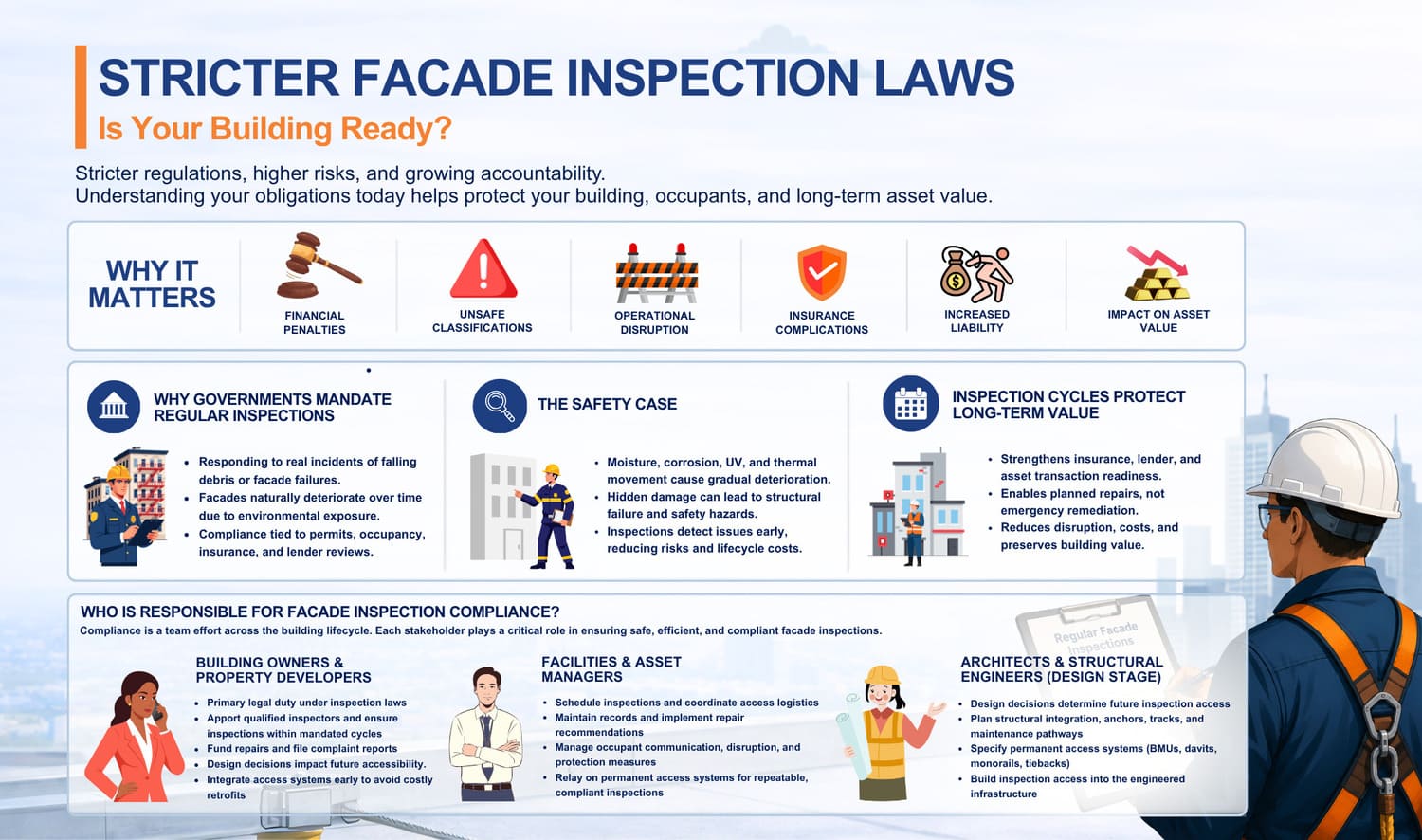
Responsibility for facade inspection compliance is not always straightforward. Legal accountability shifts depending on the stage of the building lifecycle and the role each stakeholder plays in design, construction, operations, and maintenance. In most jurisdictions, the building owner carries the primary legal obligation. However, architects, structural engineers, facade consultants, and facilities managers all influence whether inspection compliance can be achieved safely and efficiently throughout the building’s operational life.
Building owners typically hold the primary legal duty under facade inspection laws. They are responsible for appointing qualified inspectors, ensuring inspections occur within mandated cycles, funding required repairs, and filing compliant reports with the appropriate authorities. Developers also influence long-term compliance during the design and construction phases. Decisions surrounding facade geometry, roof zoning, structural loading, and access infrastructure determine whether the building can be inspected safely in the future. Buildings designed without permanent facade access infrastructure often face costly retrofit projects later. Integrating facade access systems early reduces future operational constraints and supports long-term compliance planning.
Facilities managers oversee day-to-day compliance management once the building becomes operational. Their responsibilities include scheduling facade inspections, coordinating access logistics, maintaining inspection records, and implementing repair recommendations. They also manage operational impacts associated with inspection cycles. This may include coordinating occupant notifications, minimizing tenant disruption, arranging temporary protection measures, and planning remediation schedules. As regulations become more stringent, facilities teams increasingly rely on permanent facade access systems that support repeatable, code-compliant inspection access throughout the building lifecycle.
Design-stage decisions shape whether facade inspections can be performed safely and efficiently decades into the future. Architects and structural engineers determine how facade access systems integrate with the building structure. This includes roof load capacity, parapet coordination, concealed track integration, anchor embedment, facade geometry constraints, and future maintenance pathways. Specifying permanent facade access systems such as Building Maintenance Units (BMUs), davit systems, monorails, and tieback anchors during design prevents expensive retrofits later. It also ensures that facade inspection access becomes part of the building’s engineered infrastructure rather than an operational workaround.
There is no single global standard for facade inspection requirements. Regulations vary by country, city, building type, and occupancy classification. Inspection schedules, reporting requirements, and access standards continue to evolve as governments strengthen building safety regulations. The following overview highlights some of the major facade inspection frameworks across regions where Facade Access Solutions operates. Since regulations can change over time, building owners should always confirm current requirements with local authorities or qualified inspection professionals.
New York City’s Facade Inspection Safety Program (FISP), formerly Local Law 11, requires buildings taller than six stories to undergo facade inspections every five years by a Qualified Exterior Wall Inspector (QEWI). Buildings are classified as Safe, SWARMP (Safe With a Repair and Maintenance Program), or Unsafe. Chicago follows a similar Exterior Wall Program for buildings over 80 ft, with inspection cycles ranging from four to twelve years depending on the building type and facade materials. In Canada, requirements vary by province and municipality, while suspended access equipment used during inspections commonly falls under CAN/CSA-Z271 standards.
The United Kingdom strengthened building safety regulations following the Grenfell Tower disaster. The Building Safety Act 2022 introduced stricter accountability for higher-risk residential buildings over 18 m tall. BS 8811 governs suspended access equipment used for facade inspection and maintenance, while the Construction (Design and Management) Regulations 2015 outline responsibilities for safe building access and maintenance planning.
Dubai Municipality requires facade and structural inspections as part of building permit and occupancy compliance requirements. In Abu Dhabi, the OSHAD-SF framework establishes safety requirements for working-at-height and facade access systems. The region’s extreme heat, UV exposure, and sand abrasion can accelerate facade deterioration, making regular inspections and durable access systems especially important.
Singapore introduced its Periodic Facade Inspection (PFI) regime in 2022. Buildings over 13 m in height and older than 20 years must undergo facade inspections every seven years. Australia follows the National Construction Code together with state-based Work Health and Safety regulations. Many jurisdictions require annual visual inspections along with periodic close-range assessments and documented safe work procedures.
EN 1808 is the main European standard governing suspended access equipment used for facade inspection and maintenance. France requires inspections for buildings taller than 28 m, while Germany applies state-level regulations alongside DGUV and EN 1808 standards. In the Netherlands, Bouwbesluit 2012 encourages permanent facade access systems during the design stage to support long-term maintenance and inspection access.
| Region | Governing Standard | Inspection Frequency | Height / Age Threshold | Qualified Inspector | Key Requirement |
|---|---|---|---|---|---|
| USA (NYC) | FISP / Local Law 11 | Every 5 years | 6+ stories | QEWI (PE or RA licensed in NY) | Classified report: Safe / SWARMP / Unsafe |
| USA (Chicago) | Chicago Exterior Wall Program | Every 4–12 years | Buildings over 80 ft | Licensed architect or structural engineer | Inspection cycle varies by material and building type |
| Canada | CAN/CSA-Z271 + local codes | Varies by province | Varies by municipality | Qualified structural engineer | Access equipment must comply with CSA standards |
| United Kingdom | Building Safety Act 2022, BS 8811, CDM 2015 | Varies; ongoing duty of care | 18m+ higher-risk buildings | Competent person defined by duty holder | Principal accountable person must maintain safety case |
| UAE (Dubai) | Dubai Municipality / OSHAD-SF | Per project and permit conditions | Per building permit specifications | Approved engineer registered with Dubai Municipality | Access equipment must meet OSHAD-SF framework requirements |
| Singapore | BCA PFI Regime | Every 7 years | 13m+ height and 20+ years old | PE or Registered Architect | Close-range inspection of minimum 10% of each elevation required |
| Australia | NCC + state-based WHS legislation | Annual minimum plus periodic | State-specific thresholds | Competent engineer or qualified inspector | WorkSafe documentation and safe work method statements required |
| France | Code de la Construction / EN 1808 | Typically every 10 years | Buildings over 28m | Certified technical controller | DTU standards govern suspended access equipment |
| Germany | Landesbauordnungen + DGUV / EN 1808 | Every 4 years | State-specific | Prufingenieur or accredited inspector | Access equipment must meet DGUV and EN 1808 standards |
| Netherlands | Bouwbesluit 2012 / EN 1808 | Varies | Buildings requiring maintenance access | Certified inspector | Permanent access systems encouraged at design stage |
A facade inspection is not a single check. It is a systematic assessment of every external building element that could deteriorate, detach, or create a hazard to occupants and the public. Understanding what inspectors evaluate helps building owners and facilities managers plan for the access systems, documentation, and maintenance strategies needed to support ongoing compliance.
Masonry, concrete, brickwork, curtain wall systems, and cladding panels are inspected for common defects including spalling, cracking, delamination, render failure, and efflorescence. Spalling, often referred to as concrete cancer, typically indicates internal reinforcement corrosion and progressive structural deterioration. Efflorescence appears as white salt deposits and signals moisture migration within facade materials. These issues are not always visible from ground level. Many require direct-access assessment through suspended access systems or close-range inspection methods.
Expansion joints, control joints, window perimeter sealants, waterproofing membranes, and facade transitions are examined for UV degradation, cracking, compression failure, and water ingress. Sealant failure remains one of the most common pathways for moisture to enter the building envelope. Once water penetrates the structure, corrosion and material breakdown accelerate rapidly. Early identification allows targeted repairs before deterioration spreads into structural components.
Tieback anchors, davit bases, stabilization anchors, cladding fixings, and suspended access attachment points are inspected for corrosion, loose connections, deformation, and structural integrity. These are load-bearing components that support both facade systems and maintenance operations. Failure within these elements can create severe safety risks during inspection or maintenance activities. This is why properly engineered anchor systems, including Intermittent Stabilization Anchors (ISAs), are designed to comply with OSHA, CAN/CSA-Z91, and ASME/ANSI standards. Facade Access Solutions tieback anchors and lifelines are engineered to support safe, code-compliant facade inspection and maintenance operations across a wide range of building types.
Balcony slabs, parapet walls, railings, cornices, shading structures, and projecting facade elements are inspected for slab corrosion, instability, displacement, and loose materials. These features present elevated public safety risk because they extend beyond the building line. If deterioration progresses unchecked, falling debris incidents can occur. Regular inspections help identify these conditions before they escalate into unsafe classifications or emergency remediation projects.
Understanding facade inspection requirements is only part of the challenge. The other challenge is physically accessing every part of the facade safely and in a way that satisfies modern close-range inspection obligations. As inspection regulations increasingly require direct-access assessment rather than distant visual observation, facade access systems become part of the compliance strategy itself rather than simply a maintenance tool. Without permanent access infrastructure, many buildings must rely on repeated temporary scaffolding or complex rope access mobilization during every inspection cycle. Over time, this increases cost, disruption, and operational complexity.
Many facade inspection regulations now require inspectors to physically access facade surfaces. Singapore’s BCA PFI regime requires close-range inspection of a minimum portion of each elevation. NYC’s FISP also requires hands-on assessment where conditions warrant additional investigation. Permanent facade access systems remove the logistical barrier to meeting these requirements. They ensure inspection access pathways are available whenever inspection cycles occur.
Building Maintenance Units provide engineered, motorized access to the full facade perimeter. These systems use roof-mounted track systems and suspended platforms to deliver safe, repeatable access across complex building elevations. For high-rise buildings subject to recurring facade inspections, BMUs support systematic inspection coverage while reducing reliance on temporary access methods. Facade Access Solutions BMUs are engineered to comply with OSHA, ASME A120.1, CAN/CSA-Z271, and EN 1808 requirements depending on project location. Facade Access Solutions Building Maintenance Units are designed to provide safe, repeatable access for long-term facade inspection and maintenance operations.
Not every building requires a full roofcar BMU system. Davit systems and monorail-guided suspended platforms provide targeted access solutions for buildings with more localized inspection requirements. Davit systems may include fixed bases, portable davit arms, powered platforms, and modular configurations that support flexible facade access. Monorail systems guide suspended platforms along engineered trackways and are commonly used for atriums, recessed elevations, podium structures, and specialized facade zones. Facade Access Solutions davit systems support flexible, targeted access strategies for buildings with localized facade inspection requirements. Facade Access Solutions monorail systems are engineered to support safe suspended access across specialized architectural conditions and facade geometries.
During facade inspections performed using rope access or suspended cradles, tieback anchors provide the code-required connection point used to secure access equipment safely to the building. Facade Access Solutions tieback anchors include flush-mounted, wall-mounted, and stabilization configurations engineered to comply with OSHA, CalOSHA, ASME/ANSI, and CAN/CSA-Z91 requirements. With a 5,000 lb load rating, these systems support safe working-at-height operations while ensuring inspection access points are integrated into the building from the design stage onward.
Buildings without permanent facade access systems often rely on temporary scaffolding for every inspection cycle. For buildings subject to recurring five- or seven-year inspection programs, these costs compound significantly over time. Temporary scaffolding also increases tenant disruption, extends inspection timelines, and creates recurring mobilization expenses. A high-rise residential tower entering its first mandatory inspection cycle without permanent access infrastructure may face substantial temporary access costs, occupant inconvenience, and operational delays. Permanent systems such as BMUs, davits, and monorails provide long-term inspection infrastructure that improves lifecycle efficiency and ensures compliant access remains available throughout the building’s operational life.
Skipping or delaying a facade inspection is rarely a simple operational decision. Across jurisdictions, non-compliance can trigger financial penalties, unsafe classifications, insurance complications, and direct liability exposure. These enforcement mechanisms are part of routine compliance management in many major cities and continue to become more structured over time.
Common consequences of non-compliance include:
There is also escalation risk. Under NYC’s FISP, SWARMP conditions that remain unresolved by the next filing cycle may automatically convert to Unsafe status. For developers and asset managers, facade inspection compliance now plays an increasingly important role in long-term operational planning, risk management, and asset protection.
The most cost-effective time to address facade inspection requirements is during the design stage, not after construction is complete. Buildings designed without permanent facade access infrastructure frequently face expensive retrofit projects, structural limitations, and recurring temporary access costs later in their lifecycle. Early planning changes the economics entirely. For architects, facade consultants, developers, and project managers, facade access strategy should be treated as part of the building’s long-term operational infrastructure.
Facade access systems require structural integration with the building from the earliest design phases. This planning process typically includes:
Integrating these requirements early helps prevent costly structural modifications later while ensuring the facade access strategy aligns with the building geometry and long-term maintenance objectives. Specifying these systems during design prevents costly structural modifications later while ensuring the facade access strategy aligns with the building geometry and maintenance objectives from the beginning. Facade Access Solutions provides integrated engineering, manufacturing, and installation services that support coordinated facade access planning throughout construction.
Many older buildings were constructed before modern facade inspection regulations existed and therefore lack dedicated inspection access infrastructure. Retrofitting remains possible, but it requires detailed structural assessment, roof load analysis, and careful selection of systems compatible with the existing building. For occupied buildings, minimizing disruption becomes a critical consideration during retrofit planning. Facade Access Solutions has decades of experience delivering retrofit facade access solutions for operational buildings requiring long-term inspection access improvements.
Not every building requires the same facade access solution. System selection depends on building height, facade geometry, roof configuration, inspection frequency, local regulations, and lifecycle cost objectives. BMUs are typically suited to high-rise buildings requiring full-perimeter access. Davit systems offer flexible and economical solutions for many mid-rise applications. Monorails are effective for atriums, podium structures, recessed facades, and specialized architectural conditions.
Complex buildings may require multiple integrated systems to achieve full inspection coverage. Regional compliance requirements including OSHA, EN 1808, BCA PFI, and OSHAD-SF must also be factored into system design from the outset.
Facade inspection regulations vary significantly by region, and compliance obligations continue to evolve. Working with a facade access specialist that understands both local regulations and long-term maintenance requirements reduces compliance risk while improving operational planning. Early consultation allows the facade access strategy to become part of the building design itself rather than a retrofit workaround added later.
Every building has a different facade inspection and compliance profile. Height, location, occupancy type, facade geometry, and existing infrastructure all influence the access strategy required. Facade Access Solutions supports developers, architects, building owners, and facilities teams with integrated facade access strategies designed to support long-term inspection compliance, operational efficiency, and safe building maintenance. If you are reviewing facade inspection requirements for an existing property or planning access infrastructure for a new development, Facade Access Solutions can help you evaluate the right long-term access strategy for your building.
Disclaimer: Graphics shown are illustrative only and do not represent actual products, equipment, or real-life conditions.
Speak with our specialists to explore the right solution for your building.
Request a Quote TodayFacade inspection frequency varies by jurisdiction. Many cities require inspections every five to seven years, while others mandate annual visual assessments combined with periodic close-range inspections. Requirements often depend on building height, occupancy type, and local safety regulations.
Qualified facade inspectors are typically licensed architects, structural engineers, or accredited facade specialists depending on the region. Some jurisdictions require additional certification, such as a QEWI designation in New York City.
A visual inspection is conducted from a distance using ground-level observation or adjacent viewpoints. A close-range inspection requires inspectors to physically access facade surfaces to assess materials, joints, fixings, and structural conditions directly.
Yes. Many facade inspection regulations apply to industrial facilities, institutional buildings, infrastructure structures, residential towers, and mixed-use developments. The scope depends on regional building codes and the potential public safety risk associated with the structure.
Yes. Many facade inspection regulations apply to industrial facilities, institutional buildings, infrastructure structures, residential towers, and mixed-use developments. The scope depends on regional building codes and the potential public safety risk associated with the structure.