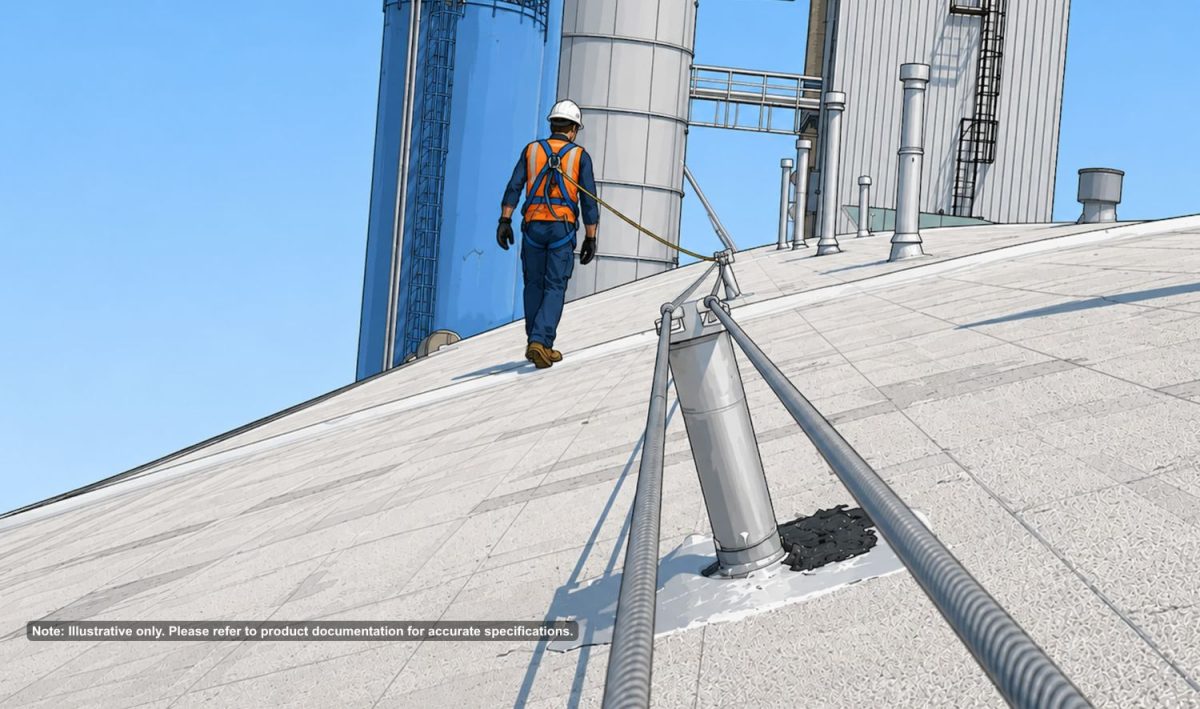
Fall protection is a non-negotiable requirement wherever facade access systems are specified, installed and operated. Whether maintenance personnel are using a building maintenance unit (BMU), suspended platform, davit system or rooftop lifeline, working at height remains one of the leading causes of workplace fatalities worldwide. Regulations exist specifically to reduce these risks and establish safe procedures for facade maintenance, inspection and cleaning operations. For architects, facade consultants, developers, facilities managers and contractors, fall protection compliance is not governed by a single international standard. Instead, requirements vary significantly across regions and are shaped by regulations including OSHA standards in the United States, EN standards across Europe, the Work at Height Regulations in the United Kingdom and regional workplace safety frameworks throughout the Middle East and Asia-Pacific.
Understanding which standards apply to a project is critical when specifying facade access equipment. A suspended access strategy designed for a tower in New York may require a different compliance approach than a project in Dubai, Singapore or London. The following sections examine the key fall protection regulations and facade access safety standards across the regions where Facade Access Solutions (FAS) operates, including North America, Europe, the United Kingdom, the Middle East and Asia-Pacific. They also highlight the standards governing BMUs, davit systems, monorails, tieback anchors, horizontal lifelines and fall arrest systems used during facade maintenance operations. All Facade Access Solutions systems are engineered to align with the applicable standards required in each project market, supporting safe and compliant maintenance access throughout the building lifecycle.
Fall protection regulations exist because working at height during facade maintenance, inspection and cleaning carries real and well-documented risks. Every suspended platform, rooftop access route and maintenance activity exposes workers to potential fall hazards, which is why regulatory frameworks across the world impose strict requirements on how elevated access equipment is designed, installed and operated. Regulatory agencies including OSHA in the United States, the Health and Safety Executive (HSE) in the United Kingdom and Safe Work Australia consistently identify falls from height as one of the leading causes of workplace fatalities in construction and building maintenance.
For building owners, architects, facade consultants and facilities managers, compliance is closely tied to building approvals, insurance coverage, operational liability and long-term maintenance planning. Permanent access equipment such as BMUs, davit systems, monorails, tieback anchors and horizontal lifelines play a critical role in supporting safe and compliant facade maintenance throughout the building lifecycle.
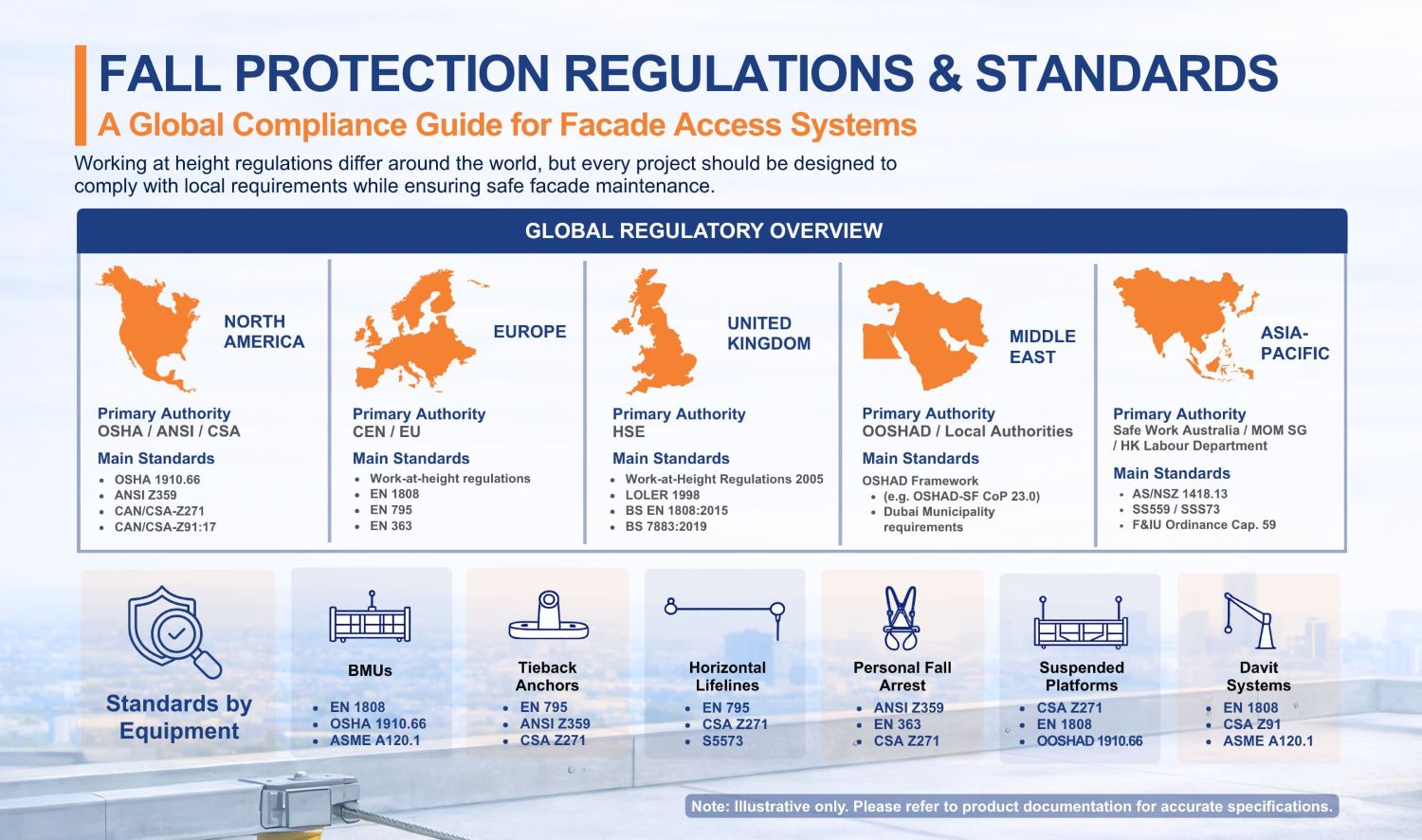
There is no single global fall protection standard governing facade access systems. Requirements vary significantly by country and, in some cases, by state, province or municipality. A high-rise project in New York may fall under OSHA 29 CFR 1910.66 and ASME A120.1, while a tower in London must comply with the Work at Height Regulations 2005 and LOLER 1998.
For architects, developers, facade consultants and facilities managers working across multiple regions, understanding which regulations apply to a project is essential when specifying suspended access equipment, rooftop safety systems and maintenance access strategies. The comparison below summarizes the primary regulatory frameworks across the regions where Facade Access Solutions operates. Because regulations continue to evolve, project teams should always verify the latest requirements with the relevant authority or qualified safety professional before finalizing facade access specifications.
Note: Regulatory requirements vary by jurisdiction and may change over time. Always verify the latest standards and compliance obligations with the relevant authority or qualified safety professional before specifying facade access systems.
| Region | Primary Body | Key Regulation | Trigger Height | Scope | BMU/Access Standard |
|---|---|---|---|---|---|
| United States | OSHA / ANSI | OSHA 29 CFR 1910.66, OSHA 29 CFR 1926 Subpart M, ASME A120.1 ANSI/ASSP Z359 | 4 ft (general industry) / 6 ft (construction) | General industry, construction, fall protection | OSHA 1910.66, ASME A120.1 |
| Canada | CSA / Provincial OHS | CAN/CSA-Z271, CAN/CSA-Z91:17 CSA Z259 | Varies by province | Suspended platforms, facade maintenance Fall protection equipment and systems | CAN/CSA-Z271 |
| European Union | CEN / EU | National work-at-height regulations, EN 1808, EN 795, EN 363 | 2 m typical national trigger | Suspended access, PPE | BS EN 1808:2015 |
| United Kingdom | HSE | Work at Height Regulations 2005, LOLER 1998, BS EN 1808:2015, BS 7883:2019 | No fixed threshold | All work at height | BS EN 1808:2015 |
| UAE / Dubai | Dubai Municipality / OSHAD | OSHAD-SF CoP 23.0, Dubai Municipality requirements | 1.8 m (Abu Dhabi) / 2 m commonly referenced in Dubai specifications | Construction, maintenance | OSHAD-SF framework |
| Australia | Safe Work Australia | WHS Regulations, AS/NZS 1418.13:2013, AS/NZS 1891 | 2 m | All industries | AS/NZS 1418.13:2013 |
| Singapore | MOM / WSH Council | WSH (WAH) Regulations, SS 559, SS 573 | 2 m | All workplaces | SS 559 |
| Hong Kong | Labour Department | F&IU Ordinance Cap. 59 | 2 m | Industrial, construction | Local CoP |
| France | Ministry of Labour | Code du travail Art. R4323-58 | No fixed threshold | Risk-based work-at-height obligations | EN 1808 |
| Germany | DGUV / State authorities | DGUV Regel 112-198, EN 1808 | 2 m typical national trigger | Maintenance, facade access | EN 1808 |
Facade access and fall protection compliance are governed by OSHA regulations, ANSI/ASSP consensus standards and ASME equipment standards in the United States. Together, these frameworks establish the requirements for suspended access equipment, personal fall protection systems and safe working procedures for maintenance personnel operating at height.
Key regulations and standards include:
Facade Access Solutions tieback anchors are designed to meet applicable OSHA, Cal/OSHA and ASME/ANSI requirements, supporting compliant suspended access operations across commercial, institutional and high-rise building projects.
In Canada, facade access and fall protection compliance are governed through a combination of CSA standards and provincial occupational health and safety legislation. While enforcement requirements vary by province, CSA standards provide the technical framework for suspended elevating platforms, fall protection systems and window cleaning operations on commercial and high-rise buildings.
Key regulations and standards include:
Facade Access Solutions anchor systems are designed to comply with CAN/CSA-Z91:17 requirements, supporting safe and code-compliant suspended access operations across Canadian commercial and institutional projects.
Beyond regional regulations, facade access equipment is also governed by technical standards covering design, manufacture, testing, inspection and operation. These standards directly influence how BMUs, suspended platforms, anchor systems and personal fall protection equipment are specified for commercial and high-rise buildings.
For architects, facade consultants and specifiers, understanding these standards is essential when evaluating suspended access compliance, rooftop safety infrastructure and long-term maintenance requirements. The overview below highlights the primary standards governing facade access equipment across different regions and equipment categories.
| Standard | Scope | Region | Relevant Equipment |
|---|---|---|---|
| EN 1808 | Safety requirements for suspended access equipment | Europe / International | BMUs, suspended platforms, cradles |
| OSHA 1910.66 | Powered platforms for building maintenance | United States | BMUs, roofcars, powered platforms |
| ASME A120.1 | Safety requirements for powered platforms | United States | BMUs, powered davit systems |
| CAN/CSA-Z271 | Safety code for suspended elevating platforms | Canada | Suspended platforms, BMUs |
| CAN/CSA-Z91:17 | Operational requirements for suspended access equipment | Canada | Suspended platforms, davits, BMUs |
| ANSI/ASSP Z359 Series | Personal fall protection systems | United States | Harnesses, anchors, lanyards, SRLs |
| EN 795 | Anchor devices for fall protection | Europe | Tieback anchors, anchor points, lifeline systems |
| EN 363 | Personal fall protection systems | Europe | Full personal fall protection systems |
| BS 7883:2019 | Guidance for anchor installation under EN 795 | United Kingdom | Anchor systems, inspection |
| AS/NZS 1891 | Industrial fall arrest systems | Australia / NZ | Harnesses, anchors, lifelines |
| SS 559 | Suspended access and lifting equipment | Singapore | BMUs, suspended platforms |
| SS 573 | Personal fall protection systems | Singapore | Harnesses, anchors, lifelines |
| CSA Z259 Series | Personal fall protection equipment | Canada | Harnesses, lanyards, lifelines, anchorage connectors |
EN 1808 is the primary European harmonised standard governing the design and operation of suspended access equipment, including BMUs, suspended platforms, roofcars and other facade maintenance systems used on commercial and high-rise buildings. The standard establishes requirements for structural integrity, platform stability, electrical systems, control systems, suspension systems and integrated safety devices used during facade maintenance operations. It also outlines testing procedures and operational safety requirements intended to reduce risks associated with working at height and suspended access activities.
All Facade Access Solutions BMUs and suspended access systems designed for European and international markets are engineered in accordance with EN 1808 requirements, supporting compliant facade maintenance operations across a wide range of building types and facade configurations.
The regulations and technical standards covered above establish the broader compliance framework for work at height and suspended access operations. In practice, those standards apply to specific categories of equipment used during facade maintenance, inspection and cleaning activities. For building owners, architects, consultants and procurement teams, understanding which standards govern which equipment types is essential when selecting compliant facade access solutions and rooftop safety infrastructure. The following sections connect key equipment categories with the standards that govern their design, testing, inspection and operation.
Permanent anchor points and tieback systems are among the most critical safety components within any facade access strategy. These systems provide the structural connection points used to secure suspended platforms, lifelines and fall arrest equipment during facade maintenance activities. Because they are load-bearing safety components and not simple rooftop fittings, anchor systems must be properly engineered, installed, tested and inspected in accordance with the applicable standards. For retrofit projects, additional structural assessment may be required to verify whether existing rooftops and anchor locations can safely support modern suspended access and fall protection requirements. Older buildings may not have been designed for current compliance standards, particularly where rooftop layouts or maintenance strategies have changed over time.
Several international standards govern the design and performance of permanent anchor systems. In the United States, OSHA requirements and ANSI/ASSP Z359.18 establish the criteria for anchorage connectors and fall protection anchorage systems used during work at height. In Europe, EN 795 defines the performance requirements for anchor devices, including Types A through E covering fixed anchors, horizontal lifelines, deadweight anchors and rail systems. EN 353-1 and EN 353-2 apply specifically to guided-type fall arresters used with rigid or flexible anchor lines, while EN 363 establishes the broader requirements for complete personal fall protection systems incorporating anchors, connectors, harnesses and fall arrest devices. Facade Access Solutions tieback anchors are engineered to meet applicable OSHA, Cal/OSHA, ASME/ANSI and CAN/CSA-Z91:17 standards for suspended access systems.
Guardrails are one of the most effective forms of collective fall protection used on rooftops and maintenance access areas. Unlike personal fall arrest systems that rely on individual operator equipment, guardrails provide a passive safety barrier designed to prevent personnel from reaching exposed fall hazards in the first place. Within the hierarchy of controls used in fall protection planning, collective protection measures such as guardrails should be prioritised wherever feasible before relying solely on personal fall arrest systems. The hierarchy focuses first on eliminating hazards, followed by passive or collective protection measures that reduce operator exposure to fall risks before administrative controls and PPE are introduced.
Because guardrails create a physical barrier between personnel and exposed roof edges, they help minimise reliance on active fall arrest systems and reduce the risk of human error during rooftop maintenance activities. On commercial and high-rise buildings, guardrails are often integrated alongside BMUs, monorails, davit systems and rooftop track systems to support safer rooftop movement and maintenance access. Rooftop edge protection systems on commercial buildings are typically governed by BS 6180, BS EN 1991-1-1 and Building Regulations Part K in the United Kingdom and Europe. BS EN ISO 14122-3 applies primarily to industrial machinery and rooftop plant access systems rather than general rooftop edge protection for occupied buildings. Under AS 1657:2018, permanent guardrail systems used for industrial access and rooftop safety applications must maintain a minimum guardrail height of 1,000 mm.
Even well-designed facade access systems can develop compliance gaps when fall protection planning is introduced too late or treated separately from the overall building maintenance strategy. One common issue is delaying facade access coordination until after rooftop layouts and mechanical systems have already been finalised. This can create space conflicts that limit safe movement or reduce the available area for BMUs, monorails and anchor systems.
Another frequent mistake is treating tieback anchors as standard rooftop fittings rather than engineered structural safety components. Permanent anchors must be designed, tested and certified to the applicable standards to support safe suspended access operations. Retrofit projects can also present challenges, particularly where older buildings were not originally designed to accommodate modern rooftop safety infrastructure or working at height regulations. Finally, compliance should not be viewed as a one-time certification process. Ongoing inspections, recertification and operator training are essential to maintaining safe and compliant facade maintenance operations throughout the building lifecycle.
For developers, architects and facilities managers working across multiple jurisdictions, navigating different fall protection frameworks is a practical challenge. A building in Dubai operates under different standards than one in Sydney, Singapore or New York. Trigger heights, inspection obligations, anchor requirements and operator competency standards can all vary depending on the region involved.
Ensuring compliance across international projects requires more than selecting access equipment that meets a single standard. Project teams must evaluate local regulations, identify the applicable technical standards and ensure that suspended access systems and rooftop safety infrastructure align with regional requirements from the earliest stages of design. With engineering teams located in Germany, Spain, Luxembourg, Toronto, Dubai and Singapore, Facade Access Solutions supports region-specific compliance strategies across North America, Europe, the United Kingdom, the Middle East and Asia-Pacific.
The most effective way to ensure compliance is to address fall protection requirements during the building design stage before construction begins. Early planning allows project teams to identify potential fall hazards, determine the appropriate maintenance strategy and integrate compliant access systems into the building design from the outset rather than relying on retroactive solutions later in the project lifecycle.
A fall hazard assessment evaluates every area where maintenance personnel may be required to work at height, including facades, rooftops, recessed elevations, atriums, canopies and architectural features that require ongoing inspection, cleaning or repair. For specifiers evaluating rooftop layouts and maintenance strategies, early coordination is particularly important on complex or retrofit projects where structural limitations, rooftop congestion or architectural features may affect equipment placement and long-term maintenance planning.
Maintaining compliance with fall protection regulations requires more than installing compliant access equipment. Ongoing inspection, testing, maintenance and recertification are essential throughout the operational life of the building. The overview below summarises the typical inspection frequencies associated with facade access systems and rooftop safety infrastructure.
| Component | Standard Reference | Recommended Frequency | Inspected By |
|---|---|---|---|
| Tieback anchors | OSHA / EN 795 / BS 7883 | Annually (minimum) | Competent person / qualified engineer |
| BMUs / Suspended platforms | EN 1808 / OSHA 1910.66 / ASME A120.1 / LOLER | Annually + pre-use checks | Certified engineer or competent person |
| Harnesses and lanyards | ANSI Z359.1 / EN 365 | Before each use + annually | Competent person |
| Horizontal lifelines | EN 795 / ANSI Z359.6 | Annually | System designer or installer |
| Guardrails | OSHA 1910.29 / BS 6180 / EN 13374 | Annually or after impact event | Competent person |
| Monorail and track systems | EN 1808 / ASME A120.1 | Annually + pre-use checks | Manufacturer or certified engineer |
Fall protection compliance is not a one-size-fits-all process. Requirements can vary significantly depending on the building location, height, facade geometry, maintenance strategy and whether the project is a new build or retrofit development. Early coordination with facade access specialists helps project teams avoid redesigns, compliance gaps and long-term maintenance limitations by integrating suspended access equipment and rooftop safety infrastructure into the building strategy from the outset.
With engineering teams across six global locations and experience spanning more than 16,000 installations, Facade Access Solutions supports compliant facade access strategies across North America, Europe, the United Kingdom, the Middle East and Asia-Pacific. FAS provides full single-source responsibility from concept development through design, manufacturing, installation, commissioning and ongoing service support, helping ensure that compliance considerations remain integrated throughout the operational life of the building.
Disclaimer: Graphics shown are illustrative only and do not represent actual products, equipment, or real-life conditions.
Speak with our specialists to explore the right solution for your building.
Request a Quote TodayEN 1808 is the primary international standard governing suspended access equipment, including BMUs and suspended platforms. It establishes requirements for structural integrity, platform stability, electrical systems, control systems, safety devices, testing procedures and operational safety for facade maintenance equipment used on commercial and high-rise buildings.
Trigger heights vary depending on the region and applicable regulation. OSHA requires fall protection at 4 ft in general industry under OSHA 29 CFR 1910.28 and 6 ft in construction under OSHA 29 CFR 1926.501(b). Many jurisdictions including Germany, Australia, Singapore and Hong Kong commonly apply 2 m trigger heights, while the United Kingdom follows a risk-based approach under the Work at Height Regulations 2005 (WAHR) without a fixed threshold. In the United Kingdom, the Work at Height Regulations apply whenever there is a risk of injury from a fall regardless of a specific height threshold.
Most facade access systems and fall protection equipment require annual inspections by a competent person or certified engineer. Pre-use checks are also typically required before each operation, while anchor systems and suspended access equipment may require additional testing or recertification following modification, repair or major maintenance work.
Yes. New buildings can integrate facade access systems and rooftop safety infrastructure into the original design process, which often simplifies compliance planning. Retrofit projects may require additional engineering assessments, structural evaluations and customised access solutions to accommodate existing building conditions and updated regulatory requirements.
Fall protection compliance is typically a shared responsibility between building owners, architects, consultants, contractors and maintenance providers. Responsibilities may vary by jurisdiction and project phase, but all parties involved in the design, installation, operation and maintenance of facade access systems play a role in supporting safe and compliant working at height operations.