
Cleaning a 200-meter tower is not simply a maintenance task. It is a carefully planned operation involving specialized equipment, trained personnel, safety protocols, and long-term scheduling.
For engineers, facility managers, and building owners responsible for commercial high-rises, facade cleaning is an ongoing operational discipline rather than a reactive service. Cleaning schedules are measured in months and years. Equipment is engineered with redundancy in mind. Every descent follows strict inspection and safety procedures, and environmental conditions are monitored continuously. The buildings that maintain clean, visually striking facades over decades do so because facade access was considered as carefully as any other critical building system. Understanding how these operations function provides valuable insight into the long-term management of high-rise assets.
Cleaning frequency is rarely consistent across an entire tower. Instead, facades are divided into zones based on visibility, occupancy, and operational priorities. Shanghai World Financial Center (SWFC) provides a clear example of this approach. The 492-meter-tall skyscraper utilizes 19 building maintenance units (BMUs) operating from seven machine levels to maintain approximately 95,000 square meters of facade. Observation deck areas are typically cleaned twice each month, while office zones may follow a two-month cycle. Hotel sections are adjusted according to occupancy requirements.
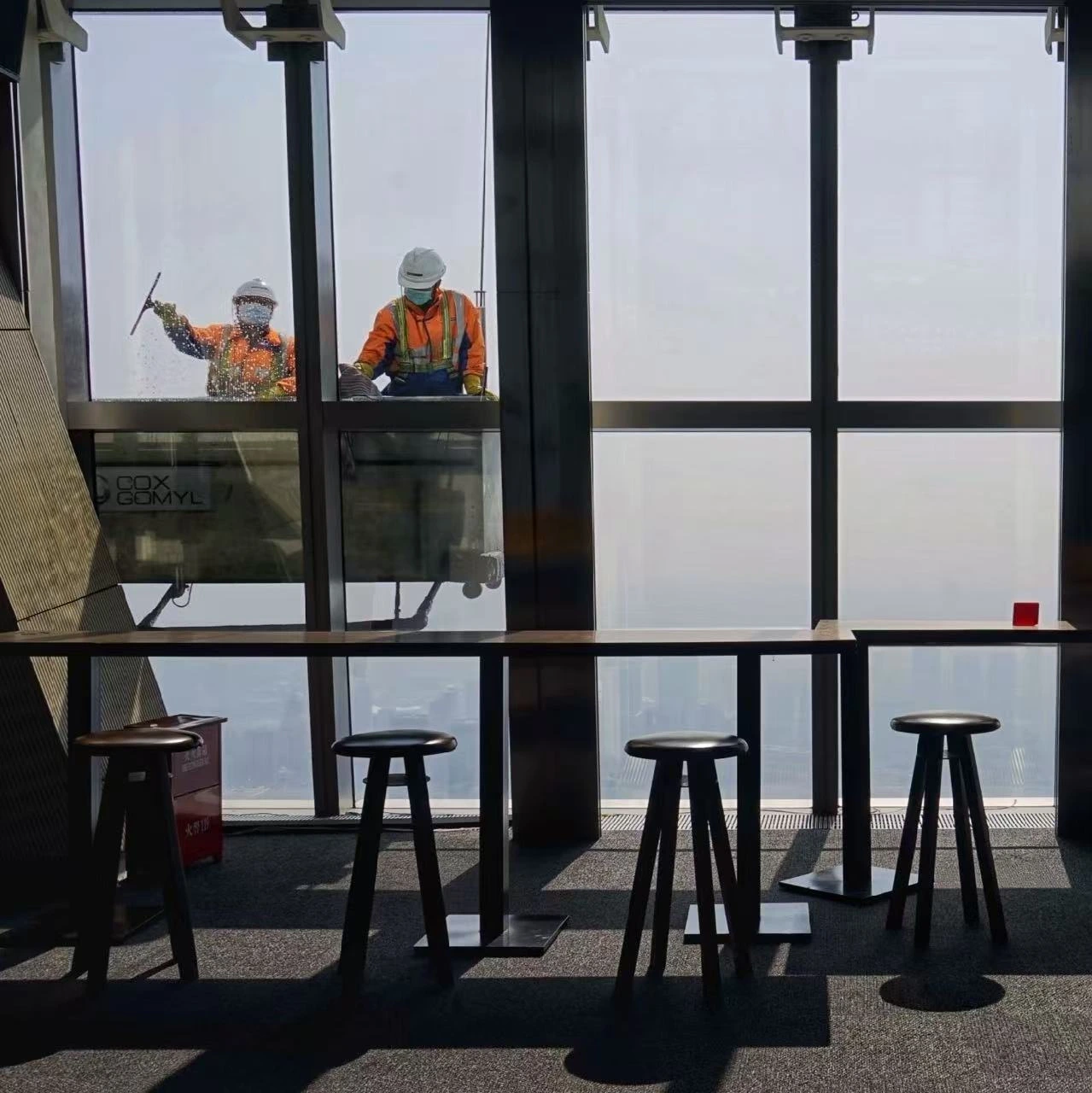
After overseeing facade operations at SWFC for nearly two decades, Judy Wang , General Manager of Facade Access Solutions China, describes facade cleaning as a continuous managed operation rather than a daily task. Each day begins with safety briefings and equipment inspections before crews follow predetermined cleaning routes, moving methodically through individual building zones.
The same operational philosophy applies to high-rise projects throughout Europe. Facade Access Solutions team in Spain explains that teams begin each shift with comprehensive pre-use inspections of the BMU. Structural anchorages, hoists, safety devices, and wind conditions are all verified before personnel enter the cradle. Once approved, cleaning proceeds sector by sector from the top of the building downward. On many towers exceeding 200 meters, a single facade elevation may require several days of coordinated work. Equally important are end-of-shift procedures, which include securing equipment, parking cradles, completing operational logs, and preparing systems for the next scheduled operation.

The ability to clean a building efficiently is often determined long before construction is complete. Building geometry directly influences facade access requirements, maintenance efficiency, and long-term operational costs. Structures designed with facade access in mind allow predictable and safe cleaning operations. Buildings that prioritize architectural aesthetics without considering maintenance access can create decades of operational challenges.
Several design characteristics consistently affect cleaning operations. Narrow parapets can limit cradle parking locations. Deep recesses often require telescopic or articulating jib systems. Curved or staggered facades may necessitate custom BMUs and specialized track configurations. Sloped crowns frequently require rack-and-pinion or hoist-based climbing solutions rather than conventional systems. Some of the world’s most visually impressive towers are also among the most complex to maintain. Architectural features such as unconventional cladding angles, narrow roof edges, and inaccessible recesses often require customized engineering solutions to ensure safe facade access.
For this reason, early collaboration between architects, structural engineers, and facade access specialists remains one of the most effective ways to control lifecycle costs. Design issues resolved during concept development rarely become operational challenges later. Integrated design services help ensure facade access requirements are incorporated into the building from the earliest stages of development.
No operational factor influences high-rise cleaning more than wind. Conditions at the top of a tower can differ dramatically from those experienced at street level. Wind speeds and gust patterns may change rapidly, particularly at elevations exceeding 150 or 200 meters. Weather station readings often fail to reflect actual conditions at the crown of a building.
Wind remains the dominant operational variable affecting facade access work. Teams continuously monitor meteorological data and follow strict protocols governing work suspension when conditions become unfavorable. Judy emphasizes that even with well-maintained equipment, environmental conditions can change rapidly. As a result, weather forecasting plays a critical role in daily planning and risk mitigation. Limited visibility also makes night operations undesirable for most high-rise cleaning activities.
While wind-speed limits vary according to equipment manufacturer specifications and local regulations, operational reality remains consistent across the industry. Work is typically suspended well before conditions approach maximum allowable thresholds. Managing fatigue is equally important. Personnel working hundreds of meters above ground require sustained concentration throughout each shift. Effective scheduling, hydration, rotation planning, and supervision all contribute to maintaining safety and operational performance. These practices form an integral part of broader inspection, training, and compliance programs .
Rope access and BMU systems are often discussed as competing solutions, but in practice they serve different operational purposes. Rope access offers flexibility and rapid deployment. It is particularly effective for localized maintenance activities, difficult-to-reach areas, and short-duration work where conventional equipment may not provide practical access.
For large-scale, long-term facade maintenance, however, BMUs offer significant advantages. According to Judy, a properly designed and maintained BMU provides a more controlled working environment with built-in redundancy features that improve both safety and operational consistency. These benefits become increasingly important when building owners evaluate long-term maintenance strategies.
Redundancy is especially valuable because facade cleaning is an ongoing process rather than a one-time event. Many large towers operate multiple BMUs across separate roof zones. If one unit becomes unavailable, another can often assume its responsibilities, reducing disruption to cleaning schedules and maintenance activities. This operational resilience is one of the primary reasons permanent facade access systems continue to play a central role in the management of complex high-rise buildings.
Facade access systems operate within a complex regulatory environment that varies by region . In Europe, suspended access equipment is governed by EN 1808. In North America, OSHA requirements and ASME standards provide the primary framework. Local building regulations frequently introduce additional requirements that owners and operators must satisfy.
For organizations managing international property portfolios, compliance involves more than adhering to a single standard. Inspection schedules, certification requirements, documentation procedures, and operator qualifications often differ between jurisdictions. Despite these regional variations, the underlying principles remain consistent. Safe work at height depends on properly engineered equipment, documented inspections, ongoing maintenance, and trained personnel.
The true cost of facade access is rarely limited to equipment acquisition. When a BMU becomes unavailable, cleaning operations stop. Delayed cleaning can contribute to facade deterioration, tenant dissatisfaction, operational disruption, and reputational impact. The economic consequences often extend well beyond the cost of the repair itself.
According to Judy, much of the work that supports a successful facade access program occurs behind the scenes. Safety training, preventive maintenance, spare-parts management, and ongoing workforce development all contribute to reliable operation. Without these activities, minor issues can quickly escalate into costly failures. Several elements consistently influence long-term performance:
When a BMU eventually approaches the end of its operational life, owners must evaluate whether refurbishment or replacement offers the best long-term value. In many cases, refurbishment and retrofit solutions can modernize critical systems while preserving existing infrastructure. This approach often delivers substantial cost savings while minimizing disruption to building operations.
The long-term results of disciplined asset management are evident at Shanghai World Financial Center. Judy notes that with dedicated maintenance and cleaning teams operating on-site, the building has maintained continuous operations since 2008 without experiencing major long-term equipment downtime. Ultimately, the success of a facade access program is not measured by whether windows are clean today. It is measured by whether the building remains safely and efficiently maintainable decades into the future.
Glass cleaning in high-rise buildings is fundamentally an engineering and asset-management challenge. Buildings that maintain clean facades year after year share several characteristics. Their access systems were specified with long-term maintenance in mind. Their equipment receives consistent inspections and servicing. Their operators and maintenance teams understand the building’s unique requirements. Successful facade maintenance begins with informed design decisions and continues through every stage of the asset lifecycle. Reliable BMUs, proactive service programs, and disciplined operational practices help prevent minor issues from becoming major disruptions. The financial impact of poor planning may take years to become apparent. The benefits of getting it right, however, accumulate every year the building remains operational.

Speak with our specialists to explore the right solution for your building.
Request a Quote TodayCleaning frequency is typically determined by building use and visibility requirements rather than applied uniformly across the entire facade. Observation decks may require cleaning twice per month, while office areas often follow two-month cycles. Hotel, residential, and mixed-use developments frequently adjust schedules based on occupancy patterns.
Manufacturer-rated limits for suspended platforms are commonly around 12.5 m/s (approximately 45 km/h). In practice, operations are often suspended before these limits are reached. Continuous weather monitoring and on-site wind readings guide daily decisions.
Refurbishment is often the preferred option when the primary structure remains sound and access requirements have not changed significantly. Modernization can include upgrades to control systems, hoists, and cradles while retaining existing tracks and structural components. Replacement becomes more appropriate when buildings are significantly altered, re-clad, or repurposed.
EN 1808 governs suspended access equipment throughout Europe and is widely referenced internationally. OSHA requirements and ASME A120.1 apply in the United States, while local building regulations introduce additional jurisdiction-specific requirements.
